The profit margins of operational projects are indeed very low, and it is difficult to survive with the previous rough management approach. Therefore, the company decided to introduce AI management to optimize process management, thereby reducing variable costs such as energy consumption and chemical usage to gain profits. To avoid being misled by AI software companies and falling into traps, we chose to engage in technical exchanges with companies that have practical case studies and recommendations from acquaintances, and formed teams to conduct on-site investigations of AI management effects. We have basically clarified the differences between AI control and PLC/DCS control in process control. Here, we will take the aeration control of an aerobic tank as an example. Currently, ourPLC/DCS control of the aeration volume in the aerobic tank is relatively simple, which is achieved throughsingle-point feedback control of dissolved oxygen (DO). The DO value is manually set, generally between 2-4 mg/L. When it falls below 2 mg/L, the fan operating frequency is increased, and when it exceeds 4 mg/L, the fan operating frequency is reduced, maintaining a constant frequency between 2-4mg/L. This method relies solely on the DO feedback value to control the aeration air volume, which has obvious drawbacks: 1. Control Lag: The DO value in the biochemical tank actually represents the remaining amount of oxygen supplied by the aeration fan after being utilized by microorganisms, indicating whether the aeration air volume is appropriate, excessive, or insufficient. Controlling the air volume based on its feedback is a typical reactive control method, adjusting only when the current aeration air volume does not match the actual demand of the biochemical system. This method has poor adaptability to changes in water volume. In water treatment plants with significant water quality fluctuations, it is possible that just after an adjustment, the water quality changes again, necessitating further adjustments, making it impossible to achieve precise aeration. 2. Waste of Fan Energy Consumption. What is the appropriate range for controlling the DO value? Many people rely on experience for setting it, without analyzing and discussing a large amount of historical data from the plant and conducting bold and careful trials. This can easily lead to an excessively high DO control value, resulting in excessive air volume and increased energy consumption of the fan. So how does AI control work? In simple terms, AI adopts a proactive control strategy, providing air volume as needed, which is a form of proactive control. It uses current parameters such as the inflow water volume, water quality, and sludge concentration in the biochemical tank, along with the target DO control value, as input parameters for the AI calculation model (for example, the Activated Sludge Model (ASM)) to predict the required air volume in advance. Based on this result, it automatically adjusts the fan air volume. The accuracy of this predicted air volume is evaluated through the DO feedback value. If the prediction is incorrect, the AI will self-review and correct the algorithm to improve prediction accuracy, demonstrating self-review and learning capabilities, leading to increasingly precise predictions. To emphasize again, this target DO control value is not set based on human intuition; it is derived from a large amount of inflow and outflow water quality data and continuous trial-and-error reviews by the AI, which will overturn our experiential understanding. Please see the figure below: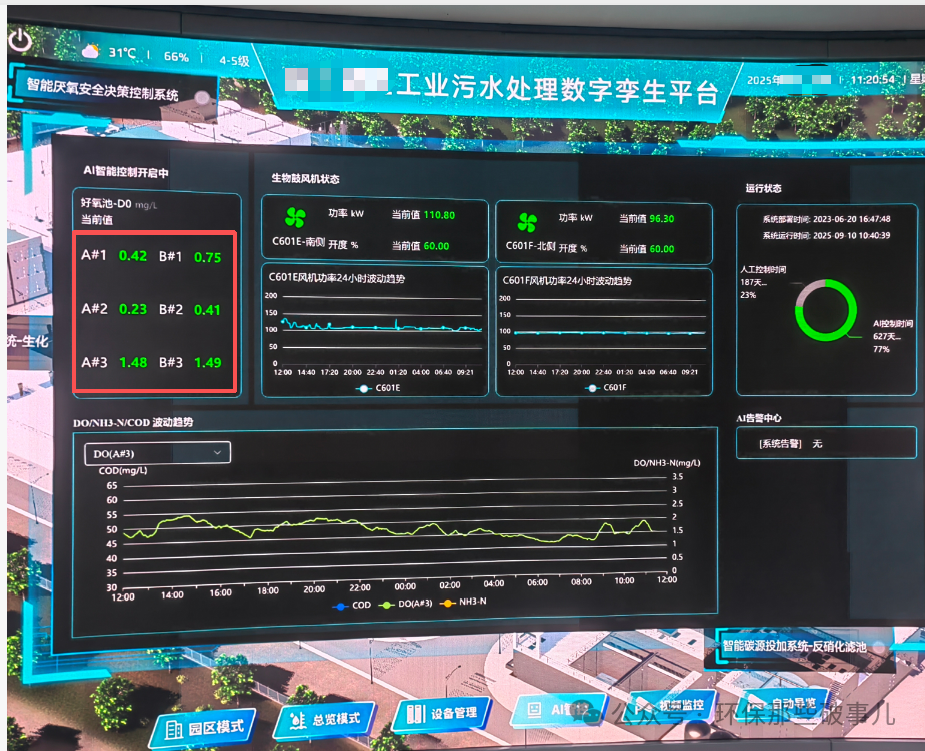 The aerobic tanks in the figure are divided into two series, each with three aerobic tanks running in series. What are your thoughts on the DO values of the aerobic tanks controlled by AI? Are you surprised?