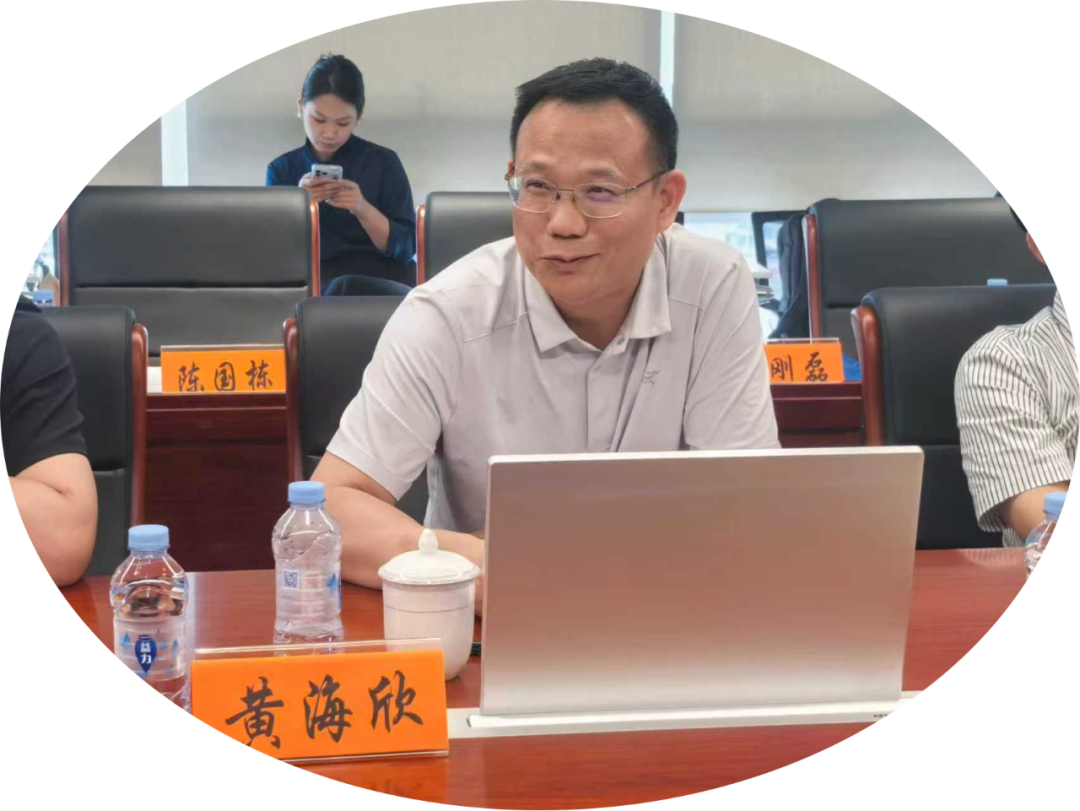
Recently, the “Hospital IoT Conference Series Public Welfare Activity [Walking Classroom] Visit and Study Guangdong Station – Hospital IoT Technology and Application Innovation Exchange Conference” was held in Shenzhen. Huang Haixin, the president of Liuzhou Workers’ Hospital and vice president of the Hospital IoT Branch of the China Medical Equipment Association, was invited to attend this exchange meeting and shared in detail the practice and exploration of smart Liuzhou Workers’ Hospital driven by the dual engines of the Internet of Things (IoT) and Artificial Intelligence (AI) during the roundtable dialogue session.
Under the promotion of the national “Healthy China 2030” strategy, smart hospitals have become an essential path to solve the tightness of medical resources, improve service quality, and optimize operational efficiency. Liuzhou Workers’ Hospital focuses on the construction of smart hospitals based on the “three-in-one” (smart medical care, smart services, smart management) model, deeply integrating the intelligent decision-making capabilities of AI with the real-time perception capabilities of IoT to build a comprehensive digital system covering clinical diagnosis and treatment, patient services, operational management, and logistical support.
1. Empowering Clinical Diagnosis and Treatment
The localized deployment of the domestic large model DeepSeek is a core breakthrough for the hospital to achieve “AI + all-scenario medical care”.
1. Integration with Electronic Medical Records: Improving Document Quality and Diagnosis Efficiency: The DeepSeek large model is embedded in the core module of electronic medical records, relying on multidimensional medical data (vital signs, medical history, examination results) to achieve intelligent interactive analysis—providing doctors with diagnostic suggestions, document writing references, and abnormal indicators in test reports.
2. Integration with Health Checkup Systems: AI combines health checkup data to generate easily understandable report conclusions while analyzing users’ lifestyles and family medical history, assessing the risk of chronic diseases such as cardiovascular diseases and diabetes; for issues like thyroid nodules and arrhythmias, AI recommends personalized re-examination cycles and lifestyle adjustment plans, upgrading health checkup services from “single report” to “health management plan”.
3. Integration with Radiotherapy Systems: Building a “Doctor-Patient Interaction – Data Accumulation” Closed Loop: Accessing digital human doctor assistants through WeChat public accounts/mini-programs; a cloud-based app for doctors, technicians, and patients integrates functions such as radiotherapy appointment scheduling and positioning guidance; at the same time, IoT devices monitor the operational status of radiotherapy equipment in real-time (such as dosage accuracy and mechanical errors), ensuring the safety and controllability of the radiotherapy process, with the platform automatically accumulating clinical data, which has helped the department publish over ten papers in core journals.
2. Optimizing Patient Services
Enhancing patient experience is one of the core goals of smart hospital construction.
1. Self-Service and Intelligent Guidance: The self-service system covers functions such as health code processing, appointment registration, outpatient/inpatient payment, report printing, and fee inquiries, supporting multiple payment methods including cash, bank cards, and QR codes, allowing patients to avoid queuing at windows, reducing the average registration and payment time from 20 minutes to 5 minutes.
2. Chronic Disease Management AI Assistant: Extending medical services to patients’ home scenarios, patients can automatically sync data to the AI assistant through IoT devices (such as smart blood pressure monitors and blood glucose meters), which not only reduces the incidence of complications but also decreases unnecessary hospitalizations, alleviating the economic burden on patients.
3. Innovating Operational Management
Hospital operational management involves multiple dimensions of “people, finance, materials, and processes”; the traditional management model relying on manual statistics is inefficient and prone to errors.
1. Surgical Behavior Management: Achieving full-process traceability of surgical gowns and shoes, synchronizing surgical scheduling information, supporting automatic issuance and recovery, with real-time warnings for overdue returns; the AI system controls personnel access permissions in the operating room, limits the total number of personnel in the operating room, and intelligently statistics the usage and opening rates of operating rooms, ensuring surgical safety and efficiency.
2. Intelligent Management of Drugs and Supplies: Achieving “full-process traceability”: Intelligent drug management introduces third-party logistics extension services, using IoT technology to link automatic dispensing machines and smart medicine cabinets with the compounding center, realizing intelligent scheduling of the entire process from “dispensing – compounding – delivery”, reducing manual dispensing errors; fixed asset management uses IoT technology to achieve lifecycle tracking from “procurement – warehousing – maintenance – disposal”, avoiding asset loss or idleness.
4. Strengthening Logistical Support
1. Smart Building Systems: Integrating five major systems and 20 subsystems, including building equipment management, public safety, and information rooms, achieving interconnection of equipment data across multiple campuses through OPC interfaces; IoT sensors collect real-time data on water, electricity, and heating/cooling consumption, as well as equipment operational status across campuses, ensuring real-time and accurate data transmission.
2. Integrated Management Platform for Smart Logistical Support Across Multiple Campuses: Using AI technology to display work order overviews, inspection progress, energy consumption data, etc., management can view logistical operations across campuses through the platform, achieving “global monitoring and collaborative scheduling”.
3. IoT Security Devices: Building a comprehensive security system, deploying over 2000 IoT cameras, and breaking the limitations of fixed button alarms with portable alarm devices for medical staff, with alarm signals simultaneously pushed to the fire control center, security personnel, and leadership, linking video verification and location display to achieve “no blind spots” in security assurance.
5. Outlook
In the future, with the wider coverage of IoT technology and deeper optimization of AI models, smart hospitals will further break through the “in-hospital boundaries” and achieve ecological collaboration with regional medical care, public health, and health management, providing stronger support for the implementation of the “Healthy China 2030” strategy.