“The core of developing C-end products domestically lies in ‘countering one’s own common sense.’ The elite perspective of founders often disconnects from the real needs of the mass market. When you find that users are unwilling to pay for your product, do not first doubt the users, but rather reflect on your own ‘common sense.’ After that, consider whether it is time to seek funding.”
This afternoon, my friend Jack and I met with a seasoned entrepreneur in the overseas market (hereinafter referred to as Senior Z) for tea. Like Jack, I am a newcomer to the AI C-end field, filled with excitement, confusion, and various ideas about the future. Senior Z, on the other hand, is a true practitioner, a co-founder and CTO of a well-known overseas product, and now the founder of a rapidly growing AI company.
This originally scheduled one-hour consultation turned into a three-hour brainstorming session. The density of information and the intensity of cognitive impact made me feel as if I had been force-fed a complete system course on products, business, and personal development. After returning, I spent the entire evening reviewing and digesting my densely packed notes.
I am well aware of how valuable these insights are for other entrepreneurs on the same journey, so I decided to organize them into writing. This is not just a meeting summary, but a deep reflection on how entrepreneurs in the AI era think, make decisions, and survive.
01The Soul-Searching of AI Native Products—What Are We Really “Creating”?
The first topic we discussed was what constitutes a truly “AI native” product. Both Jack and I believe that the product forms in the AI era must break free from the constraints of traditional software.
We proposed a core viewpoint: The future of AI native applications will transition from “structured” to “canvas-based” interfaces.
Traditional efficiency tools, such as Notion, are essentially database-driven, requiring users to adhere to their preset frameworks to organize information. However, the revolutionary aspect of LLM lies in its exceptional understanding of unstructured, multimodal information. Therefore, a truly AI native product should not confine users with rigid tables and fields, but rather provide an infinitely free “canvas.” Users can freely input text, images, links, or even a voice segment, allowing AI to actively understand, organize, and create. This represents a more natural “end-to-end” interaction form that aligns with human thinking and expression.
Senior Z agreed with this, but his subsequent point made us realize that our thinking was still shallow.
He argued that form is merely superficial; the soul of a product lies in the “atomicity” of value delivery. Whether it is a “whiteboard” or a “comic,” the key is whether it can provide users with an irreplaceable value point. For ordinary users, they do not care how sophisticated your underlying agent design is; they only care about one thing: “Can you deliver an outcome that exceeds my expectations?”
He gave an example: a meditation app that only provides timing and guiding words remains a tool. However, if it can generate a comforting “today’s fortune” based on the user’s state, or provide a positive psychological suggestion after a meditation session, it has achieved a value leap—from solving a specific functional problem to providing a positive emotional experience.
This was an enlightening moment for me. We often obsess over building powerful “capabilities,” yet overlook that what users truly need may just be a small but precise “comfort.”
02The Arena Rules—How to See Through Your Competitors with “Sensory Perception”?
As a startup team, one of our most anxious issues is competition. When we see competitors in the field with impressive data, it is hard not to feel pressured.
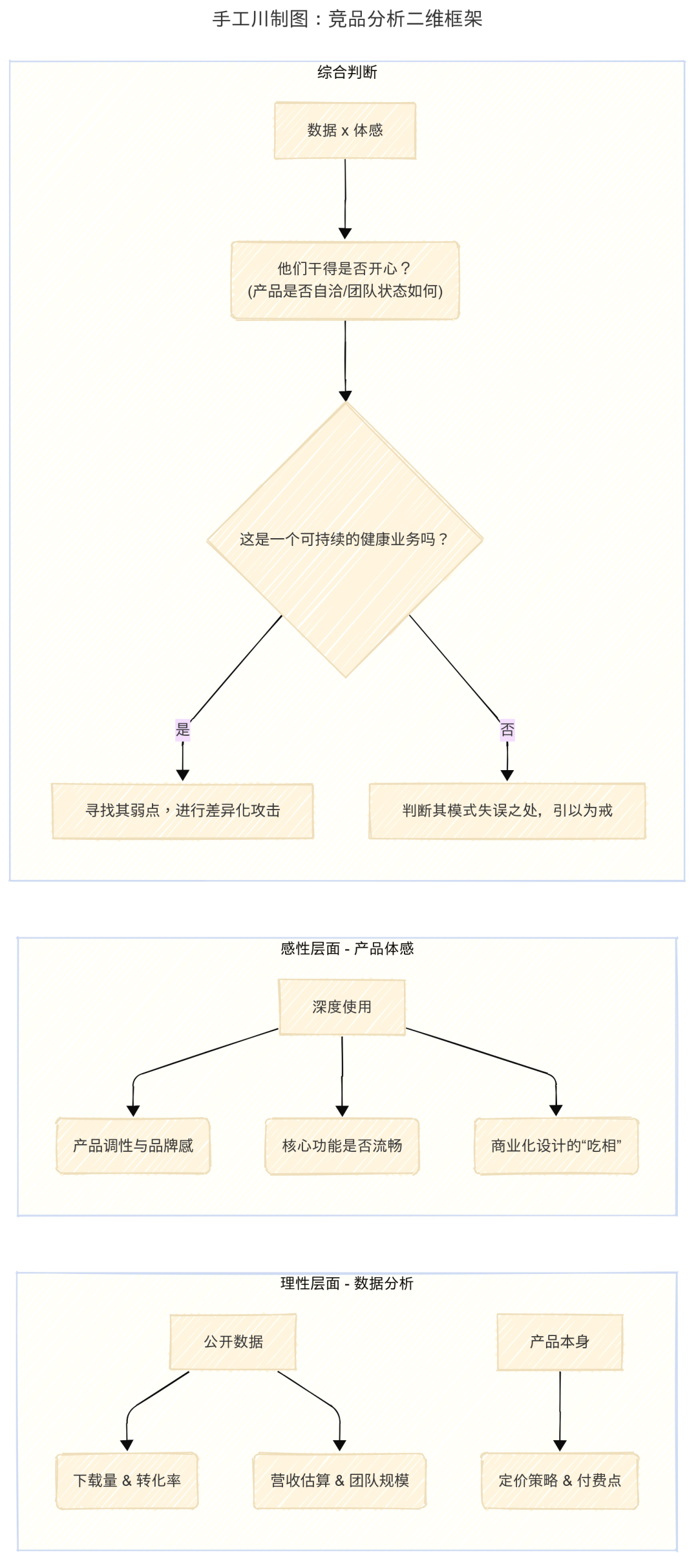
Senior Z shared his unique two-dimensional analysis framework, which combines rational data with sensory “perception,” giving me a new understanding of competitive analysis.
Dimension One: Rational Data Axis (Fundamentals)
This is a routine operation familiar to all product managers, piecing together the real operational status of competitors from publicly available information like a detective:
- Traffic and Users: Analyze their download volume, active users, conversion rates, and user profiles through tools like App Store and Similarweb.
- Commercialization: Infer their revenue scale (Run Rate), average revenue per paying user (ARPPU), and team size from their pricing strategies, payment point designs, recruitment information, and press releases.
ad-tip {title: Run Rate}Run Rate (annualized operating revenue) is an indicator that predicts the total revenue for the next year based on the revenue of a specific period (usually a month or a quarter). The calculation formula is: Run Rate = Revenue for Specific Period × Annualization Multiple for that Period. For example, if a company has a monthly revenue of $100,000, its Run Rate would be $100,000 × 12 = $1,200,000. This is a snapshot indicator for quickly assessing a company’s growth momentum, but it assumes that current performance will remain stable and does not account for seasonal fluctuations and other factors.
Dimension Two: Sensory Perception Axis (Unique Insights)
The most ingenious and unconventional aspect of this framework is the introduction of a non-data-based measurement standard—”perception.” Senior Z said that after reviewing all the cold data, he always asks himself a soul-piercing question:
“Is the team of this company happy?”
The state of a team will be unreservedly projected onto the product. An “unhappy” team may produce data-impressive but awkward products. This “awkwardness” may manifest in various aspects, such as chaotic product tone, feature bloat, and poor commercialization.
When a competitor appears strong in data but gives you the impression that “they are not happy,” this often represents your breakthrough opportunity. It indicates that their growth may be encountering bottlenecks or that internal strategies are in disarray. You can target those “awkward” parts of their product and offer smoother, more elegant solutions.
After returning, I tried to illustrate this framework in a diagram to express Senior Z’s thoughts more clearly:
When discussing pricing, Senior Z also shared a psychological insight about discounts: Unusual numbers are more effective than regular numbers. Conventional discounts like 50% or 70% give users the psychological hint of “clearance sale.” In contrast, a seemingly odd discount, such as “17% off” (which is 83% of the original price), conveys the message that “this is the maximum sincerity we can offer after careful calculation,” making the discount itself appear more valuable and scarce.
03Reconstructing Worldviews—The Essence of Globalization is the Localization of “Mindset”
For Chinese AI entrepreneurs, “going overseas” is almost a mandatory option. However, in Senior Z’s view, most teams’ understanding of globalization remains very superficial. He proposed the “three levels of localization.”
- First Level: Interface Localization. This is the most basic, including translation, UI layout, and date and currency formats that conform to local customs.
- Second Level: Operational Localization. This requires that AI responses and system emails must be consistent with the language used by the user. If a user asks in German, you must respond in German. This is the most basic respect for users.
- Third Level: Mindset Localization. This is the highest level and the most challenging. It requires founders to understand that users’ perceptions of “value” differ significantly across cultural backgrounds. For American users, the value of an efficiency tool lies in “saving time”; for East Asian users, its value may lie in “providing a tool that surpasses peers, gaining a competitive advantage.”
Therefore, the pricing, marketing language, and brand story of global products must undergo deep “mindset adaptation,” rather than using a universal value proposition to appeal to users in all markets.
For startup teams like ours, Senior Z suggested a pragmatic market entry order: North America, Europe, Japan, and South Korea as the first tier; after successful product validation, use Hong Kong and Singapore as a springboard to reach the Asia-Pacific market; as for markets like India and Indonesia, they should be placed in a later stage.
04The Cultivation of Founders—The “Counterintuitive” Philosophy of C-End Entrepreneurship
All discussions about products, markets, and competition ultimately point to the founders themselves. Senior Z candidly stated that the ceiling of a company is the cognitive ceiling of its founders. For C-end entrepreneurship, the most important philosophy he offered is the striking statement at the beginning of this article:
“Counter your own common sense.”
He explained that especially when developing C-end products in China, founders must be vigilant against their inherent “common sense” and “elite perspective.” The entrepreneurial team is often composed of highly educated, high-income users from major cities, and our definition of a “good product” may differ significantly from that of the broader real user market.
C-end entrepreneurship is a continuous and painful process of “self-denial.” Founders must set aside their preferences to understand the real context of users and empathize with their anxieties and desires.
So, when the product value proposition is clear but user conversion rates remain low, what should be done? Senior Z’s advice is: “If it is difficult to earn money from your customers, you should consider whether it is time to seek funding.”
The deeper meaning of this statement is that the commercialization of C-end products sometimes requires the patience of “fighting to sustain the fight.” You may need to secure enough ammunition and time through funding to educate the market and cultivate user habits, rather than making distorted product shape and short-sighted commercialization decisions due to cash flow pressure in the early stages.
Finally, regarding the “self-improvement” track we are exploring, Senior Z keenly pointed out that the essence of this track is not to provide cold productivity tools, but to sell a “hope to become better.” Therefore, the design language of the product should not be “mass-market” but must be “brand-oriented.” Users choose your product not only for its functionality but also for a sense of identity. The product’s color scheme, font, and interaction animations must be as precise and clear as the “piano sound of macarons,” striking the user’s heart in an instant.
Macaron is a recently popular AI agent.
Conclusion
As I left the café, Jack and I were silent for a long time, our minds buzzing. This exchange was less about product discussion and more about cognitive upgrading. It made me deeply realize that in the era of AI entrepreneurship, technology is merely the ticket; insights into the essence of business, understanding of human nature, and the iterative cognition of the founders themselves are the keys to determining how far we can go.
Most importantly, it made me understand that entrepreneurship is ultimately a journey of inward exploration. You must continuously break your own “common sense” to truly touch the “reality” of users.