

The research team at the University of Maryland has developed a new type of photonic chip. This photonic device can passively convert a monochromatic laser source into red, green, and blue light without any active control or repeated optimization, allowing it to operate stably. This breakthrough technology provides new tools for research in quantum computing, high-precision frequency measurement, and optical metrology. The related results were published in the latest issue of the journal Science.
Traditional photonic devices can capture and manipulate photons, achieving separation, guidance, amplification, and interference of photon streams, but they have limited functionality and are difficult to produce stably in large quantities. Unlike ordinary prisms that only decompose light colors, if the chip can directly generate new frequencies that do not originally exist in the input light, it not only saves space and energy occupied by additional lasers but also produces light frequencies that currently do not exist.
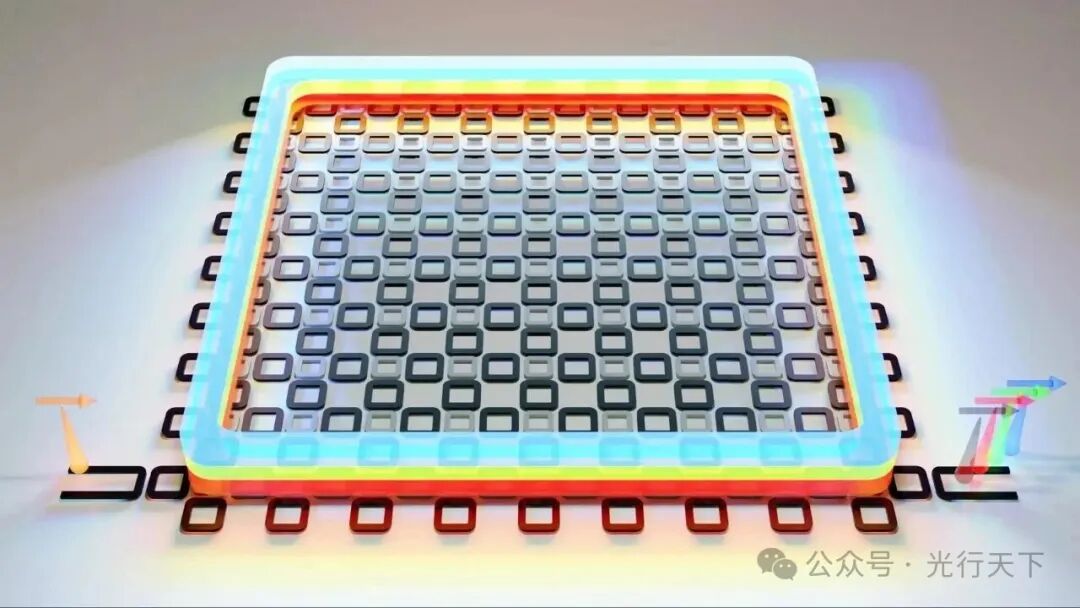
The researchers designed and tested a new type of chip that can reliably convert one color of light (as shown by the orange pulse in the lower left corner of the image) into multiple colors of light (as shown by the red, green, blue, and dark gray pulses emitted from the chip in the lower right corner). The chip consists of a series of ring structures, each of which is a resonator that allows light to circulate hundreds of thousands or even millions of times, ensuring that the interaction between the incident light and the chip can double, triple, or quadruple its frequency.
Achieving this functionality relies on special nonlinear light-matter interactions. However, the nonlinear effects are very weak, so to enhance the effect, scientists use photonic resonators to allow light to circulate multiple times within the chip, where the weak effects can accumulate to form a significant result. However, a single resonator generating multiple frequencies still has limitations.
Previously, the team proposed a method of using a small array of resonators to work together, amplifying the nonlinear effects through an array composed of hundreds of micro-rings, guiding light to propagate along the edges, and converting pulsed lasers into multi-frequency light. In the latest research, the team found that the array itself can improve the success rate of frequency conversion without active adjustment. Experiments showed that six chips on the same wafer produced second, third, and fourth harmonic light corresponding to red, green, and blue light when input with standard 190THz laser. In contrast, three single-ring chips, even with embedded heaters, only produced second harmonic light under limited conditions in one of the chips.
The team stated that the different circulation speeds between the small rings and the “super rings” in the array make it easier for light to meet the conversion conditions within the chip, effectively passively achieving matching. As the input light intensity increases, the chip can also generate more frequency light, similar to the previous multi-frequency light effect.
This method has broad implications in fields such as optical metrology, frequency conversion, and nonlinear optical computing, working efficiently without active adjustment, providing new ideas for the multifunctional and mass application of chip light sources.

For more content, please visit Optics Sky: http://www.opticsky.cn
2025 Advertising Reservations, contact WeChat: cyqdesign
Research Manuscripts | Technical Article Submissions: [email protected]