
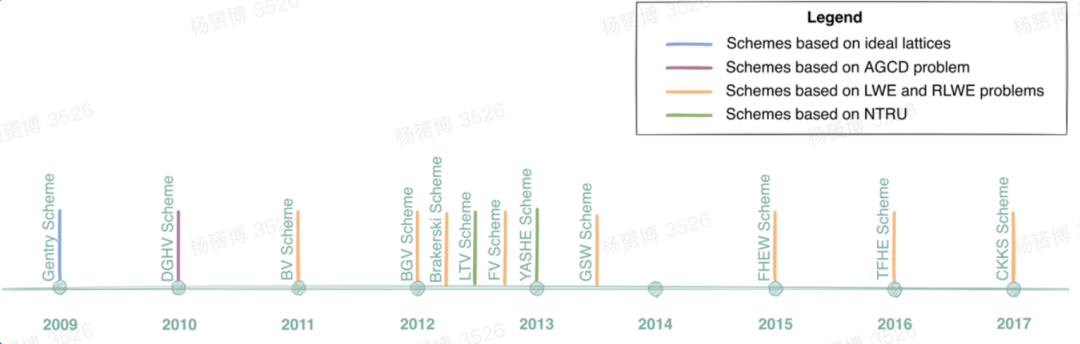
The pioneer in the field of fully homomorphic encryption is Gentry, whose groundbreaking work paved the way for three main research phases in fully homomorphic encryption.
This article will categorize classic papers on fully homomorphic encryption according to their research phases and provide relevant reading suggestions.
For previous works on fully homomorphic encryption, please refer to Learning Homomorphic Encryption: A Collection of First Generation Classic Papers on Fully Homomorphic Encryption, Learning Homomorphic Encryption: A Collection of Second Generation Classic Papers on Fully Homomorphic Encryption, Learning Homomorphic Encryption: A Collection of Third Generation Classic Papers on Fully Homomorphic Encryption, and Learning Homomorphic Encryption: A Collection of Fourth Generation Classic Papers on Fully Homomorphic Encryption.
Interested students can also read past issues to learn more about the knowledge system of fully homomorphic encryption, please see Knowledge System of Fully Homomorphic Encryption (Part 1) and Knowledge System of Fully Homomorphic Encryption (Part 2).
1
English Books
Homomorphic Encryption and Its Applications (Published in 2014)
Homomorphic encryption is a form of encryption that allows specific types of computations to be performed on ciphertexts and generates encrypted results, which match the results of operations performed on plaintext when decrypted.
This book introduces the basic technologies of homomorphic encryption and their applications. It first discusses the history of encryption technology, from classical ciphers to key encryption and public key encryption, including key encryption and public key encryption models. Then, it provides the definition of homomorphic encryption and describes some well-known homomorphic encryption schemes.
Real Applications of Fully Homomorphic Encryption (Published in 2019)
-
Detailed review of the latest research on cloud security and fully homomorphic encryption (FHE)
-
Provides a series of solutions to improve the performance of practical algorithms when handling FHE data
-
Proposes the basic design of a cryptographic processor architecture that supports FHE operations
Partially Homomorphic Encryption (Published in 2021)
Almost simultaneously with the invention of the first public key cryptographic algorithm RSA, the potential applications of homomorphic operations on encrypted functions were recognized and appreciated. The RSA algorithm is multiplicatively homomorphic. Over the next 30 years, with continuous innovations in algorithms and complex mathematics, several additive or multiplicative homomorphic encryption functions emerged. However, until 2009, it was unclear whether there would be a fully homomorphic encryption algorithm that allows both additive and multiplicative homomorphisms. This issue was resolved by Craig Gentry, followed by several authors who proposed fully homomorphic encryption algorithms and addressed issues related to their formulations, algorithms, efficiency, and security. Despite the significant efficiency barriers that remain, we now have various fully homomorphic encryption algorithms that can be applied to various private computing problems in healthcare.
Protecting Privacy Through Homomorphic Encryption (Published in 2021)

This book discusses methods of using homomorphic encryption to protect privacy. Privacy means different things to different people. In this volume, we will use the term “privacy” to refer to a concept defined by some social scientists, which is that individuals or organizations should have the right to control how their data is used or shared. Without necessary encryption tools to secure data against unauthorized access or use, privacy cannot be achieved.
2
Chinese Books
Principles and Algorithms of Homomorphic Cryptography (Published in 2022)

This book provides a comprehensive introduction to homomorphic encryption technology from multiple perspectives, including origins, principles, applications, and implementations. It covers the basics of cryptography, fundamental concepts of homomorphic encryption technology, semi-homomorphic encryption algorithms, partially homomorphic encryption algorithms, fully homomorphic encryption algorithms, and programming practices of homomorphic encryption. The theoretical explanations focus on the ideas behind homomorphic encryption, helping readers better understand the property of “homomorphism”; the programming practices cover several of the most popular homomorphic encryption libraries, including Charm-crypto, HElib, SEAL, and TFHE, allowing readers to write code based on the content to further grasp homomorphic encryption. This book is suitable for practitioners in computer technology and information security interested in homomorphic cryptography, as well as senior undergraduates and graduate students in related colleges for reading and study.
Fully Homomorphic Encryption – From Theory to Practice (Published in 2022)

This book mainly studies the design methods of fully homomorphic encryption. On one hand, it theoretically proposes more efficient fully homomorphic encryption schemes and optimization methods; on the other hand, it proposes methods for analyzing the specific security parameters of fully homomorphic encryption from a practical perspective, providing specific security parameters for each scheme, ensuring the systematic and comprehensive nature of the research.
This book primarily investigates how to eliminate the key switching process in the design of fully homomorphic encryption, proposing a new design method: the dimension-lifting method. The dimension-lifting method is a general framework that can design all fully homomorphic encryption schemes without key switching on the ring LWE problem. Therefore, the dimension-lifting method has significant theoretical implications.
On this basis, two important concepts are proposed: abstract decryption structure and ciphertext stacking method, using these as theoretical research tools to analyze the relationship between ciphertext, noise, and plaintext from the decryption structure, achieving theoretical abstraction and summarization of the construction methods of fully homomorphic encryption, thus formalizing the research on the construction methods of fully homomorphic encryption, addressing why fully homomorphic encryption can be constructed on lattices, the relationship between existing fully homomorphic encryption algorithms on lattices, and whether there exists a unified formal description for all algorithms.
3
Video and Blog Recommendations
https://fhe.org/
http://homomorphicencryption.org/introduction/
https://homes.esat.kuleuven.be/~nsmart/FHE-MPC/
https://www.youtube.com/playlist?list=PLD7HFcN7LXRef-eTSGt_XOUJLZNoDINUn
https://blog.openmined.org/tag/homomorphic-encryption/
Everyone is welcome to supplement the Chinese and English books and learning websites you think are good in the comments section to improve the learning materials for homomorphic encryption!
END
Previous Recommendations
1.Paper Sharing | Security Conference S&P 2022: A Real-Time Trusted Execution Environment RT-TEE2.Learning Homomorphic Encryption: A Collection of Fourth Generation Classic Papers on Fully Homomorphic Encryption3.Note Sharing | Zhejiang University Summer Cryptography Course: Lattice-based Crypto I and II4.Learning Homomorphic Encryption: A Collection of Third Generation Classic Papers on Fully Homomorphic Encryption