“Prices change several times a day,” and “the surge is faster than gold”—a price surge in storage chips ignited by AI is sweeping the globe. Over the past six months, global storage chip prices have continued to rise, with price increase news becoming more frequent in the last month.
The core driving force behind this cycle is attributed to AI servers, which are rewriting industry rules with astonishing storage demands. However, behind the prosperity lies a crisis: the complex manufacturing process of HBM is squeezing the production capacity of traditional storage chips, leading to a structural imbalance in supply and demand. On one side, the AI market is booming, while on the other, the consumer electronics sector is facing shortages, with phenomena such as price inversions and soaring spot market prices occurring frequently. How will this industry chain shock triggered by technological transformation reshape the global storage ecosystem? What opportunities and challenges lie ahead?
01. AI Servers Significantly Increase Demand, Structural Imbalance is Obvious
Unlike previous boom cycles, the current upturn in the storage chip market is primarily driven not by personal consumer electronics, but by AI servers. This is due to the unprecedented storage demands brought about by AI model training and inference, which have rewritten the cyclical logic of the storage industry.
Specifically, the demand for storage chips from AI servers exhibits a characteristic of simultaneous increases in both quantity and price. In terms of quantity, a single AI server uses approximately eight times the DRAM of a traditional server and three times the NAND Flash. More importantly, there is a qualitative leap. AI model parameters reach trillions, requiring massive data to be processed in parallel during training, and the data transfer speed of traditional memory has become a bottleneck limiting computational power release, known as the “memory wall” problem. High Bandwidth Memory (HBM), which emerged to address this, vertically stacks multiple DRAM chips to provide several times the transfer speed of traditional memory, becoming standard for AI chip giants like NVIDIA.
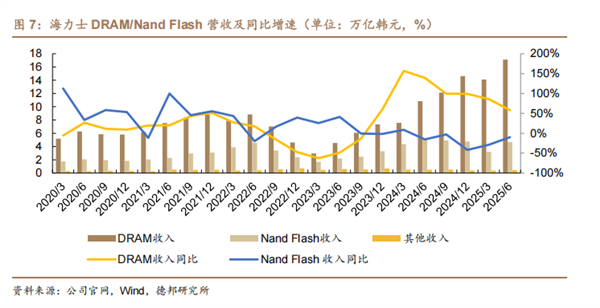
However, the manufacturing process of HBM is complex and expensive, consuming more than three times the wafer capacity of standard DRAM, which directly squeezes the production capacity of traditional DRAM, exacerbating overall market supply tightness. This has led to a structural contradiction of “one end overheating, the other end cooling”: the AI market is thriving, while the consumer electronics market is facing supply shortages. Moreover, this structural mismatch in supply and demand has also triggered rare phenomena in pricing. As HBM continues to erode production capacity, the supply of traditional DRAM (such as DDR4) is becoming increasingly tight, with price increases even surpassing those of more advanced DDR5, resulting in price inversions. In the spot market, server memory prices have skyrocketed to several times their previous levels, ultimately passing through to the consumer end, causing prices of products like solid-state drives and memory sticks to continue rising.
This series of changes is also reconstructing the entire supply chain ecosystem. Large cloud service providers, leveraging their scale advantages, have locked in most of the original factory’s capacity in advance, forcing small and medium-sized enterprises to compete for the dwindling resources in the spot market, making their situation difficult. At the same time, end manufacturers such as PC brands are also beginning to consider reducing memory configurations in future products to control costs or seeking other technical solutions to cope with this ongoing supply tightness.
02. Industry Growth and Cyclicality, 2027 May Be a Key Node
This imbalance exposes the fragility of the supply chain and the inherent uncertainty of the storage chip market, which oscillates between “high growth” and “strong cycles”.
From the product perspective, storage chips are a rare type of technology commodity with significant characteristics of standardization, large markets, and strong cycles, relying not only on high capital expenditures but also being very sensitive to downstream demand. Looking back at several cycles of storage chips, price trends often fluctuate dramatically, with the industry jokingly referring to it as “either counting money until your hands cramp or losing money until your heart races.” The root of this severe volatility lies in the mismatch of supply and demand over time. Building a new wafer fab can cost hundreds of millions of dollars and take two to three years; once market demand surges, supply cannot respond quickly, leading to price spikes. When major manufacturers release their capacities, it can easily lead to oversupply, causing prices to drop.
In summary: price surges → manufacturers make huge profits and expand production wildly → oversupply → price crashes → manufacturers incur losses and cut capital expenditures → supply and demand gradually balance → the next round of price increases begins. The “lag effect” of capital expenditure and the “homogenization” of products continuously amplify this cycle, making its periodicity particularly strong.
In this context, finding the balance point of supply and demand in the industry is particularly important. Morgan Stanley predicts that the storage industry will enter a “super cycle” driven by AI, with global storage revenue expected to reach $200 billion by 2025. JPMorgan states that the trend of “memory hunger” is driving the entire industry into a structural growth phase, with the DRAM market entering an “unprecedented four-year pricing upcycle” from 2024 to 2027, and by 2027, the global storage market size is expected to reach nearly $300 billion.
03. Where Are the Opportunities in the Industry Chain?
It is precisely because of the dual characteristics of cyclicality and growth in the industry that the storage chip market brings uncertainty, but also nurtures new opportunities. Optimistic predictions for the 2027 market by institutions like Morgan Stanley not only reflect the long-term potential of AI demand but also imply a revaluation of the value of various links in the industry chain.
Orient Securities points out that from the demand side, with the continuous launch of large models, the demand for DRAM and NAND will significantly increase. From the supply side, next year, as Yangtze Memory’s new products and Changxin’s HBM3 and other latest products gradually break through, coupled with the rapid increase in data center demand for SSDs and HBM leading to supply-demand mismatch, it has stimulated the expansion momentum of Changxin and Yangtze Memory. It is expected that next year will be a big year for the expansion of both storage types, and it is recommended to focus on the overall opportunities in the domestic storage industry chain: NAND & DRAM semiconductor (related to Changxin) industry chain: Zhongwei Company, Tuojing Technology, Anji Technology, Jingyi Equipment, Zhongke Feimiao, Xinyuan Micro; Changxin & HBM storage chip industry chain: Northern Huachuang, Zhaoyi Innovation, Jingzhida, Shanghai Xinyang, Yake Technology, Bai’ao Chemical, Demingli, Jiangbolong, Shannon Chip Creation.
Open Source Securities believes that from a process perspective, the expansion of storage will significantly drive the demand for etching and thin film equipment. Etching equipment: Northern Huachuang, Zhongwei Company; thin film deposition equipment: Tuojing Technology, Northern Huachuang, Weidao Nano, Maiwei Co., etc.; process control equipment: Zhongke Feimiao, Jingce Electronics, etc.; back-end equipment: Changchuan Technology, Jingzhida, Xidian Co., etc.
04. Conclusion: Don’t Forget Strong Cycles Amid High Growth
Finally, looking at this round of the storage chip super cycle, AI undoubtedly plays a disruptive role. It has not only accelerated the rapid iteration of high-end technologies like HBM but also exposed deep-seated contradictions such as supply-demand mismatches and resource competition within the industry chain. From the market structure perspective, large cloud service providers are seizing capacity with their scale advantages, squeezing the survival space of small and medium enterprises; from the perspective of technological evolution, high bandwidth and high capacity storage products are gradually becoming the core infrastructure of the computational power era.
Although institutions like Morgan Stanley predict that by 2027, the global storage market size is expected to exceed $300 billion, this growth path is not smooth—wafer fab construction cycles are long, and capital investment is huge, and the industry will continue to exhibit characteristics of both “high growth” and “strong cycles.” For the domestic industry chain, breakthroughs by companies like Yangtze Memory and Changxin Storage in HBM and advanced storage fields may become key to breaking international monopolies and achieving self-control. In the future, as AI application scenarios continue to deepen, the demand structure, technological routes, and competitive logic of storage chips will further be restructured. Only companies that keep pace with technological trends and optimize capacity layouts can seize the initiative in this storage transformation.
– End –