Sharing is the greatest support, and following is the best encouragement


1. Article 109: During the construction of the mine, the monitoring and communication systems must comply with the following regulations: (1) During the excavation of the shaft, sensors for gas, carbon monoxide, etc., must be installed, and video monitoring systems must be installed at the hoisting platform, shaft entrance, and the hoist room.
2. Article 155: The design, use, and management of coal bunkers and coal (gangue) chutes must comply with the following regulations:
(4) Coal bunkers must be equipped with video monitoring, personnel proximity warning, carbon monoxide sensors, methane sensors, coal level gauges, and other monitoring instruments. Relevant data must be integrated into video monitoring and safety monitoring systems to promptly detect and alarm for abnormal coal accumulation.
3. Article 166: When a skip hoisting shaft or a shaft equipped with a belt conveyor is used as a ventilation shaft, the following regulations must be followed:
(1) When the existing skip hoisting shaft of a production mine is used as a return air shaft, the loading and unloading devices and the shaft tower (frame) must have dust prevention and sealing measures. When a shaft equipped with a belt conveyor is used as a return air shaft, methane sensors must be installed, and a power cut-off lockout for methane over-limit must be implemented.
4. Article 169: Independent ventilation must be implemented in mining and excavation working faces, and interlinked ventilation between two coal mining working faces is strictly prohibited.
When it is difficult to arrange independent ventilation between a coal mining working face and its connected excavation working face, or between two adjacent excavation working faces in the same mining area, interlinked ventilation may be used after measures are formulated, but the number of interlinked ventilations must not exceed one.
When an excavation tunnel or coal mining working face that constitutes a new ventilation system encounters geological structures and needs to be re-excavated, if it is difficult to arrange independent ventilation, its return air may be linked into the coal mining working face, but safety measures must be formulated, and the number of interlinked ventilations must not exceed one; once an independent ventilation system is established, it must immediately switch to independent ventilation.
For the interlinked ventilation specified in this article, methane sensors must be installed in the tunnel entering the interlinked working face, and the concentrations of methane and carbon dioxide must not exceed 0.5%, while the concentrations of other harmful gases must comply with the requirements of Article 156 of these regulations.
5. Article 205: The extraction of gas must comply with the following regulations:
(1) When extracting gas from the goaf of coal seams that are prone to spontaneous combustion, the extraction pipeline must be equipped with carbon monoxide, methane, and temperature sensors to achieve real-time monitoring. Immediate measures must be taken upon discovering signs of spontaneous combustion.
6. Article 528: Safety monitoring equipment must have a fault lockout function. When equipment related to lockout control is not in normal operation or malfunctions, the power supply of all non-intrinsically safe electrical equipment in the monitored area must be cut off and locked out; when the equipment related to lockout control is functioning normally and stably, it must automatically unlock.
The safety monitoring system must have methane electrical lockout and wind electrical lockout functions. The methane concentration over-limit alarm, methane electrical lockout, and wind electrical lockout control functions at the mining and excavation working face must be completed by on-site equipment. When the monitoring distance exceeds 2000m, remote power cut-off by underground equipment is allowed. In case of a fault in the main unit or system cable, all functions of methane electrical lockout and wind electrical lockout must be ensured. The system must have power cut-off and power feed status monitoring and alarm functions.
The safety monitoring system must have self-diagnostic functions for sensors, sub-stations, power supplies, power cut-off controllers, main units, and network equipment.
7. Article 531: Safety monitoring equipment must be regularly calibrated and tested. Methane sensors must be calibrated using calibration gas samples and air samples at the equipment installation site, and portable methane detection alarms must be calibrated in the instrument maintenance room. Carrier catalytic methane sensors and portable carrier catalytic methane detection alarms must be calibrated at least once every half month. Laser methane sensors and portable laser methane detection alarms must be calibrated at least once every six months. Other sensors and portable detection alarms should be calibrated regularly according to relevant standards.
The methane electrical lockout and wind electrical lockout functions must be tested at least once every half month; for those that may cause local ventilation fan power cut-off, testing must be done at least once every six months. Other safety monitoring equipment must be calibrated or tested at least once every six months.
8. Article 532: Daily checks must be conducted on the safety monitoring equipment and cables in the mining and excavation working face and return air flow to ensure they are functioning normally. Underground safety monitoring workers or gas inspectors must use portable optical methane detectors or portable methane detection alarms to compare with methane sensors and report the records and inspection results to the mine duty officer; when the readings of the two devices differ beyond the allowable error, safety measures must be taken based on the higher reading, and calibration of both devices must be completed within 8 hours.
9. Article 536: The installation locations of methane sensors, alarm, power cut-off, recovery concentration, and power cut-off range, as well as the alarm values of portable methane detection alarms, must comply with the requirements of Table 19.
Table 19: Installation locations of methane sensors, alarm, power cut-off, recovery concentration, and power cut-off range, as well as alarm values of portable methane detection alarms
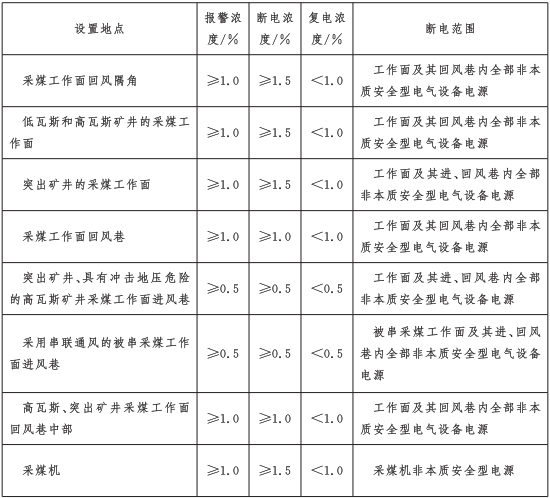
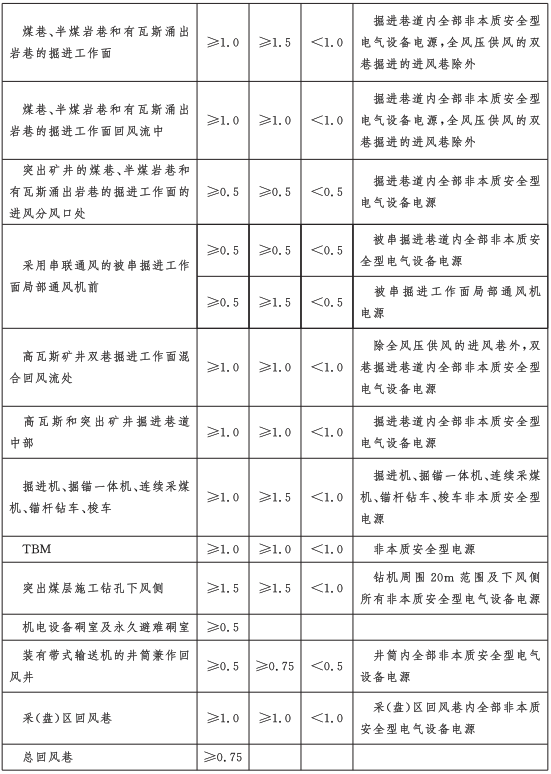
10. Article 537: Non-intrinsically safe electrical equipment in the return air flow must implement methane electrical lockout. Methane sensors must be installed at the following locations:
(1) Coal mining working faces and their return air tunnels and return air corners; when the return air tunnel length exceeds 1000m in high gas and outburst mines, it must be installed in the middle of the return air tunnel.
(2) Coal tunnels, semi-coal rock tunnels, and excavation working faces with gas outbursts, and in their return air flow; when the excavation tunnel length exceeds 1000m in high gas and outburst mines, it must be installed in the middle of the excavation tunnel.
(3) Inflow tunnels of coal mining working faces in outburst mines and those with dangerous rock bursts.
(4) Inflow split points of coal tunnels, semi-coal rock tunnels, and excavation working faces in outburst mines.
(5) Within 5-10m downwind of drilling holes in outburst coal seams.
(6) Within 3-5m downwind of the inflow side of electromechanical equipment chambers and permanent refuge chambers.
(7) In shafts equipped with belt conveyors used as return air shafts, within 10-15m upwind of the belt conveyor.
(8) During interlinked ventilation, in the inflow tunnels of the coal mining working face; in front of the local ventilation fan of the excavation working face.
(9) In the return air tunnels of the mining (panel) area, and at the wind measurement stations of the total return air tunnel.
(10) Within 3-5m downwind of the coal loading points in the main transport tunnels using explosion-proof diesel locomotives.
(11) Downwind of the upper opening of the coal bunker and above the closed belt conveyor ground corridor.
(12) Inside the ground gas extraction pump room.
(13) Outside the fence downwind of the temporary gas extraction pump station and discharge outlet underground.
(14) In the input and output pipelines of the gas extraction pump.
Other locations requiring additional safety monitoring and types of sensors, alarm values, power cut-off values, and power cut-off ranges will be determined by the chief engineer of the coal mine.
11. Article 538: The sensors installed at the following locations in outburst mines must be full-range methane sensors:
(1) Coal mining working faces and their inflow, return air tunnels, and return air corners.
(2) Coal tunnels, semi-coal rock tunnels, and excavation working faces with gas outbursts, and in their return air flow and inflow split points.
(3) Return air tunnels of mining (panel) areas.
(4) Total return air tunnels.
12. Article 539: Coal mining machines, excavation machines, bolting machines, continuous miners, TBMs, etc., must be equipped with methane cut-off devices with power cut-off lockout functions. The methane concentration and monitoring data for coal mining machines in high gas and outburst mines must be integrated into the safety monitoring system.
Underground equipment must be equipped with methane cut-off devices with power cut-off lockout functions, wireless methane sensors, or portable methane detection alarms:
(1) Shuttle cars, bolting drill rigs.
(2) Transport equipment powered by explosion-proof batteries or explosion-proof diesel engines.
(3) Other mobile equipment that requires installation.
13. Article 540: Wind direction sensors must be installed 10-15m at the entrance of the inflow tunnels of coal mining working faces and 10-15m in the inflow direction at the inflow split points of excavation working faces.
When wind flow reversal occurs, an audible and visual alarm signal must be issued. Wind speed sensors must be installed in the return air tunnels of coal mining working faces and excavation tunnels. When the wind speed is below or exceeds the specified value in these regulations, an audible and visual alarm signal must be issued.
Each mining (panel) area and total return air tunnel must have wind speed sensors installed. The main ventilation fan’s wind tunnel must have wind pressure sensors installed.
14. Article 541: Flow, temperature, and pressure sensors must be installed in the suction pipeline of the gas extraction pump station. For gas extraction pump stations in self-igniting and easily igniting coal seams, carbon monoxide sensors must also be installed in the suction pipeline, with the alarm concentration determined by the chief engineer of the coal mine.
Carbon monoxide and temperature sensors must be installed in the return air flow of coal mining working faces, excavation working faces, mining (panel) area return air tunnels, and total return air tunnels. The carbon monoxide alarm concentration must be greater than or equal to 0.0024%. The temperature alarm value will be determined by the chief engineer of the coal mine.
Transport tunnels for diesel-powered equipment such as explosion-proof diesel locomotives, rubber-tired vehicles, and monorails must have carbon monoxide sensors installed, with installation locations and alarm concentrations determined by the chief engineer of the coal mine.
Within 10-20m downwind of the head and tail rollers of the belt conveyor in the inflow tunnel, carbon monoxide, temperature, and smoke sensors must be installed. The carbon monoxide alarm concentration must be greater than or equal to 0.001%. The temperature alarm value will be determined by the chief engineer of the coal mine.
In the return air flow of coal mining working faces, excavation working faces, and in the return air flow of outburst mines, carbon dioxide sensors must be installed, with the alarm concentration complying with the regulations.
In coal mining working faces using carbon dioxide for fire prevention, carbon dioxide and oxygen sensors must be installed, with the alarm concentration complying with the regulations.
Charging chambers must be equipped with methane, hydrogen, carbon monoxide, smoke, and temperature sensors.
The methane alarm and power cut-off concentration must be greater than or equal to 0.5%; the hydrogen alarm and power cut-off concentration must be greater than or equal to 0.5%; the carbon monoxide alarm and power cut-off concentration must be greater than or equal to 0.0024%; the temperature alarm value will be determined by the chief engineer of the coal mine; the power cut-off range includes all non-intrinsically safe equipment power supplies in the charging chamber.
15. Article 542: Main ventilation fans and local ventilation fans must have equipment start-stop sensors.
Main air doors must have air door switch sensors installed, and when both air doors are opened simultaneously, an audible and visual alarm signal must be issued. The load side of the controlled switches for methane electrical lockout and wind electrical lockout must have power feed status sensors installed.
Please like, share, and follow to let more people see this!Disclaimer: The content of this article is sourced from the internet, and we cannot contact the copyright owner. If there are any copyright issues with the text or images in this article, please contact the public account operator at WeChat ID: qjd2013, and we will delete it!