Sensor Fusion Algorithm is a technology that integrates, complements, and optimizes data from multiple sensors to achieve more accurate, reliable, and comprehensive environmental perception or state estimation than a single sensor.
In simple terms:
“1 + 1 > 2” — Multiple sensors working together yield results superior to any single sensor.
1. Necessity of Sensor Fusion Algorithms
Each sensor has itsadvantages and limitations:
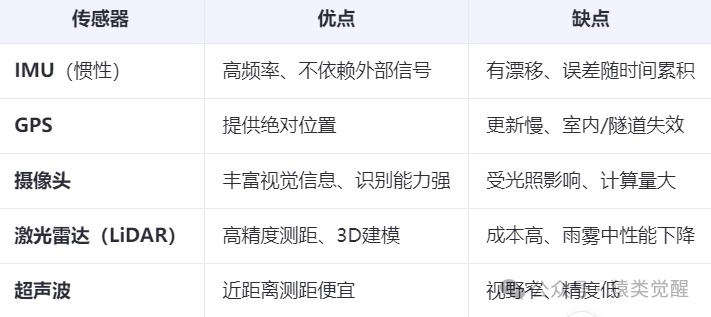
Throughfusion algorithms, we can:
- Complement advantages (e.g., GPS + IMU)
- Suppress noise and errors
- Enhance system robustness, accuracy, and reliability
- Achieve tasks that a single sensor cannot complete (e.g., autonomous driving localization)
2. Goals of Sensor Fusion Algorithms
-
State Estimation estimates the state of an object, such as:
- Position, velocity, acceleration
- Attitude (pitch, roll, yaw)
- Angular velocity, linear acceleration
-
Environment Perception builds an understanding of the surrounding environment, such as:
- Obstacle detection and tracking
- Map building (SLAM)
- Object recognition and classification
-
Tolerance and Redundancy allow the system to continue operating using other sensors when one sensor fails.
3. Common Fusion Algorithms
1. Kalman Filter (KF)
- Applicable Scenarios: Linear systems + Gaussian noise
- Principle: Fuses measurements with model predictions through prediction and update steps
- Applications: GPS + IMU localization, drone attitude estimation
Advantages: High computational efficiency, suitable for real-time systems
Disadvantages: Only applicable to linear systems
2. Extended Kalman Filter (EKF)
- Improvements: Linearizes nonlinear systems using Taylor expansion
- Applications: Robot SLAM, autonomous vehicle localization
Advantages: Can handle nonlinear systems
Disadvantages: Linearization introduces errors, higher complexity
3. Unscented Kalman Filter (UKF)
- Improvements: Uses “Unscented Transform” to approximate nonlinear transformations, avoiding linearization
- Effectiveness: More accurate than EKF, especially in strongly nonlinear systems
Advantages: High accuracy, good stability
Disadvantages: Slightly higher computational load
4. Deep Learning Fusion Methods
- Utilizes neural networks (e.g., CNN, RNN, Transformer) to learn fusion strategies directly from raw sensor data
- Applications: End-to-end autonomous driving, multimodal perception (image + point cloud + IMU)
Advantages: Can learn complex nonlinear relationships Disadvantages: Requires a large amount of training data, poor interpretability
Examples:
1. IMU + GPS Fusion (INS/GPS)
- IMU provides high-frequency motion information
- GPS provides low-frequency but drift-free absolute positioning
- Fusion achieves high precision, high frequency, and occlusion-resistant localization
Applications: Drones, autonomous driving, mobile navigation
2. Visual + IMU Fusion (VIO, Visual-Inertial Odometry)
- The camera provides visual feature matching
- IMU provides motion prediction and angular velocity
- Fusion achieves fast, robust pose estimation, even in textureless or rapid motion conditions
Applications: AR/VR, drones, robot SLAM
3. LiDAR + IMU + GPS Fusion (LIO, LiDAR-Inertial Odometry)
- LiDAR constructs high-precision point cloud maps
- IMU compensates for motion distortion during scanning
- GPS provides global reference
Applications: High-precision map collection, autonomous driving localization