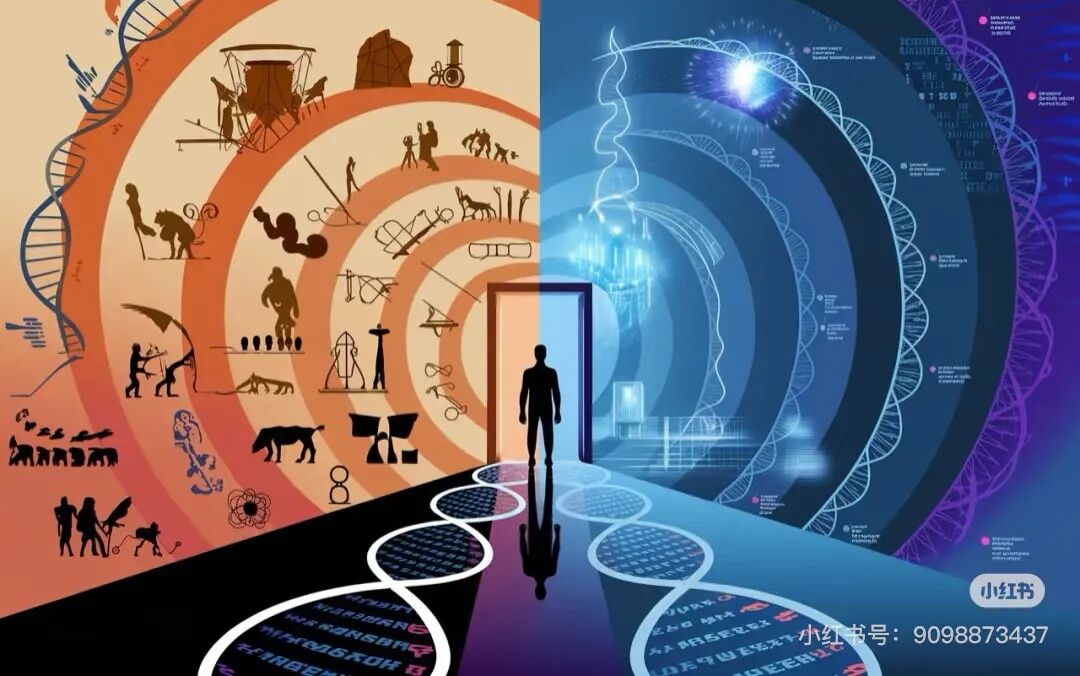
In the autumn of 2025, Elon Musk presented a series of predictions during a shareholder meeting and podcast live stream, once again pulling the “future” from science fiction into the public eye.
This man, who has made rocket recovery and electric vehicle proliferation a reality, has now sketched five disruptive “future maps”—from consciousness residing in robots to starships building interstellar bridges, each enough to send chills down the spine of the average person, yet finding a realistic footnote in his technological narrative.
Prediction 1: “Digital immortality” within 20 years, consciousness transferred to robot bodies.
“Using Neuralink to create a ‘mind snapshot’ and implant it into the Optimus robot, allowing a tin man carrying your soul model to continue living.” Musk’s confidence at the shareholder meeting makes “consciousness transfer” no longer a fantastical concept. He explains that this “digital version of self” may differ from the original, but just as you five years from now will be different from your current self, this is a natural change.
Technical confidence: Neuralink has enabled monkeys to control electronic devices with their thoughts, and the Optimus robot can perform precise gripping and autonomous obstacle avoidance. Musk’s logic is straightforward: when brain signal decoding and robot hardware mature, “consciousness transfer” is merely a natural result of technological integration. However, controversy arises—when the “digital self” possesses independent behavioral capabilities, humanity’s “uniqueness” will be redefined?
Prediction 2: Thousands of starships setting sail, building cities on Mars is not just a slogan.
“The Texas factory will produce 1,000 Starships annually in the future.” This number far exceeds the current global annual rocket production, hiding Musk’s interstellar ambitions. He casually mentions that “a 5,000-ton starship landing in the Indian Ocean at 25 times the speed of sound” is a real test just completed by SpaceX; the Falcon rocket’s over 500 recoveries, capturing 90% of the global orbital cargo transport, have reduced the cost of space travel by 100 times.
The ultimate goal: not just to send a few people into space, but to build self-sufficient cities on Mars and a million-population base on the Moon. “The starship is the Noah’s Ark of human civilization,” Musk’s words hide a precaution against Earth’s risks—when asteroids collide, climate crises emerge, interstellar colonization may be the key to the continuation of civilization.
Prediction 3: AI and robots will reconstruct the rules of social survival.
“Optimus can eliminate poverty.” This seemingly optimistic assertion is backed by Musk’s engineering mindset: when robots take on all low-value repetitive labor, labor costs approach zero, material output will experience explosive growth, allowing humanity to shift from “working for survival” to “working for passion.”
But he also punctures the current situation: “Today’s AI only tells you what you want to hear, not the truth.” In his view, true strong AI is not just a tool but a “creator” that reshapes society—it will force humanity to address ethical regulation, income distribution, and other challenges, potentially pushing capitalism towards a fairer form.
Prediction 4: Space “umbrellas” to cool down the Earth.
“Deploying thousands of AI solar satellites to block 0.1% of sunlight can regulate the climate.” Musk’s climate solution remains “hardcore”: utilizing SpaceX’s space deployment capabilities, allowing satellite arrays to act like “smart umbrellas” to fine-tune Earth’s temperature. This may seem crazy, but it aligns with his consistent style of “solving global problems with engineering thinking”—the decline in solar energy costs and the maturity of AI precision control technology make this idea feasible.
Controversy and truth: Is he really “blowing smoke”?
Some say Musk’s predictions are “sci-fi marketing,” but looking back: in 2012 he said, “we will build a reusable rocket within 10 years,” and in 2019 the Falcon 9 achieved recovery; in 2016 he proposed the “Optimus robot,” and by 2023 the prototype can walk autonomously. His “madness” has never been mere fantasy but a reasonable extrapolation based on technological progress.
Of course, skepticism has never ceased: does consciousness transfer violate the ethics of life? Can mass production of starships overcome material bottlenecks? How can we avoid the risks of AI going out of control? Musk has not provided perfect answers, but perhaps his value lies in this—using seemingly outrageous predictions to force humanity to think ahead about the boundaries of civilization.
Conclusion: Are we standing at a turning point in the era?
Musk’s predictions contain the allure of digital immortality, the romance of interstellar colonization, and the concerns of technological control. He is like an engineer holding a blueprint of the future, telling us: “Humanity’s endpoint is not on Earth, but in the infinite possibilities of stars and consciousness.”
Perhaps in 20 years, when we see the “digital self” collaborating with Optimus, watching starships depart from Earth, we will suddenly recall these “outrageous” predictions of today—realizing that the future has never arrived suddenly, but has been pulled into reality by someone ahead of time.