Continuing the discussion on pointers in C language, one of the powerful features is the function pointer, which brings unprecedented flexibility and extensibility to your code.
What is a Function Pointer?
A function pointer, as the name suggests, is a pointer variable that points to a function. It stores the memory address of a function, allowing us to indirectly call that function. This enables the program to dynamically decide which function to execute at runtime, greatly increasing the flexibility and extensibility of the code.
Basic Usage: Pointer to a Function
The syntax for declaring a function pointer is as follows:
ReturnType (*PointerVariableName)(ParameterType1, ParameterType2,...);-
<span>ReturnType</span>: The return type of the function that the pointer points to. -
<span>(*PointerVariableName)</span>:<span>*</span>indicates that this is a pointer, and<span>PointerVariableName</span>is the name of the pointer. The parentheses are necessary; otherwise, it becomes a function that returns a pointer. -
<span>(ParameterTypeList)</span>: Specifies the list of parameter types accepted by the pointed function. Parameter names can be omitted, keeping only the types.
For example, declaring a pointer to a mathematical operation function: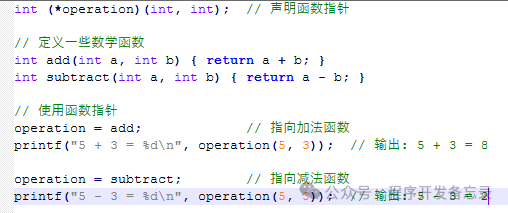
Why Use Function Pointers?
Function pointers offer three major advantages:
-
Implementing Callback Mechanisms:
This is the classic application of function pointers. A pointer to a function (callback function) is passed as a parameter to another function (often called a higher-order function), which “calls back” this function at the appropriate time.
-
Creating Flexible Function Tables (Function Table / Jump Table)
Using an array of function pointers instead of lengthy
<span>switch-case</span>or<span>if-else</span>statements makes the code cleaner, more efficient, and easier to extend. -
Supporting Polymorphic Behavior: (Polymorphism)
Although C language does not have native object-oriented support like C++/Java, we can simulate “polymorphic” behavior using function pointers and structures.
Advanced Usage 1: Array of Function Pointers (Jump Table)
When different functions need to be executed based on various conditions, the traditional approach is to use a switch statement. However, as the options increase, the switch statement can become lengthy and hard to maintain. An array of function pointers provides a more elegant solution.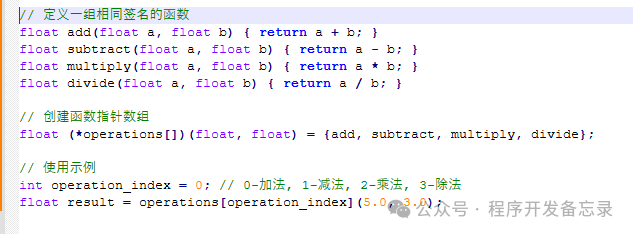
Practical Application Scenario
Suppose you are developing a calculator application where users can choose different operations:
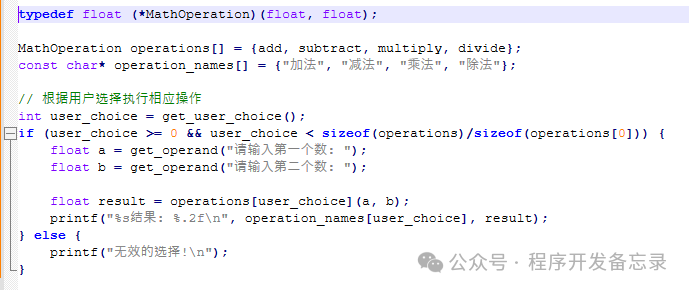 Advanced Scenario: State Machine This is a killer application of jump tables in system programming. Each state is a function, and the array of function pointers determines the next state based on the current state and input events.
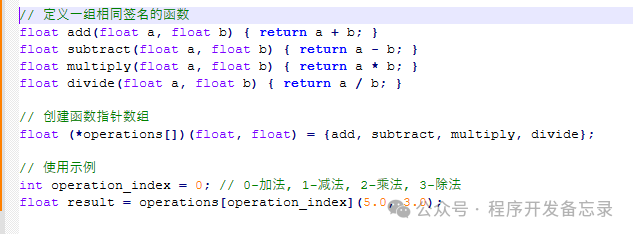 This implementation is much clearer, more efficient, and easier to extend than a large nested
 <span>switch-case</span>.
Advanced Usage 2: Callback Functions
Callback functions are one of the most powerful applications of function pointers. They allow us to pass functions as parameters to other functions, enabling highly customizable behavior.
Basic Concept
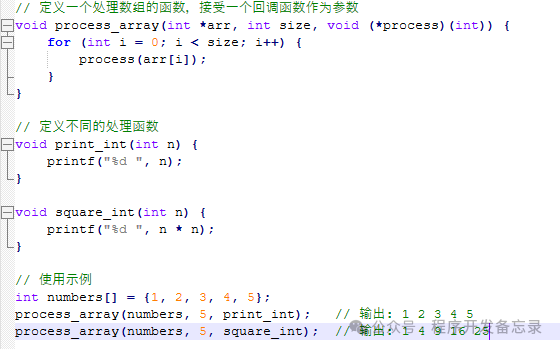
Practical Application Case
Suppose you are developing a data processing library, and users may want to perform different operations on the data:
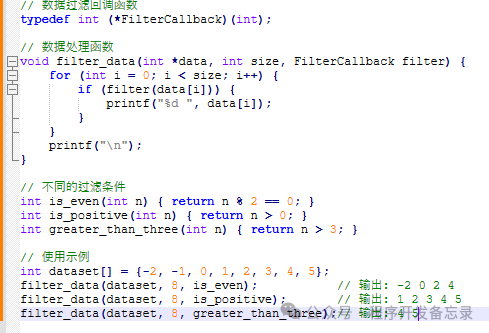 Advanced Scenario: Asynchronous Callbacks This is at the core of modern event-driven programming (like Node.js, GUI programming). Function pointers are stored and called when a future event occurs (like a timer expiration, I/O completion, user click).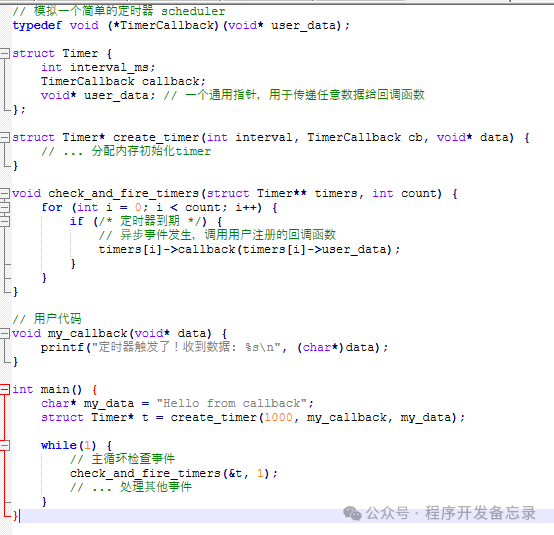
Common Pitfalls and Avoidance Guide
Despite the power of function pointers, improper use can lead to various issues. Here are some common pitfalls and solutions:
1. Type Mismatch Issues
Problem Description: Function pointers must match the signature of the pointed function exactly; otherwise, it will lead to compilation errors or undefined behavior.
Error Example:
 Solution: Use typedef to define the function pointer type to ensure type consistency.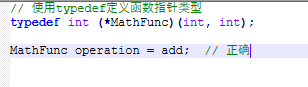
2. Null Function Pointer Issues
Problem Description: Calling a null function pointer will cause the program to crash.
Error Example:
 Solution: Always check if the function pointer is null.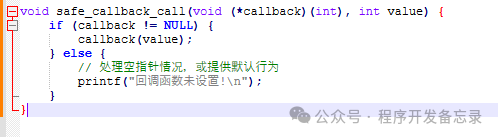
3. Array Out-of-Bounds Issues
Problem Description: Accessing a non-existent index in an array of function pointers will lead to undefined behavior.
Error Example:
 Solution: Always check the array index range.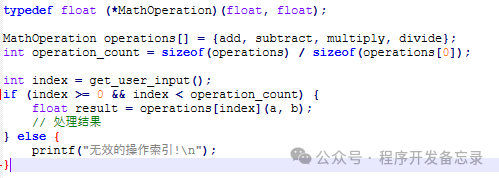
4. Lifecycle Management Issues
Problem Description: When a callback function executes, the context it relies on (such as local variables, freed memory) may no longer be valid, leading to undefined behavior.
Error Example:
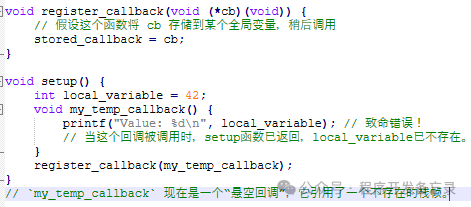
Solution:
-
Avoid using context from stack data. Callback functions are best when they are global or static.
-
If context must be used, use
<span>void* user_data</span>parameter and ensure the data’s lifecycle exceeds that of the callback function through dynamic allocation (<span>malloc</span>) and manually free it at the appropriate time (<span>free</span>).
5. Reentrancy and Thread Safety Issues
Problem Description: In a multithreaded environment, a function pointer may be modified by another thread while being called, or the callback function itself may not be thread-safe.
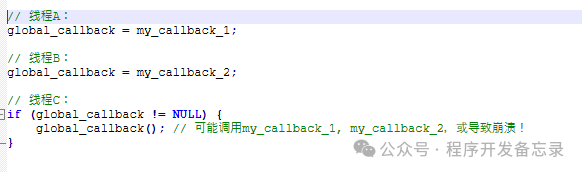
Solution:
-
Use mutexes or atomic operations to protect write operations to function pointer variables.
-
Ensure that the callback function itself is reentrant (not relying on global or static variables) or use locks to protect its shared resources.
Function pointers are a powerful and flexible feature in C language, mastering them can significantly enhance the modularity and extensibility of code. Through arrays of function pointers, we can create flexible jump tables; through callback functions, we can achieve highly customizable behavior.However, caution is needed when using them to ensure the safety of your function pointers; otherwise, the larger the program, the more uncontrollable it becomes.Personal opinions are for reference only; any issues are welcome for criticism and correction.