Concept
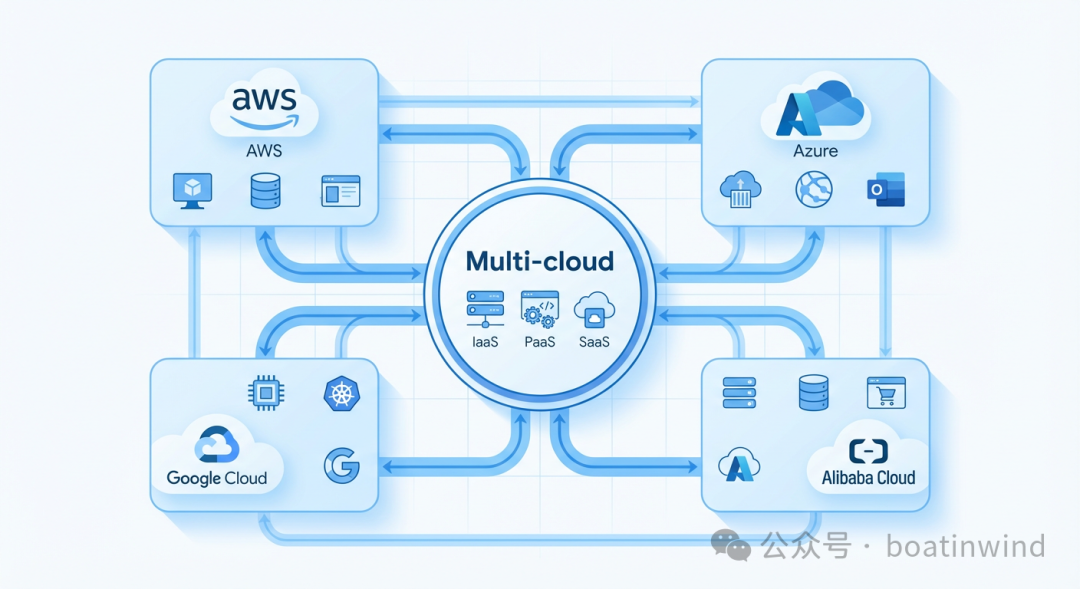
Multi-cloud refers to the strategy of enterprises using cloud computing services from two or more cloud service providers simultaneously. These services may include Infrastructure as a Service (IaaS), Platform as a Service (PaaS), or Software as a Service (SaaS), from different public cloud providers such as AWS, Microsoft Azure, Google Cloud Platform, Alibaba Cloud, etc.
In simple terms, multi-cloud is a cloud computing strategy that embodies the idea of “not putting all your eggs in one basket.” Enterprises can choose the most suitable service combinations from different cloud providers based on specific needs, rather than relying on a single vendor. For example, a company might use AWS for storage services, Azure for artificial intelligence services, and Google Cloud for data analytics services.
It is important to note that multi-cloud is not the same as hybrid cloud. Hybrid cloud typically refers to a combination of private and public clouds, emphasizing the integration of on-premises infrastructure with cloud services; while multi-cloud specifically refers to the use of services from multiple public cloud providers, focusing on horizontal integration across vendors.
Origin
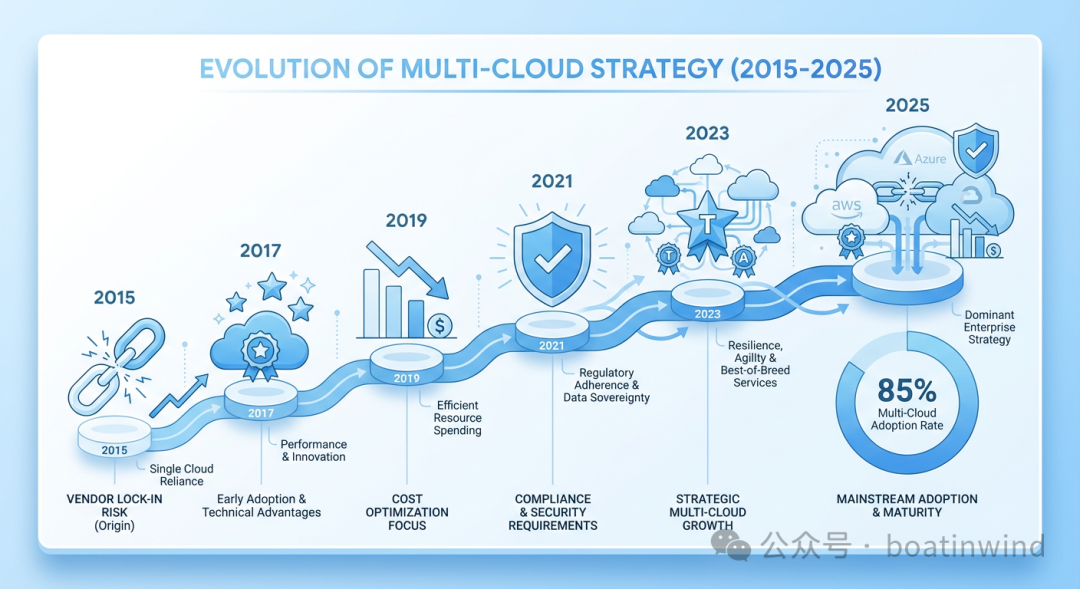
The rise of the multi-cloud concept stems from the evolution of enterprise cloud computing practices. In the early days of cloud computing, enterprises typically chose a single cloud provider to meet all their needs. However, as the cloud services market matured, several issues gradually emerged: vendor lock-in risks, limitations of a single platform, and differences in technical advantages among different providers in specific areas.
Around 2015, with the rise of platforms like Google Cloud and Microsoft Azure, a competitive landscape formed against AWS, and enterprises began to recognize the value of multi-cloud strategies. According to statistics from 2025, over 85% of enterprises have adopted or plan to adopt a multi-cloud architecture, driven mainly by the following factors:
-
Avoiding Risks: Preventing over-reliance on a single vendor to avoid service interruptions or price monopolies.
-
Technical Advantages: Leveraging the technical strengths of different cloud providers in specific areas.
-
Cost Optimization: Choosing the most cost-effective solutions by comparing pricing models from different vendors.
-
Compliance Requirements: Meeting data sovereignty and regulatory requirements in different regions.
Elements and Their Relationships
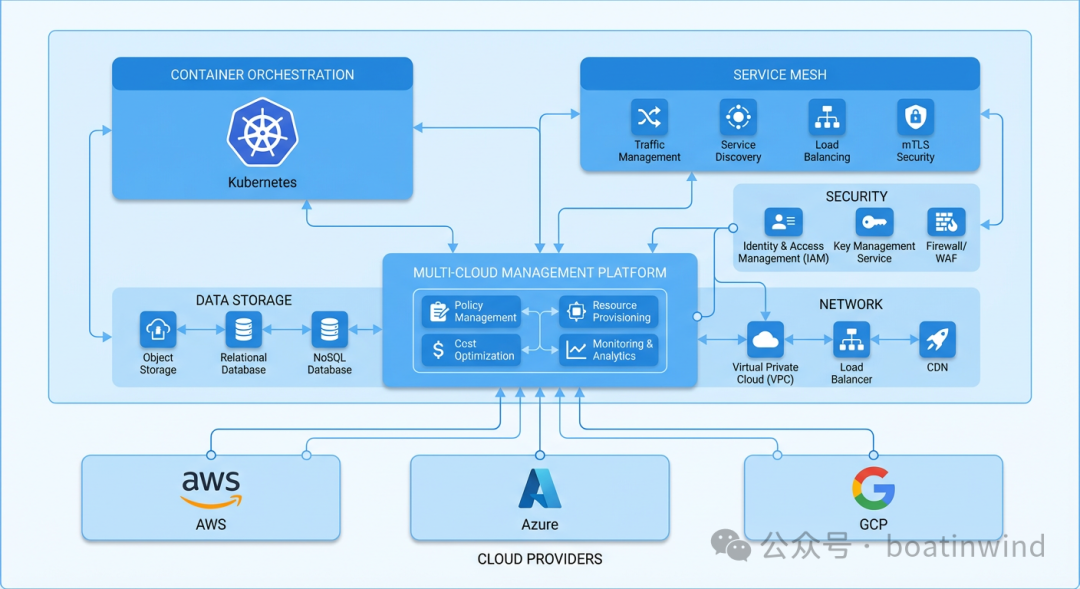
The multi-cloud architecture consists of the following core elements, which work together to form a complete ecosystem:
1. Cloud Service Providers: Including public cloud platforms like AWS, Azure, Google Cloud, IBM Cloud, Alibaba Cloud, and privately built clouds by enterprises. Each provider offers different service features, pricing models, and geographical coverage.
2. Multi-cloud Management Platform: Responsible for unified management, monitoring, and scheduling of cross-cloud resources. These platforms provide a “one-stop” console to simplify the complexity of cross-cloud operations.
3. Container Orchestration Systems: Such as Kubernetes, which is a key technology for deploying applications across clouds. It provides a standardized container management interface, allowing applications to be portable across different cloud platforms.
4. Service Mesh: Enables service discovery, load balancing, and traffic management across clouds, ensuring that services in different cloud environments can communicate with each other.
5. Data Layer and Storage: Needs to address data consistency, synchronization, and backup issues across clouds, ensuring data availability and security in multiple cloud environments.
6. Network and Security Layer: Establishes secure connections between clouds, implementing virtual networks, routing configurations, and unified security policy management.
The relationships among these elements can be understood as follows: cloud service providers form the foundational resource layer, multi-cloud management platforms serve as the control layer, container orchestration and service mesh represent the application runtime layer, while data, network, and security are the supporting layers that run throughout.
Main Technologies Used
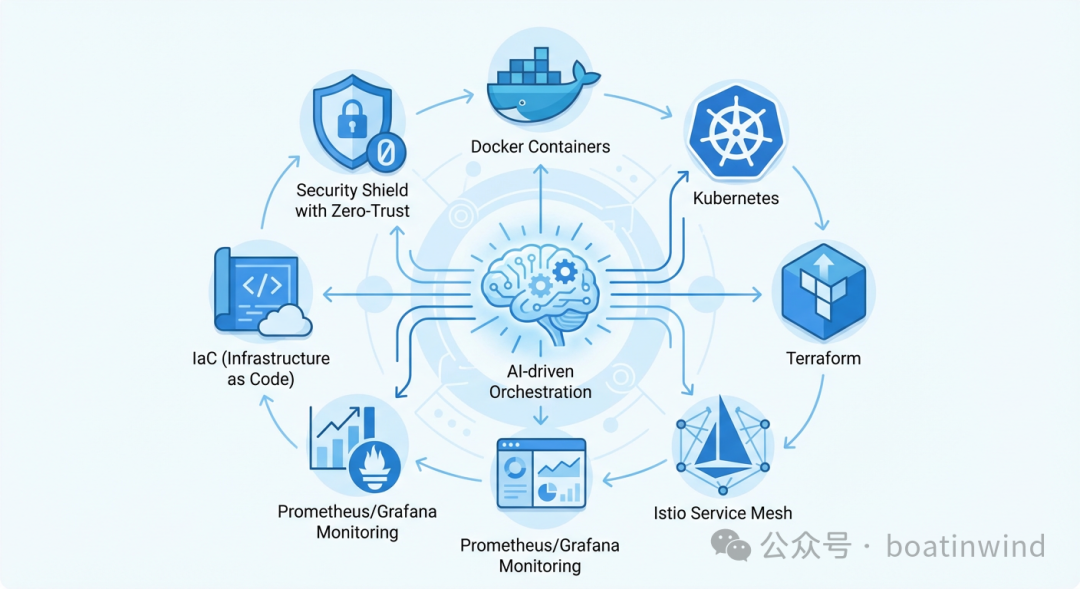
The implementation of multi-cloud environments relies on a series of key technologies:
1. Container Technology and Orchestration
-
Docker: Packages applications and their dependencies into independent containers for cross-platform deployment.
-
Kubernetes: The de facto standard for container orchestration, supporting automated deployment, scaling, and fault recovery, and is supported by all major cloud providers.
-
Helm: A package management tool for Kubernetes that simplifies the application deployment process.
2. Infrastructure as Code (IaC)
-
Terraform: A multi-cloud infrastructure configuration management tool that allows unified syntax to manage resources across different cloud platforms.
-
Ansible/Pulumi: Automation configuration and deployment tools.
3. Service Mesh Technology
- Istio/Linkerd: Provides inter-service communication, security authentication, and traffic management across clouds.
4. Multi-cloud Management Platforms
-
VMware Tanzu: An enterprise-grade multi-cloud management solution.
-
Red Hat OpenShift: An enterprise application platform based on Kubernetes.
-
Cloud-native Management Tools: Native management services from various cloud providers (e.g., AWS Systems Manager, Azure Arc).
5. Monitoring and Observability
-
Prometheus/Grafana: Open-source monitoring and visualization tools.
-
ELK Stack: A log collection and analysis platform.
-
Distributed Tracing: Tools like Jaeger and Zipkin.
6. AI-driven Orchestration and Optimization
-
Automated Workload Scheduling: AI-based resource optimization engines (e.g., AWS SageMaker, Azure Machine Learning).
-
Cost Optimization Tools: Automatically analyze and optimize multi-cloud costs.
7. Security Technologies
-
Zero Trust Architecture: Unified identity authentication and access management across clouds.
-
Encryption Technologies: Data transmission and storage encryption.
-
Compliance Management Tools: Ensure compliance with regulations in different regions.
Applicable and Non-applicable Scenarios
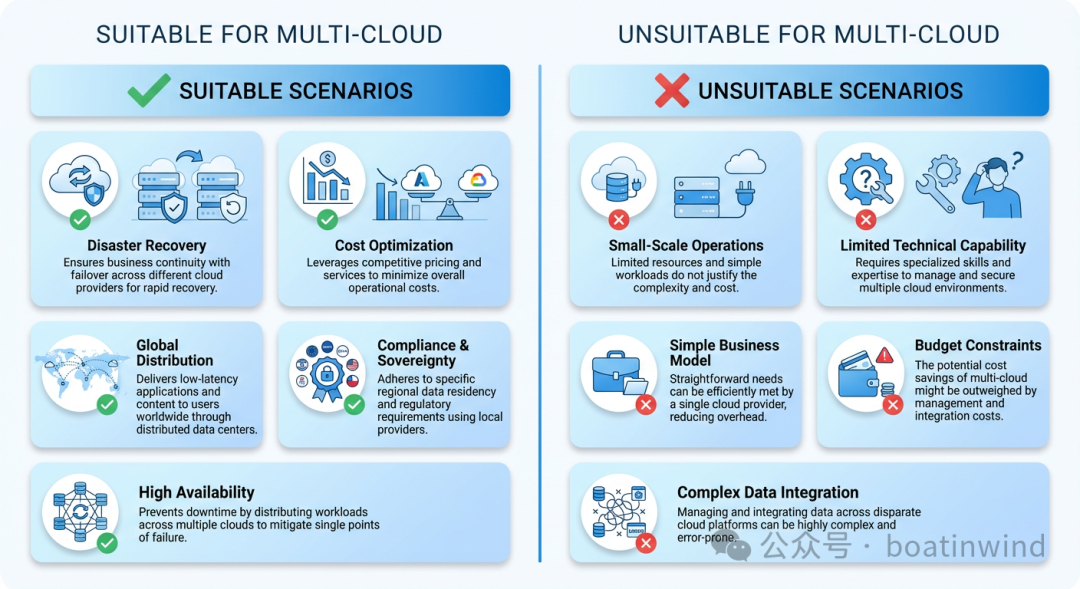
Applicable Scenarios:
-
Avoiding Vendor Lock-in: Large enterprises wish to maintain technological independence and avoid being constrained by price and policy changes from a single cloud provider.
-
Disaster Recovery and Business Continuity: By deploying critical applications across multiple cloud platforms, when one cloud fails, it can quickly switch to a backup cloud, ensuring business continuity.
-
Cost Optimization: Utilizing pricing differences and promotional activities from different cloud providers to choose the most cost-effective services for different workloads.
-
Geographical Distribution Needs: Multinational enterprises need to deploy services in different regions, and some cloud providers may not have data centers in specific areas.
-
Data Sovereignty and Compliance: Meeting data storage and processing regulatory requirements in different countries or regions, such as the EU’s GDPR.
-
Utilizing Best Services: Choosing the advantageous services of each cloud provider, such as AWS’s object storage, Google Cloud’s AI services, and Azure’s enterprise integration capabilities.
-
High Availability Requirements: Critical applications require extremely high availability guarantees, and multi-cloud deployment can reduce the risk of single points of failure.
Non-applicable Scenarios:
-
Small-scale Applications: Startups or small projects that can meet their needs using a single cloud platform; multi-cloud would add unnecessary complexity and management costs.
-
Limited Technical Capability: Teams lacking multi-cloud management experience and skills may face operational difficulties and security risks if forced to adopt it.
-
Simple Business Needs: Applications with simple business logic that do not require cross-regional deployment; a single cloud solution is more economical and practical.
-
Budget Constraints: Multi-cloud management requires additional tools, training, and manpower investment, making it unsuitable for organizations with tight budgets.
-
Complex Data Integration: Scenarios requiring extensive cross-cloud data transfer and processing may face high data transfer costs and latency issues.
-
Strict Vendor Dependence: Certain applications that heavily rely on specific cloud providers’ proprietary services may incur high costs for multi-cloud migration.
Future Development
Multi-cloud technology is evolving towards greater intelligence, automation, and edge integration, with the main development trends including:
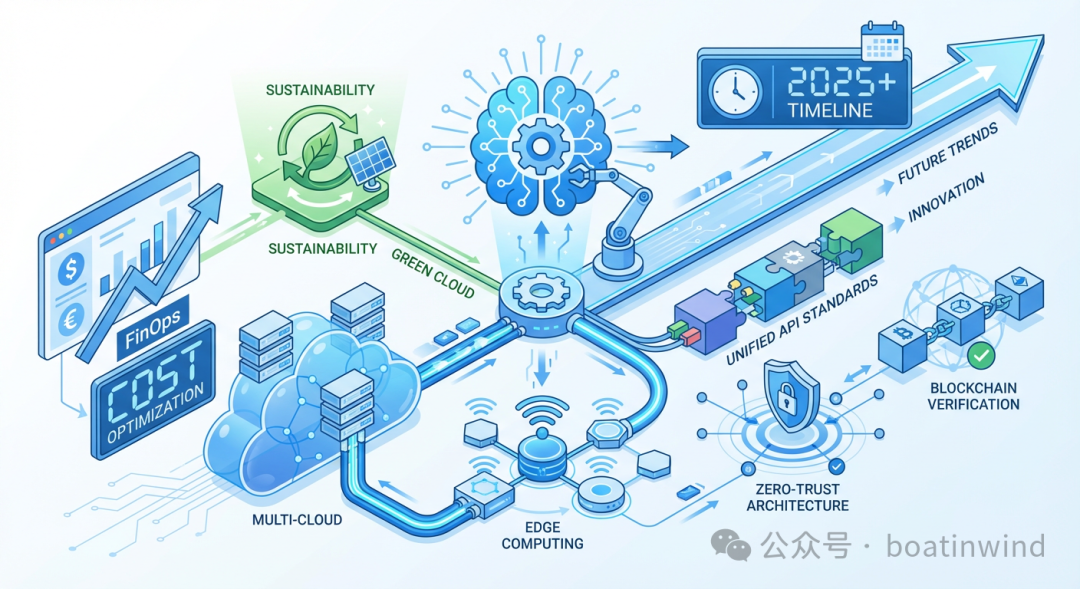
1. AI-driven Intelligent Orchestration: By 2025 and beyond, artificial intelligence will be deeply integrated into multi-cloud management. AI-driven orchestration systems will automatically analyze workload characteristics, predict resource needs, optimize resource allocation, and intelligently schedule across different cloud platforms. Platforms like AWS SageMaker and Azure Machine Learning have already begun to offer such capabilities, which will become more mature and widespread in the future.
2. Edge Computing Integration: Multi-cloud architectures will be deeply integrated with edge computing. Enterprises can deploy computing resources closer to users and devices at edge nodes while leveraging the centralized management capabilities of multi-cloud. This is particularly important for IoT, real-time data processing, and low-latency applications.
3. Automation and Self-management: Future multi-cloud platforms will possess stronger autonomous capabilities, including automatic fault detection and recovery, automatic scaling, and automatic cost optimization. The DevSecOps philosophy will be more deeply integrated into multi-cloud management, achieving automated security guarantees.
4. Unified Multi-cloud Interface Standards: With the promotion of organizations like the Cloud Native Computing Foundation (CNCF), standardized interfaces across clouds will gradually improve. Kubernetes has already become the de facto standard for container orchestration, and more standardized technologies will emerge in the future to reduce the complexity of multi-cloud management.
5. Popularization of FinOps Culture: Multi-cloud cost management will become a core focus for enterprises. FinOps (Financial Operations) practices will help enterprises control and optimize cloud spending more finely, achieving cost transparency and clear accountability.
6. Enhanced Security and Compliance: Zero trust architecture, end-to-end encryption, and automated compliance checks will become standard features of multi-cloud platforms. Blockchain technology may also be applied to cross-cloud data integrity verification and audit tracking.
7. Sustainability and Green Cloud Computing: Environmental friendliness will become an important consideration in multi-cloud choices. Enterprises will prioritize cloud data centers that use renewable energy, and multi-cloud management platforms will also provide carbon footprint tracking and optimization suggestions.
According to industry forecasts, by 2025, over 90% of enterprises will adopt some form of multi-cloud strategy. Multi-cloud will no longer be optional but a necessary choice for enterprises’ digital transformation. However, successfully implementing a multi-cloud strategy requires organizations to be well-prepared in terms of technology, culture, and processes, especially in talent development, automation tool selection, and security policy formulation.