Video Recommendations





In an EtherCAT system, ensuring the clock synchronization of all slave devices is crucial for achieving precise control. In this issue, we will explore how the AWStudio Motion Control version addresses clock inconsistency issues through a distributed clock synchronization mechanism, enhancing the system’s synchronization performance.
 Clock Synchronization Issues in EtherCAT SystemsEtherCAT does not use distributed clocks; each slave relies on its local clock to operate independently, lacking a unified time reference. This can lead to reduced reliability and control accuracy in industrial automation scenarios, resulting in the following consequences:
- Multiple devices operate out of sync: For example, multiple motors in a multi-axis machine tool or cooperating robotic joints may experience action delays or misalignment due to clock deviations, leading to decreased machining accuracy, equipment stalling, or even collisions.
- High data transmission and acquisition errors: Sensor data (such as position and temperature) uploaded by slaves may become disordered due to timestamp confusion, causing errors in calculations (such as speed and torque) at the master station, affecting the accuracy of system control.
- Communication jitter sensitivity and poor stability: Without a distributed clock hardware calibration mechanism, the system’s tolerance to communication jitter (such as signal interference and transmission delay fluctuations caused by load variations) decreases, impacting overall system stability.
- Complex topological scenarios cannot be adapted: When the EtherCAT network includes multiple slaves and employs complex topologies such as linear or tree structures, the distance differences between slaves and the master can lead to inconsistent propagation delays. The lack of a distributed clock’s delay compensation function can cause cumulative clock deviations between remote and nearby slaves, ultimately leading to synchronization collapse across the entire network, failing to meet the needs for multi-device collaboration.
To accurately control when slave devices receive output data and provide input data, ensuring the accuracy and real-time nature of data transmission, the EtherCAT device system needs to achieve time synchronization. Introducing Distributed Clocks (DC) can effectively solve this problem.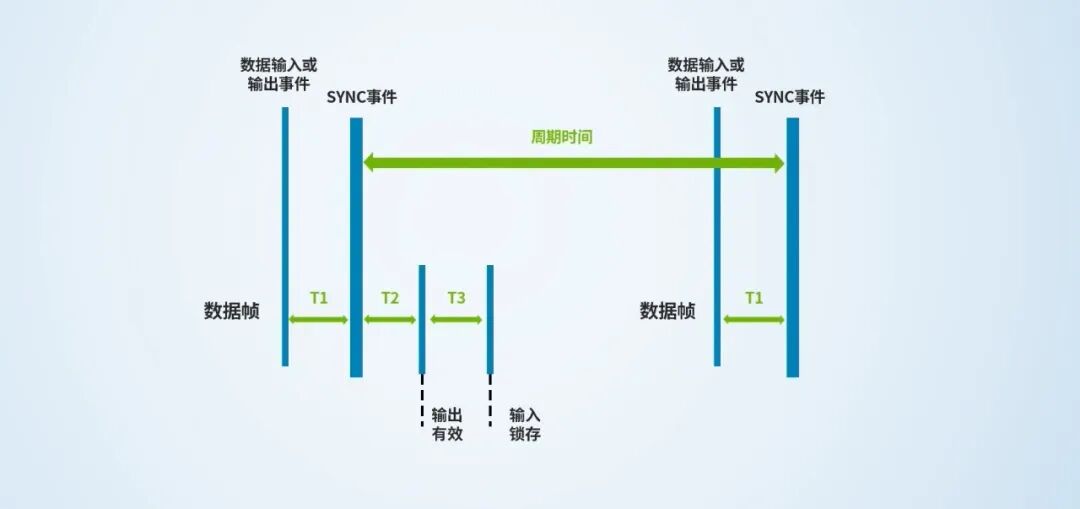 The distributed clock synchronization mechanism is a high-precision time synchronization mode. As shown in the figure, the data frame arrives at the SYNC signal ahead of time T1, and the slaves complete data exchange and control calculations before the SYNC event. Upon receiving the SYNC signal, they immediately execute output operations, thereby improving synchronization performance.It can be understood that when a data frame from a slave arrives, it is not processed immediately because some slaves may not have received the data yet. By waiting for a specified time, all slaves can process the data together, achieving better synchronization.
 Distributed Clock Configuration in AWStudio Motion Control VersionThe AWStudio Motion Control version supports detailed configuration of distributed clocks to ensure precise synchronization of slave devices across the entire network. This is particularly important for applications requiring high-precision time control.
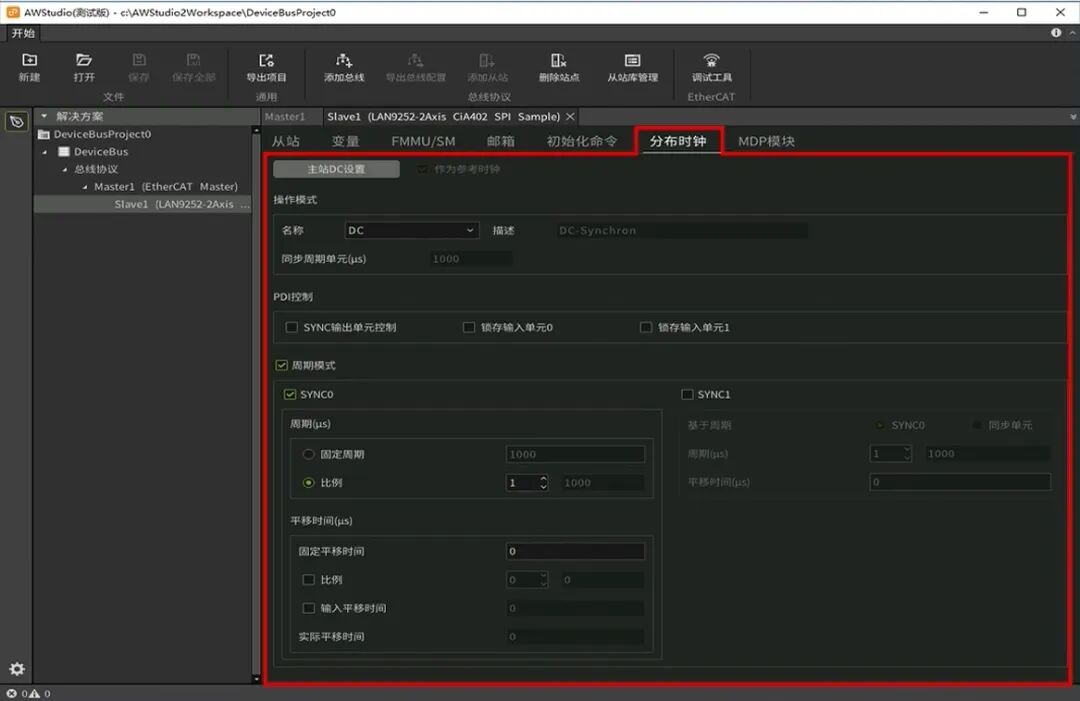 The software provides configuration options for synchronization offset and drift compensation, helping developers adjust clock parameters based on actual conditions to achieve optimal synchronization results.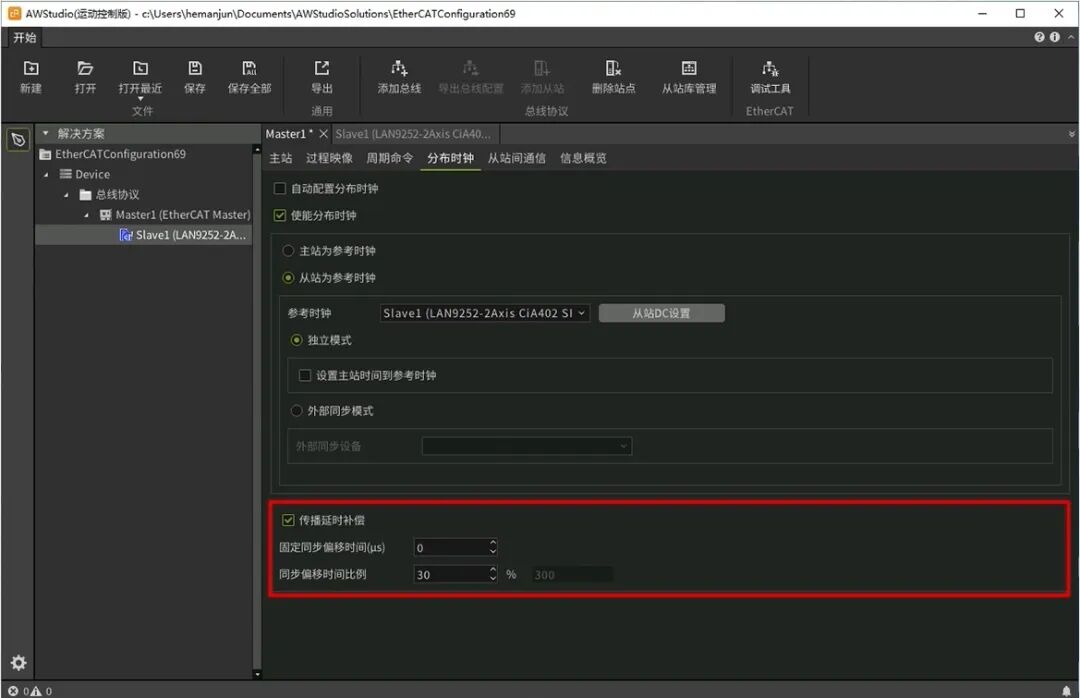
 ConclusionThrough the distributed clock synchronization mechanism, the AWStudio Motion Control version provides a high-precision time synchronization solution for EtherCAT systems. Whether for automated production lines or robotic control systems, AWStudio ensures precise synchronization of slave devices, enhancing the overall performance of the system.If you have any questions or suggestions regarding the distributed clock synchronization feature of the AWStudio Motion Control version, feel free to leave a comment for discussion.
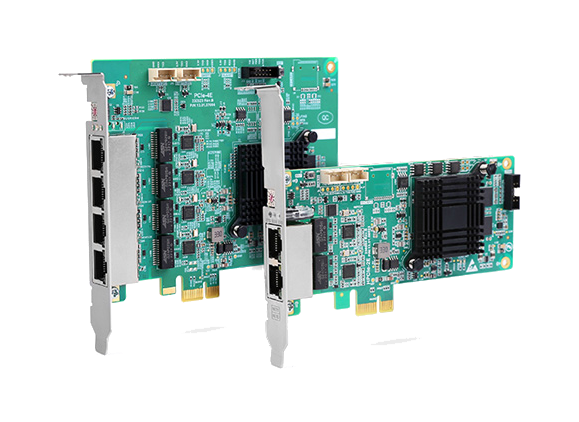 |
PCIe EtherCAT Communication Card |
Long press to purchase |