▼Click the card below to follow our official account▼
TTL, RS232, and RS485 are representations of logic levels, which are three different voltage standards for serial communication.
TTL
TTL: Full duplex (5V system, logic 1: 2.4V–5V, logic 0: 0V–0.5V). TTL refers to Transistor-Transistor Logic circuits. Many “USB to TTL” modules available on the market are actually “USB to TTL level serial” modules. In this case, a signal of 0 corresponds to 0V, and 1 corresponds to either 3.3V or 5V, which is compatible with the I/O levels of microcontrollers and SoCs. When we perform serial communication, the signals coming directly from the microcontroller are generally TTL levels.
RS232
RS232: Full duplex (logic 1: -15V–5V, logic 0: +3V–+15V). This is an asynchronous transmission standard interface established by the Electronic Industries Association, which corresponds to both voltage standards and communication protocols (timing). The voltage standard is: +3V to +15V corresponds to “0”, and -3V to -15V corresponds to “1”. The logic levels of RS232 differ from TTL, but the protocol is the same.
RS485
RS485: Half duplex (logic 1: +2V–+6V, logic 0: -6V–2V). Here, the voltage refers to the voltage difference between the two lines A and B. RS485 is a serial interface standard that uses differential signaling for long-distance transmission. It transmits differential signals, meaning the voltage difference between the two lines A and B serves as the level signal. Differential signals can effectively resist external interference because the interference affects both lines equally, keeping the voltage difference constant and ensuring the signal transmission is unaffected. Unlike TTL and RS232, which can only connect one-to-one, RS-485 allows for up to 128 transceivers to be connected on the bus.
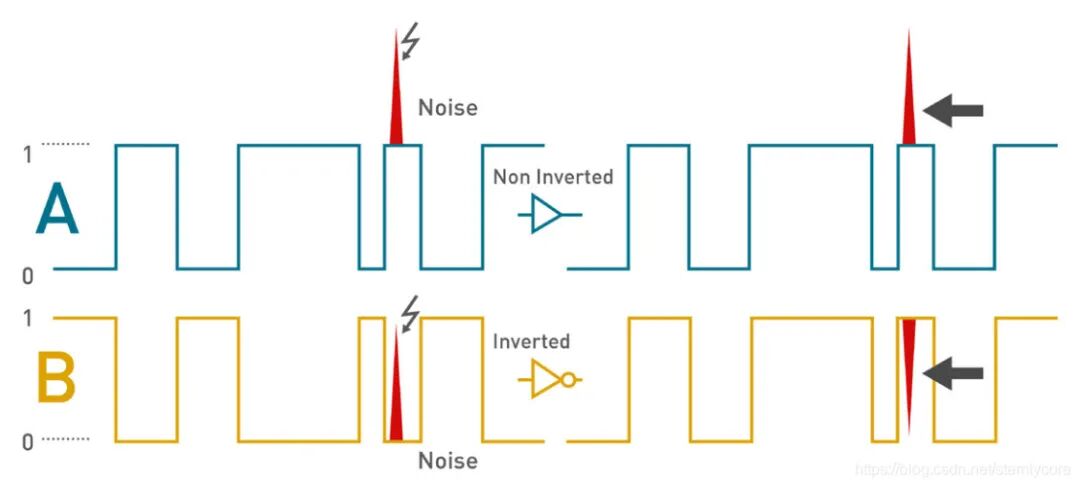
Source: Internet
end
Reply with the keyword “Join Group” in the WeChat official account to add the editor on WeChat and be added to the technical group.Recommended ReadingAfter years in the industry, my understanding of the relationship between differential input circuits and common-mode and differential-mode signalsWhat are the differences between I2C high-speed mode 3.4M/s and standard 100K/s?Learning about Buck circuits this way.Knowledge sharing | Why is hardware testing so important???
Share 💬 Like 👍 View ❤️
Support quality content with a “three-click” action!