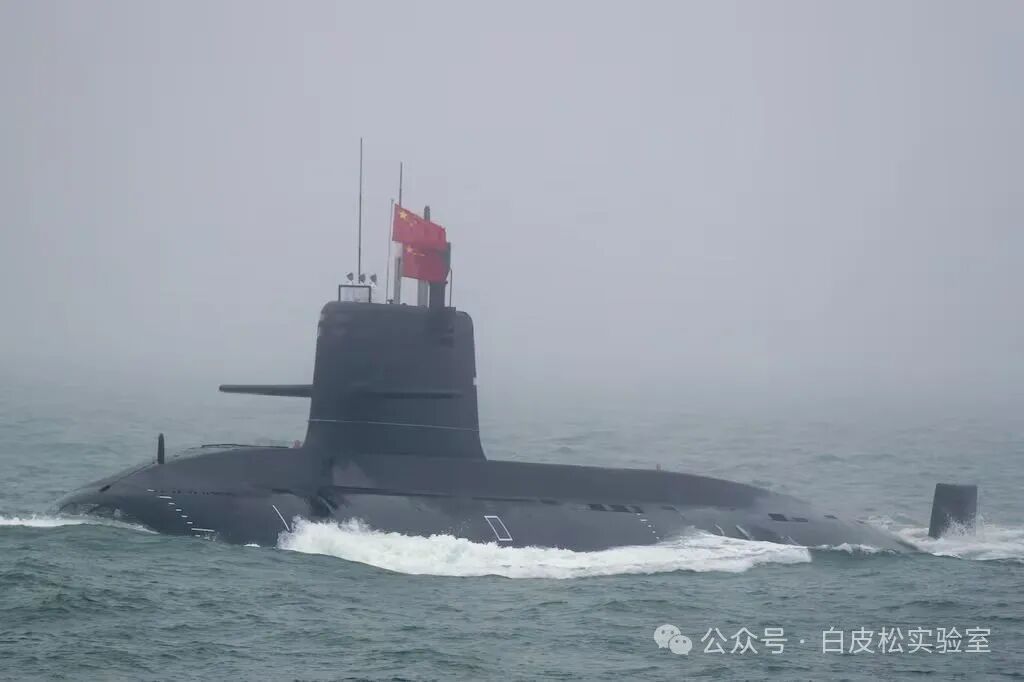
 In April 2019, a submarine of the People’s Liberation Army Navy participated in a naval parade near Qingdao, Shandong Province, China. (Mark Schiefelbein/AP Photo)Submarines are a crucial component of the Chinese Navy’s strategy. Chinese experts warn that U.S. underwater sensors pose a significant threat to these submarines.As a result, some Chinese naval officers advocate for systematic destruction of the U.S. undersea sensor network during wartime. This includes employing various countermeasures, from underwater drones to China’s vast commercial fishing fleet, to destroy, disrupt, or interfere with underwater microphones.Chinese experts believe that “the U.S. undersea surveillance system has many weak points, and the vast battlefield space of the Western Pacific amplifies these weaknesses,” wrote Ryan Martinson, a professor at the U.S. Naval War College’s China Maritime Studies Institute, in an article for the International Maritime Security Center. “If enough nodes fail, the entire system could lose functionality.”Ironically, the views of the balance of undersea power between the U.S. and China seem to be completely opposite. The U.S. and its Pacific allies are concerned about the growing fleet of Chinese submarines, with the Pentagon predicting that the number of Chinese submarines will reach 65 this year and increase to 80 by 2035. Currently, China can deploy six nuclear ballistic missile submarines and six nuclear attack submarines, along with a large number of conventional submarines equipped with anti-ship missiles, including 21 advanced Yuan-class diesel-electric submarines.Meanwhile, China is worried that the U.S.’s intensive anti-submarine operations have made its submarines overly vulnerable.“The Chinese Navy is heavily investing in submarines because it recognizes their tremendous deterrent and combat value,” Martinson wrote. “However, this value depends on the submarines’ ability to remain undetected. But according to Chinese military experts, this fundamental requirement cannot be guaranteed, and is far from being met.”Martinson analyzed an article published in November 2023 by three Chinese naval officers in the internal military journal Military Art.“This allows the authors to share their expertise with a level of frankness that is extremely rare (if not unprecedented) in publicly available PLA materials,” Martinson noted.The article in Military Art expresses concerns about the difficulty of Chinese submarines competing with the “integrated, three-dimensional surveillance system” described by the authors. This system includes warships, submarines, aircraft, satellites, underwater drones, underwater microphones from integrated undersea surveillance systems, and surface vessels from towed array surveillance systems.The U.S. sees a Chinese underwater fleet, while China perceives the U.S. as attempting to achieve “unilateral transparency” underwater. China believes that this anti-submarine warfare network is vast, even employing survey ships to map the seabed and hydrological conditions for optimal submarine detection, and using ocean surveillance vessels to obtain submarine acoustic signatures.During the Cold War, the U.S. and its allies established maritime chokepoints at strategic locations between Greenland, Iceland, and the UK, where Soviet submarines had to traverse a tightly controlled defense composed of anti-submarine vessels, aircraft, and underwater sensors to enter the North Atlantic. Today, some Chinese experts believe that the U.S. can prevent its submarines from “entering critical waterways, threatening their ‘navigational safety’ during training and operational areas,” Martinson wrote. In particular, Beijing is concerned about the safety of its six nuclear ballistic missile submarines.“The probability of our submarines being detected when leaving port is extremely high,” the article in Military Art states. “The probability of our submarines being detected and intercepted while operating in nearshore areas is also quite high.”Martinson points out that this conclusion “is a devastating indictment of the operational effectiveness of the Chinese submarine force.”One question is whether these Chinese officers are exaggerating the capabilities of U.S. anti-submarine warfare, perhaps to secure more resources or push for more aggressive maritime policies. However, Bryan Clark, a researcher at the Hudson Institute and a former U.S. Navy submarine officer, believes that “their overall assessment is realistic.”“For decades, the U.S. integrated undersea surveillance system’s fixed arrays and towed array surveillance system vessels have been very effective in tracking submarines in critical maritime areas,” Clark told Defense News.Regardless, it is inevitable that China will respond in some way to the U.S.’s large-scale anti-submarine plans. In recent years, China has placed great emphasis on disrupting the “nervous system” of the U.S. military: the complex and expensive network that integrates communications, sensors, weapons, and command and control systems. Unsurprisingly, Chinese authors advocate for employing similar methods to exploit multiple weak points in the U.S. anti-submarine warfare system.First, according to the article in Military Art, China’s own conventional military capabilities have improved to the extent that U.S. anti-submarine warfare platforms (such as aircraft and vessels) can no longer operate close to Chinese territory. Moreover, as some in the Trump administration would agree, the U.S. military has overextended itself.More directly, the Chinese military can eliminate various nodes within the U.S. anti-submarine warfare system.“Undersea cables and arrays are ‘quite vulnerable and easily severed,'” while the command and control system—referred to by Chinese officers as the “Achilles’ heel” of the U.S. undersea sensor network—can be destroyed or disrupted through kinetic attacks or cyber warfare.To thwart U.S. anti-submarine operations in the Pacific region, Chinese experts urge for intensive efforts that require long-term planning and resource investment.“At the national strategic level, China needs to combine defensive measures with countermeasures, but must place greater emphasis on countermeasures,” Martinson explains. “This means prioritizing the development of capabilities needed to ‘attack and destroy’ the U.S. undersea surveillance system.”These new capabilities will include using technologies such as acoustics, magnetics, optics, and electronic detection, as well as artificial intelligence to locate hidden undersea sensors and drones. The authors also call for the development of unmanned underwater vehicles to destroy U.S. sensor arrays.Clark questions whether China can easily disrupt the U.S. anti-submarine warfare network.“At the onset of conflict, the PLA may easily attack deployed towed array surveillance system vessels, and perhaps even attack small vessels supporting the integrated undersea surveillance system,” he said. “But this action would prevent the forces from executing other missions and could take a significant amount of time.”“Searching for small objects in the water or near the seabed is difficult,” Clark added. “This action would also trap the PLA’s underwater forces within the first island chain during conflict, whereas they would be better off operating outside the chain.”Nevertheless, there are indeed weaknesses in U.S. anti-submarine operations that China can exploit.“The PLA may only need to deploy submarines on a large scale before conflict to overwhelm the integrated undersea surveillance system,” Clark said. “The U.S. military would be unable to attack PLA submarines, and there are not enough U.S. submarines and destroyers to track all deployed PLA submarines.”Ultimately, whether China’s civilian and military leadership will heed the Navy’s advice remains to be seen.“However, serious experts are discussing these recommendations, which means the Chinese Navy may be considering them,” Martinson warns. “Therefore, U.S. Navy leaders must take them seriously as well.”(Translated based on DN Network article)