
For more timely and valuable content, please follow our WeChat official account: wc_sfdj
We sincerely invite industry professionals and organizations to submit articles to us, and there are rewards for submissions
Submission email: tougao@51wctt.com
Source | Wangcai Servo and Motion Control
Overview of RS-232
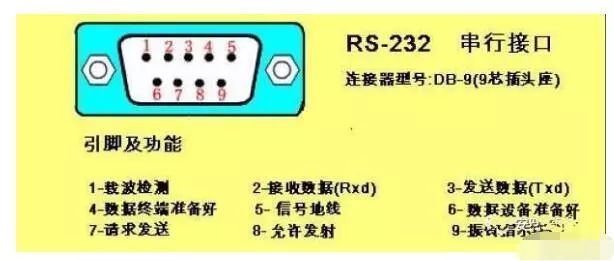
The RS-232 interface complies with the serial data communication interface standard set by the Electronic Industries Alliance (EIA), originally numbered EIA-RS-232 (abbreviated as 232, RS232). It is widely used for connecting computer serial interface peripherals. It covers the connection cables and mechanical, electrical characteristics, signal functions, and transmission processes.
The RS-232-C standard specifies data transmission rates of 50, 75, 100, 150, 300, 600, 1200, 2400, 4800, 9600, 19200 baud per second.
Characteristics of RS-232:
RS-232 is one of the mainstream serial communication interfaces today. Due to the early emergence of the RS-232 interface standard, it inevitably has some shortcomings, mainly as follows:
(1) The signal level values of the interface are relatively high, making it easy to damage the chips in the interface circuit. The voltage of any signal line in the RS-232 interface is in a negative logic relationship. That is, logic “1” is -3 to -15V; logic “0” is +3 to +15V, with a noise tolerance of 2V. This means that the receiver must recognize signals above +3V as logic “0” and signals below -3V as logic “1”, with TTL level being 5V for logic high and 0 for logic low. It is incompatible with TTL levels, so a level conversion circuit is required to connect to TTL circuits.
(2) The transmission rate is relatively low; during asynchronous transmission, the bit rate is 20Kbps. Therefore, in the 51CPLD development board, the comprehensive program baud rate can only use 19200, which is the reason for this.
(3) The interface uses one signal line and one signal return line to form a common ground transmission form, which is prone to common-mode interference, making its noise immunity weak.
(4) The transmission distance is limited, with a maximum standard transmission distance of 50 feet, but in practice, it can only be used for about 15 meters.
Overview of RS-485
When the communication distance is required to be several dozen meters to thousands of meters, RS-485 serial bus is widely used. RS-485 uses balanced transmission and differential reception, thus having the ability to suppress common-mode interference. Additionally, the bus transceiver has high sensitivity, capable of detecting voltages as low as 200mV, allowing the transmission signal to be recovered over kilometers.
RS-485 operates in half-duplex mode, meaning that at any time, only one point can be in the sending state, and therefore, the sending circuit must be controlled by an enable signal.
Characteristics of RS-485:
RS-485 is very convenient for multipoint interconnection, which can save many signal lines. By using RS-485, a distributed system can be formed, allowing up to 32 drivers and 32 receivers to be connected in parallel. To address the shortcomings of RS-232-C, the new standard RS-485 has the following features:
(1) The electrical characteristics of RS-485: logic “1” is represented by a voltage difference of +2V to +6V between the two lines, and logic “0” is represented by a voltage difference of -6V to -2V. The interface signal levels are lower than those of RS-232-C, making it less likely to damage the interface circuit chips, and this level is compatible with TTL levels, making it convenient to connect to TTL circuits.
(2) The highest data transmission rate is: 10Mbps.
(3) The RS-485 interface uses a combination of balanced drivers and differential receivers, which have strong common-mode interference immunity, meaning good noise performance.
(4) The maximum standard transmission distance for RS-485 is 4000 feet, but in practice, it can reach up to 3000 meters.
(5) The RS-232-C interface only allows one transceiver to be connected on the bus, which means single-station capability; while the RS-485 interface allows up to 128 transceivers to be connected on the bus, providing multi-station capability, enabling users to easily establish a device network using a single RS-485 interface.
Overview of RS-422
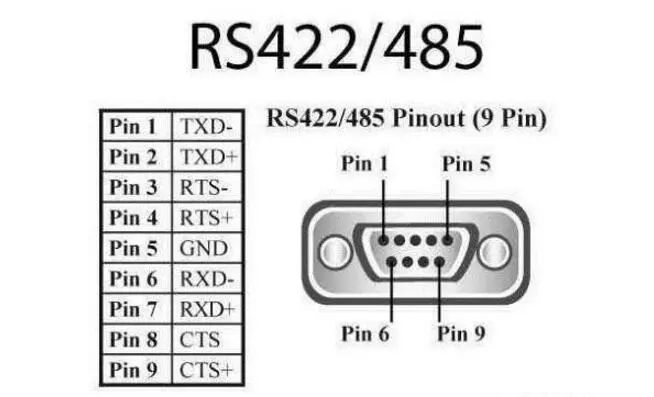
The full name of the RS-422 standard is “Electrical Characteristics of Balanced Voltage Digital Interface Circuits,” which defines the characteristics of the interface circuit. In fact, there is also a signal ground wire, making a total of five wires. Due to the receiver’s high input impedance and the transmitter’s stronger driving capability compared to RS-232, it allows multiple receiving nodes to be connected on the same transmission line, with a maximum of 10 nodes. There is one master device and the rest are slave devices, and slave devices cannot communicate with each other, so RS-422 supports point-to-multipoint bidirectional communication. The input impedance of the receiver is 4k, so the maximum load capacity at the transmitter is 10×4k + 100Ω (termination resistance).
RS-422 and RS-485 circuit principles are basically the same, both using differential transmission and reception, without needing a digital ground wire. The differential operation is the fundamental reason for the longer transmission distance under the same rate conditions, which is the main difference between the two and RS-232, as RS-232 is single-ended input/output and requires at least a digital ground wire for duplex operation. The sending line and receiving line consist of three lines (asynchronous transmission), and other control lines can be added to complete synchronization and other functions.
RS-422 can work in full duplex using two pairs of twisted pairs, while RS-485 can only work in half duplex, meaning sending and receiving cannot occur simultaneously, but it only requires one pair of twisted pairs. RS-422 and RS-485 can transmit 1200 meters at 19kbps. Using new type transceiver lines, devices can be connected.
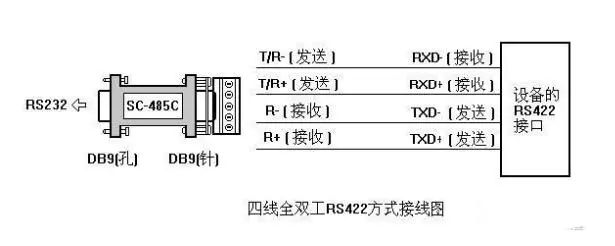
The electrical performance of RS-422 is exactly the same as RS-485. The main difference is that RS-422 has four signal lines: two for sending (Y, Z) and two for receiving (A, B). Since RS-422 separates sending and receiving, it can send and receive simultaneously (full duplex); RS-485 has two signal lines: one for sending and one for receiving.
Characteristics of RS-422:
The RS-422 four-wire interface, due to the use of separate sending and receiving channels, does not require control of data direction; any necessary signal exchanges between devices can be done through software (XON/XOFF handshake) or hardware (a pair of separate twisted pairs). The maximum transmission distance of RS-422 is 4000 feet (about 1219 meters), and the maximum transmission rate is 10Mb/s. The length of the balanced twisted pair is inversely proportional to the transmission rate; at rates below 100kb/s, it is possible to reach the maximum transmission distance. The highest transmission rate can only be achieved at very short distances. Generally, the maximum transmission rate that can be achieved on a 100-meter-long twisted pair is only 1Mb/s.
RS-422 requires a termination resistor, with a resistance approximately equal to the characteristic impedance of the transmission cable. At short distances, a termination resistor may not be needed, specifically below 300 meters. The termination resistor is connected at the farthest end of the transmission cable.
Differences Between RS-232, RS-422, and RS-485
1. RS-232 is full duplex, RS-485 is half duplex, and RS-422 is full duplex.
2. RS-485 and RS-232 differ only in the physical communication protocol (i.e., interface standard); RS-485 uses differential transmission, while RS-232 uses single-ended transmission, but the communication programs have little difference.
PCs are already equipped with RS-232, and can be used directly. If using RS-485 communication, just connect an RS-232 to RS-485 converter to the RS-232 port, no need to modify the program.
Are there any differences in appearance between RS-232, RS-422, and RS-485 interfaces?
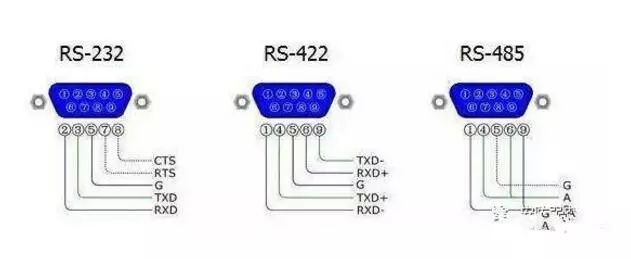
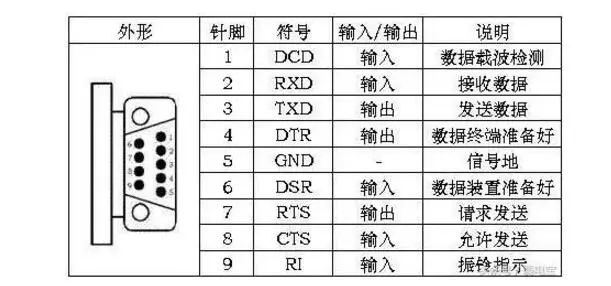
Generally, they are DB9, but there are others; it still depends on the internal wiring to determine which type among RS-232, RS-422, or RS-485.
RS-232 is a standard interface with a D-shaped 9-pin head, and the signal definitions of the connected devices’ interfaces are the same, as defined below:
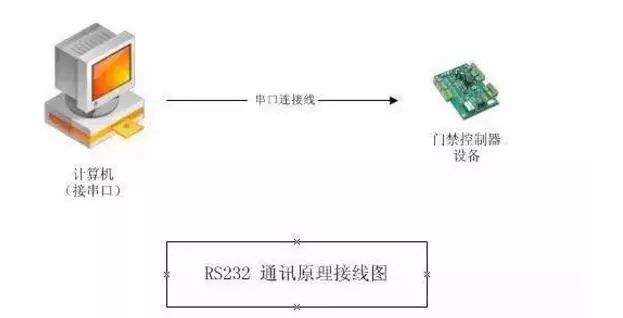
RS-232 only allows point-to-point communication (single-station capability)
RS-485 interfaces allow connecting up to 128 transceivers on the bus (multi-station capability)
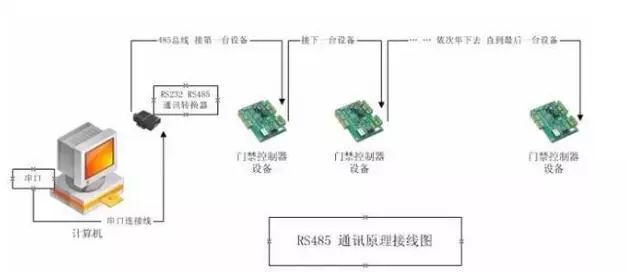
Since PCs typically only come with RS-232 interfaces, there are two methods to obtain RS-485 circuits on the PC:
(1) By using an RS-232/RS-485 conversion circuit to convert the PC’s RS-232 signal to RS-485 signal; it is best to use products with surge protection and isolation for complex industrial environments.
(2) By using a PCI multi-serial port card, you can directly choose an expansion card with RS-485 output signals.
Computers can connect multiple 485 devices (access control controllers) in sequence through RS-232-RS-485 converters, using a polling method to communicate with the devices on the bus in turn.
The wiring markings are 485+ and 485-, corresponding to the links of the devices (controllers) 485+ and 485-.
Communication distance: the theoretical distance from the farthest device (controller) to the computer is 1200 meters, but it is recommended to keep it within 800 meters for best performance. If the distance is excessively long, you can purchase a 485 repeater (extender) (please buy from a professional converter manufacturer; the placement of the repeater in the bus should refer to the manufacturer’s instructions).
Load quantity: that is, how many devices (controllers) a single 485 bus can support; this depends on the communication chips of the controllers and the 485 converters, generally available in options of 32, 64, 128, or 256 devices; these are theoretical numbers, and in actual applications, factors like environmental conditions and communication distances may prevent reaching these numbers. The micro-cultivation company’s controllers and converters are designed for 256 devices, but it is practically recommended to keep each bus to within 80 devices.
The 485 communication bus (must use twisted pairs or one group of network cables); if ordinary wires (non-twisted) are used, interference will be significant, leading to poor communication or even failure to communicate.
Each controller device must be connected in series; star connections or branches are not allowed. If there are star connections or branches, interference will be significant, leading to poor communication or even failure to communicate.
Want to learn about the latest news in servo and motion control?
Want to understand the full industry chain distribution of servo and motion control?
Then please follow us at Wangcai Servo and Motion Control!

Long press to recognize the QR code for Servo and Motion Control
【Disclaimer】The article reflects the author’s independent views and does not represent the position of Wangcai Servo and Motion Control. If there are issues regarding content, copyright, etc., please contact Wangcai Servo and Motion Control within 30 days of the publication of this article for deletion or negotiation regarding copyright usage.
Industry news, technical insights, market quotes, and daily hot topics are all hidden in the “Read the original” section, click to learn more!