Issues with Traditional Attention
- Problems with Traditional Attention
- There are constraints on context length.
- It is slow and consumes a lot of memory.
- Increase context length.
- Speed up and reduce memory usage.
- Sparse Attention: Introduces sparse biases to reduce complexity.
- Linearized Attention: Unrolls the attention matrix and kernel feature maps, achieving linear complexity through reverse order computation.
- Prototype and Memory Compression: Reduces the number of query or key-value memory pairs, shrinking the attention matrix.
- Low-order Self-Attention: Captures low-order properties of self-attention.
- Attention with Priors: Uses prior attention distributions to supplement or replace standard attention.
- Improved Multi-head Mechanism: Explores different alternatives to the multi-head mechanism.
Multi-Query Attention Overview
- Problems with Multi-head Attention
- Training Process: Has little impact on training speed, but may result in slight model performance loss.
- Inference Process: Repeatedly loading a large KV cache incurs high memory overhead, limiting performance by memory constraints.
- Multi-head Attention: Each attention head has its own query, key, and value.
- Multi-query Attention: Shares keys and values across all attention heads.
Grouped-query Attention Overview
- Introduction to Grouped-query Attention: Sits between multi-head and multi-query, having multiple keys and values.
- Large Models Using Grouped-query Attention: ChatGLM2, LLaMA2-34B/70B utilize this mechanism.
FlashAttention Overview
- Core Concept: Uses block softmax as an equivalent replacement for traditional softmax.
- Advantages: Saves HBM, efficiently utilizes SRAM, reduces memory usage, and increases speed.
- Representative Models: Meta’s open-source large model LLaMA and the UAE’s open-source large model Falcon use it to accelerate computation and save memory.
- Keywords: HBM, SRAM, Block Softmax, Re-computation, Kernel Fusion.
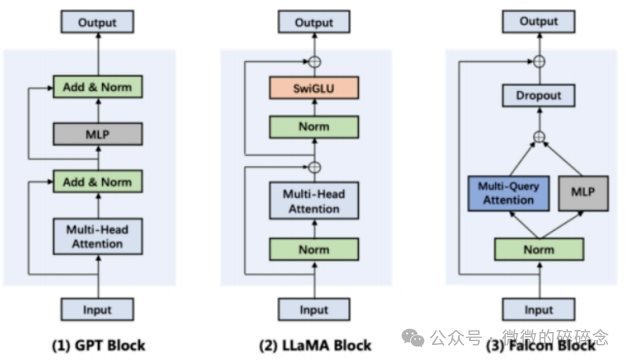
Parallel Transformer Block Overview
Replaces serial formulas with parallel ones, achieving a 15% training speed increase for 8B parameter models with slight model performance loss, while 62B parameter models show no performance loss. Falcon and PaLM use this technology to accelerate training.