Written by Erbin
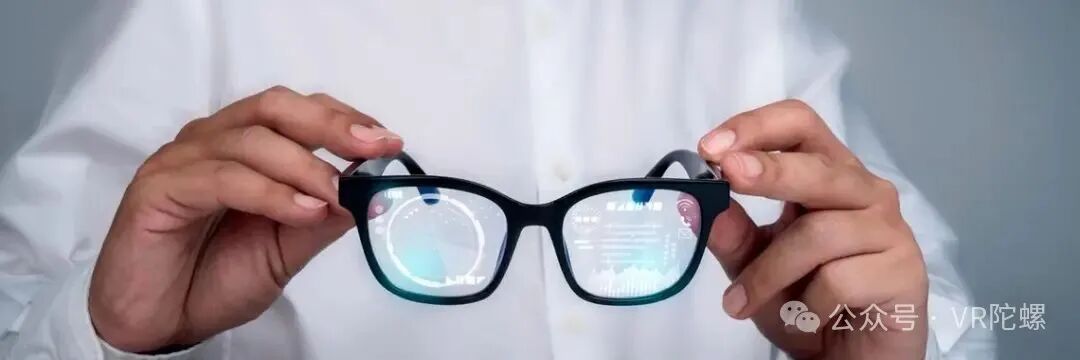
With the continuous integration of AI and smart hardware, AI smart glasses have transitioned from science fiction to a reality in everyday life. Today, the market is flooded with various new AI glasses featuring diverse shapes and rich functionalities, covering a wide range of applications from personal assistants to health management. The convenience of operation has become a major highlight of AI glasses: users can smoothly perform tasks such as prompting, photography, object recognition, real-time translation, navigation, health monitoring, and payment without frequently pulling out their phones, making them an excellent medium for human-computer interaction applications.
Challenges in Power Supply for AI Glasses
The primary challenge faced by AI glasses is battery life. Due to the weight constraints of the device, the battery capacity typically ranges from 200 to 300mAh. To support diverse application scenarios, high-performance application processors often utilize advanced process nodes of 6nm or below. Although chips manufactured at this process node exhibit outstanding dynamic performance, they also introduce significant leakage issues—leakage current increases exponentially with the shrinking of process nodes. The contradiction between high leakage current and limited battery capacity significantly shortens the actual usage time of the product, negatively impacting user experience.
Main Architectures of AI Glasses
Current AI glasses solutions primarily adopt two mainstream architectures.
1. “Application Processor + Co-Processor” Architecture
The “Application Processor + Co-Processor” solution provides users with a richer functional experience. The application processor, based on advanced process technology, focuses on high performance and typically supports high-resolution cameras, video encoding, high-performance neural network processing units, Wi-Fi, and Bluetooth communication.
The co-processor usually employs mature process technology chips, combining long-channel and short-channel transistors, focusing on low power consumption in active mode and static power consumption. The co-processor typically features a complete audio interface and considerable audio processing capabilities, supporting voice wake-up, voice calls, and music playback. The image processor GPU and display interface can support vector text and image rendering, while the built-in AI computation unit can accelerate audio algorithms such as voice recognition and noise reduction.
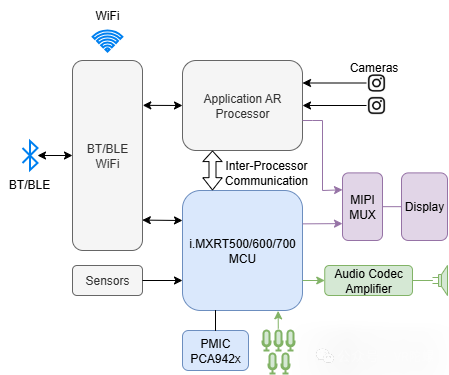
“Application Processor + Co-Processor” Architecture Block Diagram
2. “Low Power Processor” Main Control Architecture
The “Low Power Processor” main control solution places greater emphasis on the weight of the glasses, comfort during wear, and usage duration. Weight is one of the core factors affecting the user experience of glasses. The low power processor, serving as the main controller for AI glasses, can significantly reduce the number of peripheral power components and battery size, allowing the weight of the glasses to be controlled within 30g.
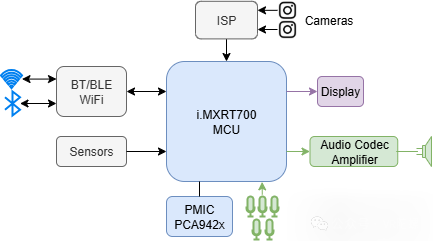
Low Power Processor Main Control Architecture Block Diagram
i.MX RT: Breaking Through Architectural Innovation and Battery Life Bottlenecks
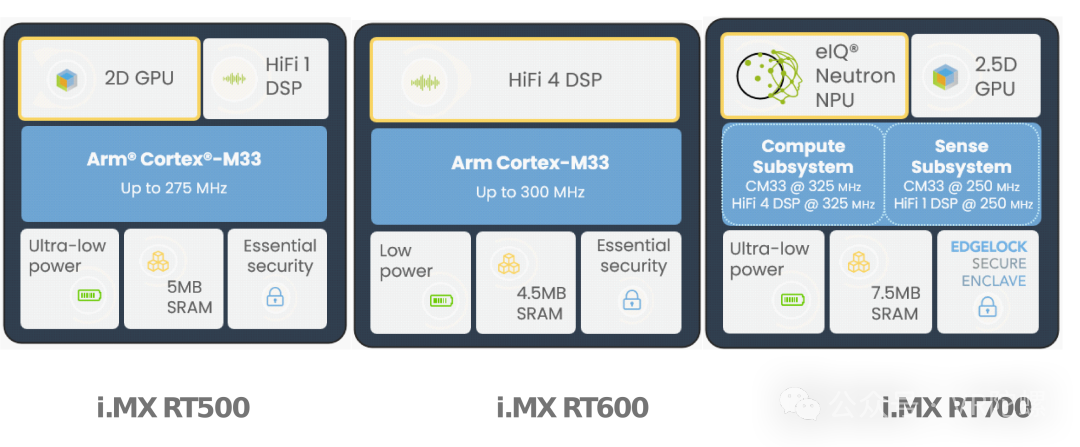
i.MX RT500, i.MX RT600, and i.MX RT700 are three chips in NXP’s i.MX RT low power product series. These chips are currently widely used as co-processors in innovative AI glasses designs by various global customers.
i.MX RT500 Fusion F1 DSP supports voice wake-up, music playback, and call functions for smart glasses. Meanwhile, the graphics processor and display interface can support image display at VGA resolution. i.MX RT600 primarily serves as the audio co-processor for smart glasses, with a maximum clock frequency of 600MHz for the HiFi4 processor, supporting most noise reduction, beamforming, and wake-up algorithms. Both i.MX RT500 and i.MX RT600 incorporate multiple low power technologies at the chip design level, such as I3C bus, dynamic voltage regulation, low static power SRAM, process-voltage-temperature sensors, low power clock sources, and power domain switches.
i.MX RT700 is the latest generation product in the i.MX RT series, featuring a dual DSP (HiFi4/HiFi1) architecture that supports various complex algorithm processing. Its 2.5D GPU display controller and MIPI DSI interface can support graphics display at a maximum of 720P and 60 frames per second. Additionally, the i.MX RT700 is equipped with a Neutron neural network acceleration unit, combined with the eIQ software development environment, enabling rapid deployment of machine learning applications and greatly simplifying the customer development process.
i.MX RT700 has achieved further optimization in low power design, with dynamic power consumption reduced by 45% compared to i.MX RT600, while static power consumption is only 20% of that of i.MX RT600. The i.MX RT700 achieves power optimization through “fine-grained partition design,” dividing the system on chip into main compute domain, sensor compute domain, media domain, power control domain, shared domain, DSP domain, and always-on domain. These domains can be independently turned on and off via power switches, and some domains can dynamically adjust voltage based on computational frequency changes, achieving an optimal balance between performance and energy consumption.
Power Saving Secrets of AI Glasses: Scene-Based Switching Modes
As a co-processor in AI glasses, the i.MX RT700 can switch roles based on different application scenarios by flexibly configuring power management and clock domains: it can function as a high-performance multimedia data processing AI computing unit or, in ultra-low power mode, act as a voice input sensor hub (Sensor Hub) for data processing.
Smart glasses primarily rely on voice control for user interaction, making voice wake-up the most frequently used scenario and a key factor determining the battery life of AI glasses. In mainstream solutions, the co-processor needs to remain active to ensure it can receive user voice commands, and noise reduction algorithms are also required for voice recognition in noisy environments. Based on this user scenario, the i.MX RT700 can be configured in sensor mode, where only a few modules such as HiFi1 DSP, DMA, MICFIL, SRAM, and power control (PMC) are active. MICFIL is used for microphone signal acquisition, DMA for transporting microphone signals, and HiFi1 for executing noise reduction and wake-up algorithms, while other internal modules of the chip remain in power-down state.
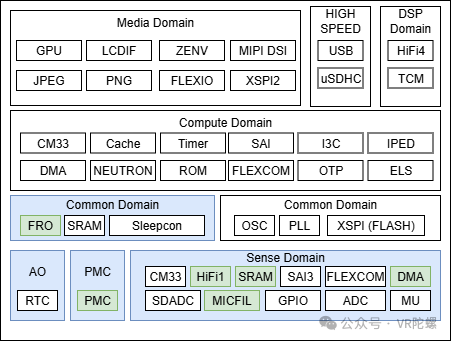
i.MX RT700 Sensor Hub Mode
In addition to the sensor mode application, low power distortion-free audio clock source FRO, microphone module FIFO, hardware voice detection (Hardware VAD), and DMA wake-up technologies also ensure that the system power consumption in the voice wake-up scenario of the i.MX RT700 can be as low as 1.91 mW, maximizing battery savings while continuously listening.
For user scenarios involving video display, the i.MX RT700 can be configured in “high-performance mode.” In this mode, the vector graphics accelerator GPU, display controller (LCDIF), display bus MIPI DSI, and display cache xSPI2 are all enabled. All peripherals of the i.MX RT700 operate in high-frequency mode. In “high-performance mode,” the i.MX RT700 also supports MIPI ULPS (Ultra Low Power State), dynamic voltage regulation, and other low power technologies.
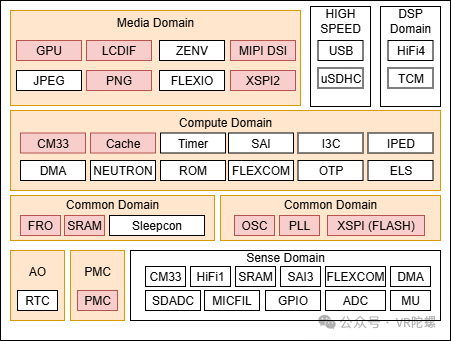
i.MX RT700 High-Performance Image Rendering Mode
The low power technologies used in the i.MX RT700 also include state retention, switched capacitor voltage conversion modules, and aggregated power management.
As a power management solution for AI/AR glasses, PMIC also plays a crucial role. PMIC not only provides power for the MCU and various peripherals but also integrates DVS functionality to work with the MCU to achieve various complex high/low frequency and high/low power operating modes, ensuring optimal overall system power consumption and maximum battery life.
As the power solution for i.MX RT500/600, PCA9420 has a battery charging capability of 315mA, along with two buck and two LDO outputs, providing full coverage for the power rails of i.MX RT500/600.
As the power solution for i.MX RT700, PCA9422 has a battery charging capability of 640mA, with a software-based battery gauge FLEXGAUGE™, three buck outputs, four LDO outputs, and one buck-boost output, which not only meets the power rail requirements of i.MX RT700 but also easily handles the power needs of various peripherals, providing a comprehensive power management solution.
As smart hardware and artificial intelligence continue to merge, selecting the right low power, high-performance chip becomes key to product innovation. The i.MX RT series, with its deep technical foundation, provides a solid basis for cutting-edge applications such as AI glasses.
For more information about the i.MX RT low power product series, please visit the NXP Semiconductor official website. Additionally, NXP offers a wealth of documentation on low power, audio-video multimedia, artificial intelligence, and other applications for developers to reference.

Author
Erbin, MCU Application Technology Manager at NXP’s Edge Processing Division, graduated from Beijing University of Technology with a Bachelor’s degree in Communication Engineering and a Master’s degree in Circuits and Systems. He joined NXP Semiconductor in 2008 and has focused on application development and product support for IIoT low power microcontroller products.
Source: NXP Semiconductor
*Disclaimer: Corporate press releases are not official statements from VR Gyro, and all legal issues are unrelated to VR Gyro.
 Stay updated on XR newsFollow the VR Gyro official website (vrtuoluo.cn)Contact VR Gyro:Business cooperation | Submissions:Liuliu (WeChat ID 13138755620)Seeking free exposure:Liuliu (WeChat ID 13138755620)Submission email: [email protected]
Gyro Research InstitutePopular Reports

“2025 AI + AR Glasses Industry Report”
“2025 First Half VR/AR Industry Investment and Financing Report”
“2024 Annual XR Large Space Industry Report”
“Micro-LED Microdisplay Industry Development Report”
“Apple Vision Pro Core Technology Disassembly and Supply Chain Analysis Report”
“2024 Global VR/AR Annual Industry Development Report”
“2024 Global VR/AR Industry Investment and Financing Report”
“2024 Annual Global VR Game Industry Report”
“2024 China XR Developer Survey Report”
“Monthly Report | 2025 June Global VR/AR Industry Frontline Dynamics”
Recommended Reading