Article Source: ZTE Document
Original Author: ZTE Document
This article introduces what Multi-core Few-mode Fiber is and its related applications.
What Is Multi-core Few-mode Fiber
With the rapid development of technologies such as the Internet, cloud computing, and big data, global data traffic is experiencing explosive growth. Although traditional single-mode fibers are already very mature, their capacity is gradually approaching its physical limits. To meet the growing communication demands, new solutions need to be explored to increase the capacity of optical communication systems.
Among various new transmission technologies that break through the theoretical limits of single-mode fibers, multi-core few-mode technology is expected to fundamentally bypass the capacity bottleneck of single-core fibers and is one of the main evolutionary directions for future optical communication. It is anticipated that it will first find application in ultra-large capacity data center short-distance interconnection scenarios.
Introducing the concepts of core and mode.
-
Core
The core is the most critical component of the optical fiber, made of high-refractive-index glass responsible for transmitting optical signals. Additionally, the middle of the fiber consists of low-refractive-index silica cladding, and the outermost layer is a resin coating for reinforcement. 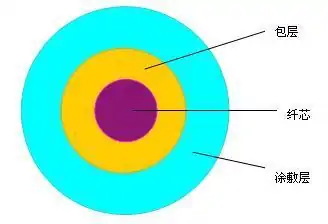
-
Mode
In the field of optical communication, “mode” is used to describe the propagation method of optical signals within the core, meaning that the mode is the path of light propagation. The generation and transmission of fiber modes are based on the total internal reflection characteristics of the fiber, where light entering the fiber is guided by the refractive index difference between the core and cladding, reflecting repeatedly within the fiber. If the core diameter is small enough, light can only propagate along the central axis (fundamental mode). If the core diameter is larger, light can propagate along different paths (multi-mode), with each mode having different optical paths and path differences.
Thus, in single-mode fibers, light propagates along a single path; in multi-mode fibers, light propagates along multiple paths.
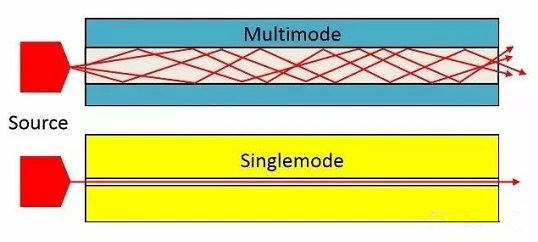
This section mainly introduces single-mode fiber, multi-mode fiber, few-mode fiber, multi-core fiber, and multi-core few-mode fiber.
-
Single-mode Fiber (SMF)
A type of fiber that transmits only a single fundamental mode at a given operating wavelength, with a core diameter typically between 8-10 microns.
Compared to multi-mode fibers, it has lower dispersion, lower attenuation, and stronger anti-interference capabilities, widely used in high-capacity long-distance transmission, such as backbone, metropolitan, and data center interconnection.
-
Multi-mode Fiber (MMF)
A type of fiber that allows optical signals to be transmitted in multiple modes, with a larger core diameter typically between 50-100 microns.
Compared to single-mode fibers, it has more noticeable dispersion, shorter transmission distances (generally not exceeding 2 kilometers), and slower signal transmission speeds (generally at the Gbps level), mainly used for short-distance data transmission, such as office local area networks and data centers.
-
Few-mode Fiber (FMF)
A fiber with a core area large enough to utilize several independent spatial modes to transmit parallel data streams.
Compared to multi-mode fibers, few-mode fibers significantly reduce mode crosstalk and dispersion, with each mode acting as an effective signal channel for transmission, greatly increasing system capacity and addressing the bandwidth crisis of future single-mode fibers.
Its disadvantage is that as the number of transmission modes increases, the multiplexing and demultiplexing of transmission modes become very complex, and due to its larger mode field diameter, the transmission distance becomes limited.
-
Multi-core Fiber (MCF)
A fiber that contains multiple independent cores within a single fiber cladding. Each core is single-mode and can simultaneously transmit multiple independent optical signals, suitable for constructing high-capacity, high-rate transmission networks.
Compared to single-mode fibers, its disadvantage is that due to the close spacing of the cores, signals between cores may interfere with each other.
Additionally, as the number of cores increases, the thickness of the fiber cladding may decrease, leading to increased limiting losses and bending losses, further affecting the transmission distance and quality of the signals. Technical challenges such as how to reduce crosstalk between different cores and how to improve the bending performance of the fiber require ongoing research and solutions.
-
Multi-core Few-mode Fiber (MC-FMF)
Multi-core Few-mode Fiber overcomes the limitations of FMF and MCF by combining the mode division multiplexing of FMF with the core division multiplexing of MCF, placing multiple cores within a single fiber cladding, with each core capable of simultaneously transmitting multiple modes, enhancing the single fiber capacity by 20 to 100 times, achieving Pbit-level ultra-large capacity while reducing the number of cables laid and costs.
Therefore, MC-FMF features the ability to construct ultra-large capacity, ultra-high spectral efficiency, and flexible expansion optical networks, making it one of the important technical research solutions for future optical transmission systems.
The application scenarios of Multi-core Few-mode Fiber mainly focus on areas with high demands for transmission capacity and efficiency, including high-speed data transmission, large-capacity communication, and data center interconnection, which can improve fiber bandwidth and transmission speed to meet the needs of high-definition video, big data, and cloud computing applications.
In recent years, ultra-large capacity optical communication technology based on Multi-core Few-mode Fiber has gained widespread attention, with countries around the world actively conducting research on Multi-core Few-mode technology.
Internationally:
-
In 2023, Japan reported an experiment based on 38-core 3-mode Multi-core Few-mode Fiber at the Optical Fiber Communication Conference (OFC), achieving a 22.9Pbps optical transmission system.
Domestically:
-
In 2023, China Information Communication Technology Group achieved an experiment with a total transmission capacity of 4.1Pbps and a net transmission capacity of 3.61Pbps using a single-mode 19-core fiber transmission system.
-
In 2023, ZTE Corporation completed laboratory tests of Few-mode Fiber using a weakly coupled core structure in collaboration with operators.
-
In 2024, ZTE Corporation, in partnership with Shandong Mobile, completed a verification of a C+L band ultra-400G OTN transmission system based on existing multi-core fiber. This verification marked the world’s first verification of four-core and seven-core fiber in the same cable, achieving a maximum single-fiber transmission bandwidth of 448T, demonstrating the feasibility of 400G/800G rates in multi-core fiber transmission.
Despite the vigorous research on spatial division multiplexing optical communication both domestically and internationally, due to the unclear standardization of Multi-core Few-mode Fiber and insufficient field demonstrations and engineering verifications, this technology still has many issues to be resolved and there is a long way to go before commercial deployment.