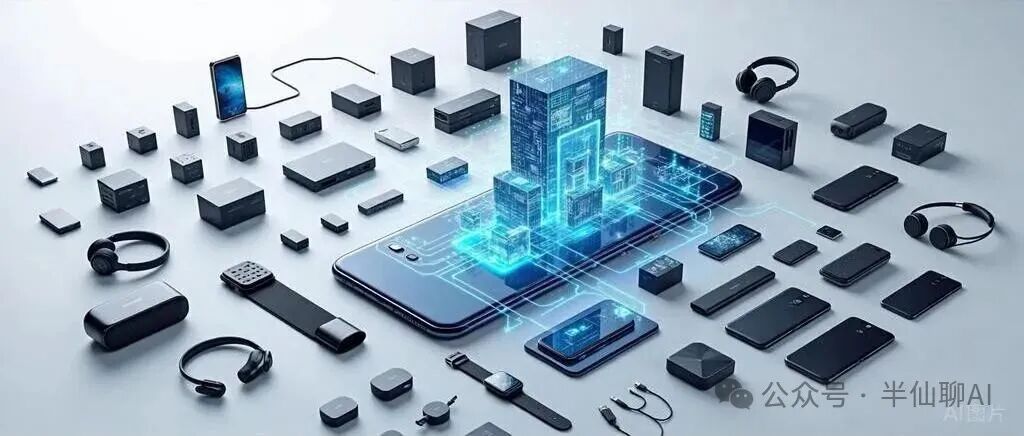
 The wave of AI is fundamentally rewriting the development logic of consumer hardware. The smartphone, once the absolute core, is no longer an isolated terminal protagonist but has diverged into two distinct evolutionary tracks: one extends outward, using the smartphone as a hub to connect various AI peripheral hardware, unleashing the full-scene capabilities of large models; the other upgrades inward, achieving a computer-like transformation through computational leaps, with accessories that closely approach the experience of productivity tools. Both tracks are making strides, not only reconstructing the core value of smartphones but also ushering in a new era of all-scene hardware centered around smartphones.1. Track One: AI Capability Spillover, Smartphones + Peripheral Hardware Unlocking All-Scene IntelligenceThe limitations of smartphones have become the breakthrough point for the explosion of AI hardware. Despite the high portability of smartphones, they are constrained by size, computational power consumption, and interaction forms, making it difficult to carry the full capabilities of large models—complex semantic analysis, real-time multimodal processing, and dedicated scene intelligence cannot be realized solely through smartphones. Thus, the ecological model of “smartphone as the core + AI peripherals as supplements” has emerged, allowing AI capabilities to permeate every corner of life.The core logic of these AI peripheral hardware is “division of labor and cooperation”: smartphones play a central role in computational power, data synchronization, and ecological connection, while peripheral hardware focuses on delivering an exceptional experience in specific scenes through lightweight AI model deployment, accurately releasing specialized intelligent capabilities. Many products have already been launched, and future scenarios will continue to expand:– AI Dedicated Function Terminals: Directly addressing high-frequency single needs, maximizing AI capabilities. For example, AI recording pens leverage smartphone computational power to achieve real-time transcription, semantic extraction, and multilingual translation, generating meeting minutes and interview records with a single click, solving the pain points of insufficient accuracy and cumbersome editing in smartphone recordings; the upcoming AI glasses will enable real-time scene recognition, voice interaction, and information pop-ups without needing to be handheld, responding to commuting navigation, outdoor translation, and daily inquiries, becoming a portable AI assistant; there are also AI reading pendants and AI health monitoring bracelets, focusing on vertical scenes like education and health, carrying dedicated AI services in a lightweight form to fill the gap in smartphone scene-based experiences.– All-Scene Intelligent Interaction: Multi-hardware collaboration forms an ecological closed loop, allowing seamless AI experiences. Smartphones act as data hubs, synchronizing user habits, preferences, and scene information, linking peripheral hardware for intelligent adaptation—an AI watch detects insufficient sleep, the smartphone synchronizes to remind the user to adjust their schedule, and the AI speaker automatically plays soothing music; when going out, AI glasses capture scene information, and the smartphone quickly computes and analyzes in the background, pushing personalized suggestions in real-time. This interaction not only amplifies the value of individual hardware but also constructs an “all-weather, no-dead-angle” AI life experience.Essentially, this track represents the “scene-based disassembly” of AI capabilities, where smartphones are no longer the sole carriers of AI capabilities but become the hub connecting all intelligent hardware, transforming large models from “functions within smartphones” to “ubiquitous services,” allowing everyone to pair dedicated AI hardware combinations based on their needs.2. Track Two: Smartphone Computerization Transformation, Accessories Boosting Productivity ToolsThe leap in smartphone computational power is blurring the boundaries between smartphones and computers. Today, flagship smartphone chip performance has dramatically improved, with CPU and GPU power approaching that of mid-range laptops, and memory and storage capacities continuously expanding. Coupled with the growing array of productivity apps in the Android and iOS ecosystems, core computer functions such as document editing, video editing, and code writing can now be easily handled by smartphones. Smartphones are no longer just communication and entertainment tools; they are accelerating their transformation into productivity terminals.However, the handheld form factor and touchscreen interaction of smartphones mean they cannot directly replace computers—long periods of typing are inefficient, multi-window operations are cumbersome, and precise control lacks tactile feedback. These pain points have become the biggest obstacles to smartphones transitioning into productivity. The model of “smartphone as the main unit + peripheral accessories as supplements” perfectly addresses this issue, allowing smartphones to closely approach or even replace some laptop functions:– Comprehensive Coverage of Basic Office Scenarios: By pairing with keyboards, mice, and docking stations, smartphones can instantly transform into desktop office terminals. Connecting a Bluetooth keyboard and mouse allows document formatting and spreadsheet creation efficiency to rival that of computers; connecting a docking station to an external monitor enables multi-window split-screen operations, allowing users to work on documents while referencing materials, meeting daily office core needs; with cloud synchronization and online office apps, working from home or on temporary business trips can be accomplished without carrying a laptop, as a single smartphone can handle most basic tasks.– Breakthroughs in Advanced Productivity Scenarios: Targeted accessories adapt to professional needs, narrowing the gap with laptops. For video creators, smartphones support high-definition material shooting and professional editing apps, paired with external storage docks to solve material storage issues, and external monitors for precise color grading; for lightweight programming and design needs, a wireless keyboard and touchpad combination enhances operational precision, and some professional apps can now achieve simple code writing and vector drawing; even with portable stands and cooling back clips, stable performance can be maintained during long periods of high-load use, completely replacing entry-level laptop usage scenarios.The core of this track is “form factor supplementation,” where smartphones leverage powerful computational capabilities to master core productivity functions, while peripheral accessories address interaction shortcomings. The combination retains the portability of smartphones while endowing them with productivity attributes, especially suited for light office and mobile office users, gradually diverting the entry-level laptop market.3. Behind the Two Tracks: The Core Value of Smartphones Has Been Completely RestructuredWhether through AI peripheral extensions or computerization transformations, the essence is the value upgrade of smartphones from “single terminal” to “all-scene hub,” hiding three core trends behind it, which also indicate the future direction of hardware development:1. The Core Position of Smartphones is Irreplaceable: Both tracks center around smartphones, fundamentally because smartphones possess three core assets: user data, ecological resources, and computational power foundation. Peripheral hardware is merely an extension and supplement, unable to exist independently from smartphones. In the future, smartphones will remain the absolute hub of the all-scene hardware ecosystem.2. Hardware Competition Enters the Ecological Era: The performance comparison of single hardware is no longer important; the collaborative experience of “smartphone + peripherals” and ecological compatibility have become core competitive advantages. Whoever can build a complete ecosystem of peripheral hardware and achieve seamless interaction between hardware and efficient collaboration of AI capabilities will capture user minds.3. User Needs Determine Hardware Form: The explosion of both tracks fundamentally matches user needs precisely—AI peripherals meet the convenient demands of “all-scene intelligence,” while computerization transformations satisfy the efficient demands of “portable productivity.” In the future, hardware forms will become more segmented, with each scene having its dedicated “smartphone + accessories” combination solution.4. Conclusion: AI + Smartphones, Ushering in a New Era of HardwareOnce, we pursued smartphones with “large and comprehensive” functions; now, AI allows hardware to return to the essence of “specialized and refined” and “cooperative and strong.” The outward-extending AI peripheral track allows intelligence to permeate every aspect of life; the inward-upgrading computerization track enables both portability and productivity. The parallel development of both tracks not only elevates the value of smartphones but also fundamentally changes the market landscape of consumer hardware.In the future, the smartphones in our hands will no longer be isolated devices but the core hub connecting all intelligent terminals—taking AI glasses + smartphones when going out for all-scene intelligent interaction; connecting keyboards + monitors for easy productivity needs; wearing AI bracelets + pendants daily for dedicated services that respond at any time. The hardware ecosystem centered around smartphones is making “all-scene intelligence and all-scene productivity” a reality, and this transformation has only just begun.Do you prefer the explosion of AI peripheral hardware or the computerization transformation of smartphones? Share your thoughts in the comments!Friends interested in AI hardware can join the group for discussions: