We share the latest paper from the National University of Singapore: Large Language Model based Multi-Agents: A Survey of Progress and Challenges, with a link to the paper at the end.
Large Language Models (LLMs) have achieved significant success across a wide range of tasks. Due to the impressive planning and reasoning capabilities of LLMs, they are used as autonomous agents to automatically complete many tasks. Recently, based on the development of using a single LLM as a single planning or decision-making agent, LLM-based multi-agent systems have made considerable progress in complex problem solving and world simulation. To provide the community with an overview of this dynamic field, we present this survey to delve into the fundamental aspects and challenges of LLM-based multi-agent systems. The goal is to provide readers with substantive insights into the following questions:What fields and environments do LLM-based multi-agents simulate? How are these agents configured, and how do they communicate? What mechanisms facilitate the growth of agent capabilities?For those interested in further exploring this field, we also summarize commonly used datasets or benchmarks for their convenience.
 Zhang Changwang, Wang Knowledge
1 Introduction
Large Language Models (LLMs) have recently demonstrated significant potential in achieving reasoning and planning capabilities comparable to that of humans. This capability aligns perfectly with human expectations for autonomous agents that can perceive their environment, make decisions, and respond [Xi et al., 2023; Wooldridge and Jennings, 1995; Russell and Norvig, 2009; Guo et al., 2023; Liang et al., 2023]. Consequently, LLM-based agents have been researched and rapidly developed to understand and generate human-like instructions, facilitating complex interactions and decision-making in a wide range of contexts [Yao et al., 2023; Shinn et al., 2023; Li et al., 2023d]. Timely review papers systematically summarize the progress of LLM-based agents, as seen in [Xi et al., 2023; Wang et al., 2023b].
Inspired by the capabilities of a single LLM-based agent, LLM-based multi-agents have been proposed to leverage the collective intelligence and specialized configurations and skills of multiple agents. Compared to systems using a single LLM-driven agent, multi-agent systems provide advanced capabilities by:
1) Specializing LLMs into individual agents with different capabilities; and
2) Enabling interactions among these diverse agents to effectively simulate complex real-world environments.
In this context, multiple autonomous agents collaborate in planning, discussion, and decision-making, reflecting the cooperative nature of human teamwork in solving problem tasks. This approach leverages the communication capabilities of LLMs, utilizing their ability to generate text for communication and respond to text inputs. Moreover, it also capitalizes on the extensive knowledge of LLMs across various domains and their potential to specialize in specific tasks. Recent studies have demonstrated promising results in utilizing LLM-based multi-agents to solve various tasks, such as software development [Hong et al., 2023; Qian et al., 2023], multi-robot systems [Mandi et al., 2023; Zhang et al., 2023c], social simulation [Park et al., 2023; Park et al., 2022], policy simulation [Xiao et al., 2023; Hua et al., 2023], and game simulation [Xu et al., 2023c; Wang et al., 2023c]. Due to the interdisciplinary nature of this field, it attracts a diverse range of researchers, not limited to AI experts but also including personnel from social sciences, psychology, and policy research.
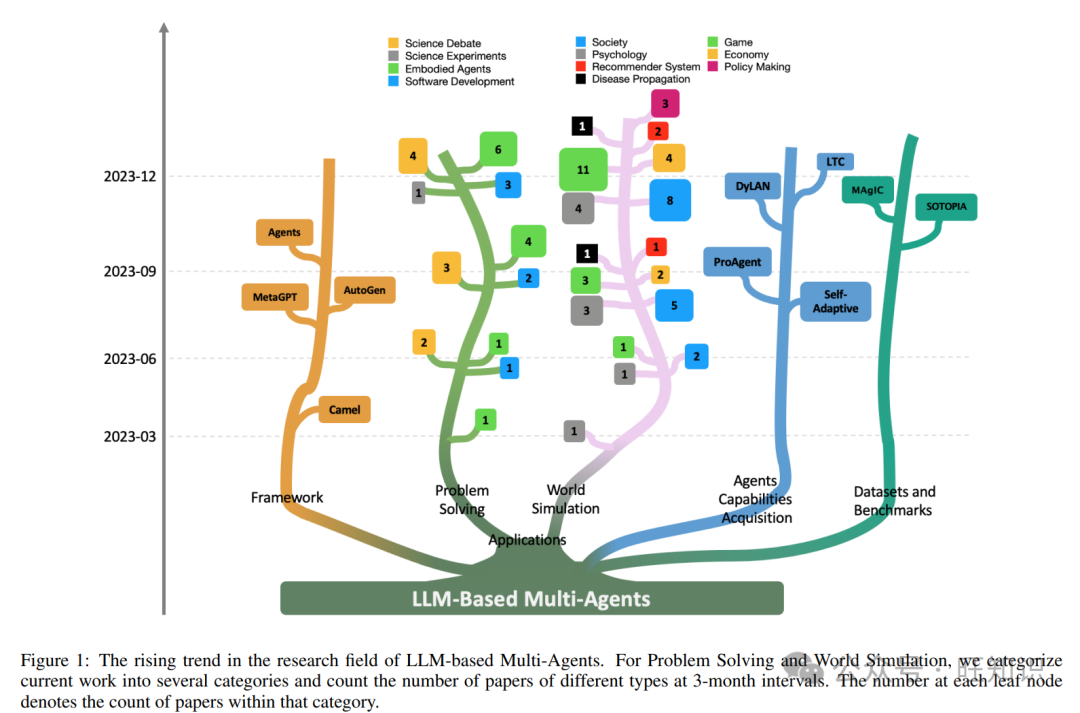
The number of research papers is rapidly increasing, as shown in Figure 1 (inspired by the design of [Gao et al., 2023b]), thereby expanding the impact of LLM-based multi-agent research. Nevertheless, early efforts have been conducted independently, leading to a lack of a systematic review to summarize them, establish a comprehensive blueprint for this field, and examine future research challenges. This underscores the importance of our work and serves as the motivation for us to propose this survey paper, focusing on the research of LLM-based multi-agent systems. We expect our survey to make significant contributions to the research and development of LLMs and the broader interdisciplinary research utilizing LLMs. Readers will gain a comprehensive overview of LLM-based multi-agent (LLM-MA) systems, grasp the fundamental concepts involved in establishing LLM-based multi-agent systems, and master the latest research trends and applications in this dynamic field. We recognize that this field is still in its early stages and is rapidly evolving with fresh approaches and applications. We hope that our survey will inspire further exploration and innovation in this field, as well as applications across a wide range of research disciplines. To assist individuals from different backgrounds in understanding LLM-MA technology and to complement existing surveys addressing unresolved issues, we organized our survey paper as follows. After introducing the background knowledge in Section 2, we address a critical question: How do LLM-MA systems align with collaborative problem-solving environments? To answer this question, we propose a comprehensive framework in Section 3 for positioning, differentiating, and connecting various aspects of LLM-MA systems. We delve into this issue by discussing the following questions:
1) Agent-environment interface, detailing how agents interact with the task environment;
2) Agent configuration, explaining how agents are characterized in specific ways through LLMs;
3) Agent communication, examining how agents exchange messages and collaborate;
4) Agent capability acquisition, exploring how agents develop their effective problem-solving abilities. Reviewing the research on LLM-MA from another perspective involves their applications.
In Section 4, we categorize current applications into two main streams: multi-agents for problem-solving and multi-agents for world simulation. To guide individuals in identifying appropriate tools and resources, we introduce open-source implementation frameworks for researching LLM-MA, as well as available datasets and benchmarks in Section 5. Based on the previous summaries, we initiate a discussion on future research challenges and opportunities in Section 6. The conclusion summarizes in Section 7.
2 Background
2.1 LLM-based Single-Agent Systems
We first introduce the background by outlining the capabilities of LLM-based single-agent systems, followed by the discussion presented in [Weng, 2023].
Decision-making thinking: This term refers to the ability of LLM-based agents to guide through prompts, breaking down complex tasks into smaller sub-goals [Khot et al., 2023], systematically thinking through each part (sometimes exploring multiple paths) [Yao et al., 2023], and learning from past experiences [Shinn et al., 2023] to make better decisions on complex tasks. This capability enhances the autonomy of individual LLM-based agents and strengthens their effectiveness in problem-solving.
Tool usage:The tool usage capability of LLM-based agents allows them to utilize external tools and resources to complete tasks, enhancing their functional capabilities and operating more effectively in diverse and dynamic environments [Li et al., 2023d; Ruan et al., 2023; Gao et al., 2023b].
Memory:This capability refers to the ability of LLM-based agents to engage in contextual learning [Dong et al., 2023a], serving as short-term memory or an external vector database [Lewis et al., 2021] as long-term memory to retain and retrieve information over extended periods [Wang et al., 2023b]. This capability enables individual LLM-based agents to maintain contextual coherence and enhance learning from interactions.
2.2 Single-Agent vs. Multi-Agent Systems
LLM-driven single-agent systems exhibit inspiring cognitive abilities [Sumers et al., 2023]. The construction of these systems focuses on formulating their internal mechanisms and interactions with the external environment. In contrast, LLM-MA systems emphasize diverse agent configurations, interactions among agents, and collective decision-making processes. From this perspective, through the collaboration of multiple autonomous agents, each equipped with unique strategies and behaviors, and communicating with each other, more dynamic and complex tasks can be solved.
3 Analyzing LLM-MA Systems: Interface, Configuration, Communication, and Capability
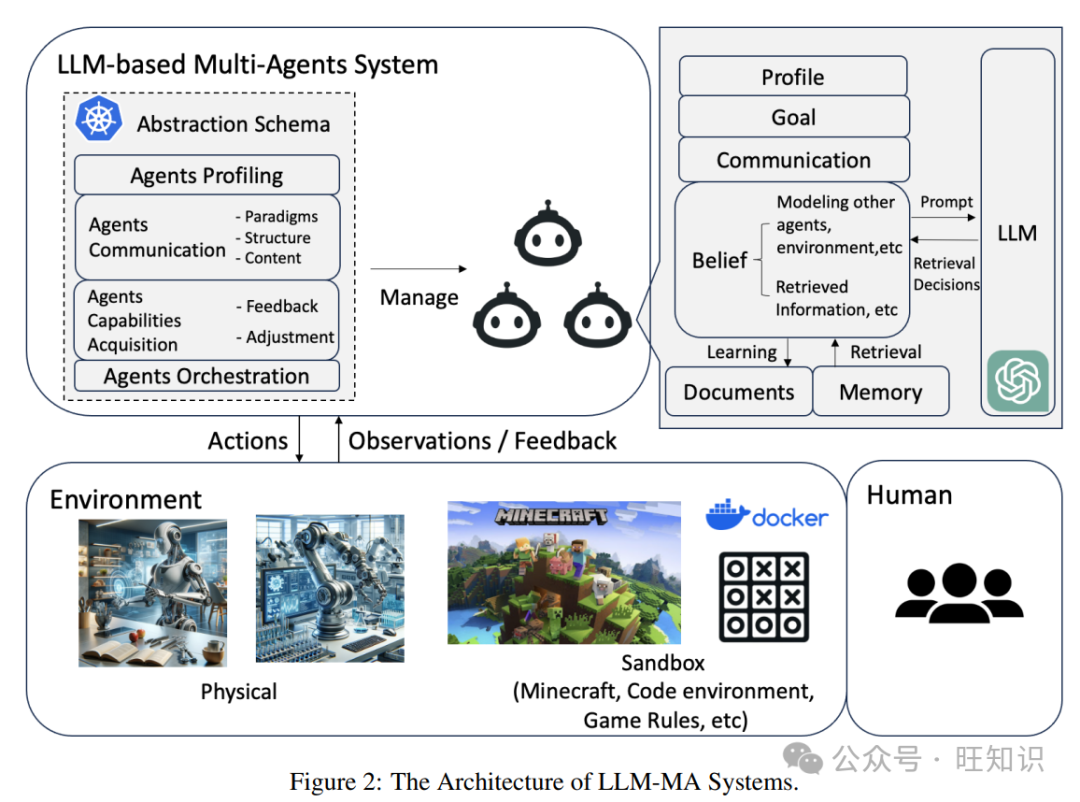
In this section, we will delve into the complexities of LLM-MA systems, where multiple autonomous agents participate in collaborative activities, akin to the dynamics of human groups in problem-solving scenarios. One key question we address is how these LLM-MA systems align with their operational environments and the collective goals they are designed to achieve. To clarify this, we present a general architecture of these systems in Figure 2. Our analysis dissects the operational framework of these systems, focusing on four key aspects: agent-environment interface, agent configuration, agent communication, and agent capability acquisition.
3.1 Agent-Environment Interface
The operational environment defines the specific context or setting in which the LLM-MA system is deployed and interacts. For example, these environments can span various fields such as software development [Hong et al., 2023], games [Mao et al., 2023], financial markets [Li et al., 2023g], and even social behavior modeling [Park et al., 2023]. LLM-based agents perceive and act within the environment, which in turn influences their behavior and decision-making. For instance, in a werewolf game simulation, the sandbox environment sets the framework for the game, including transitions from day to night, discussion phases, voting mechanisms, and reward rules. Agents, such as werewolves and seers, perform specific actions, such as killing or checking roles. After these actions, agents receive feedback from the environment, informing them of the current state of the game. This information guides agents in adjusting their strategies over time, responding to the evolving gameplay and interactions with other agents. The agent-environment interface refers to the manner in which agents interact with and perceive the environment. It is through this interface that agents understand their surroundings, make decisions, and learn from the outcomes of their actions. We categorize the current interfaces in LLM-MA systems into three types: sandbox, physical, and none, detailed in Table 1. Sandbox refers to human-constructed simulated or virtual environments where agents can interact more freely and experiment with various actions and strategies. This interface is widely used in software development (code interpreters as simulated environments) [Hong et al., 2023], games (using game rules as simulated environments) [Mao et al., 2023], etc. Physical refers to real-world environments where agents interact with physical entities, adhering to real-world physics and constraints. In physical spaces, agents typically need to take actions that can produce direct physical outcomes. For example, in tasks such as vacuuming, making sandwiches, packing groceries, and organizing cabinets, robotic agents need to iteratively perform actions, observe the physical environment, and continually improve their actions [Mandi et al., 2023]. Finally, none refers to situations where there is no specific external environment, and agents do not interact with any environment. For example, many applications [Du et al., 2023; Xiong et al., 2023; Chan et al., 2023] utilize multiple agents to debate a question to reach a consensus. These applications primarily focus on communication between agents, without reliance on an external environment.
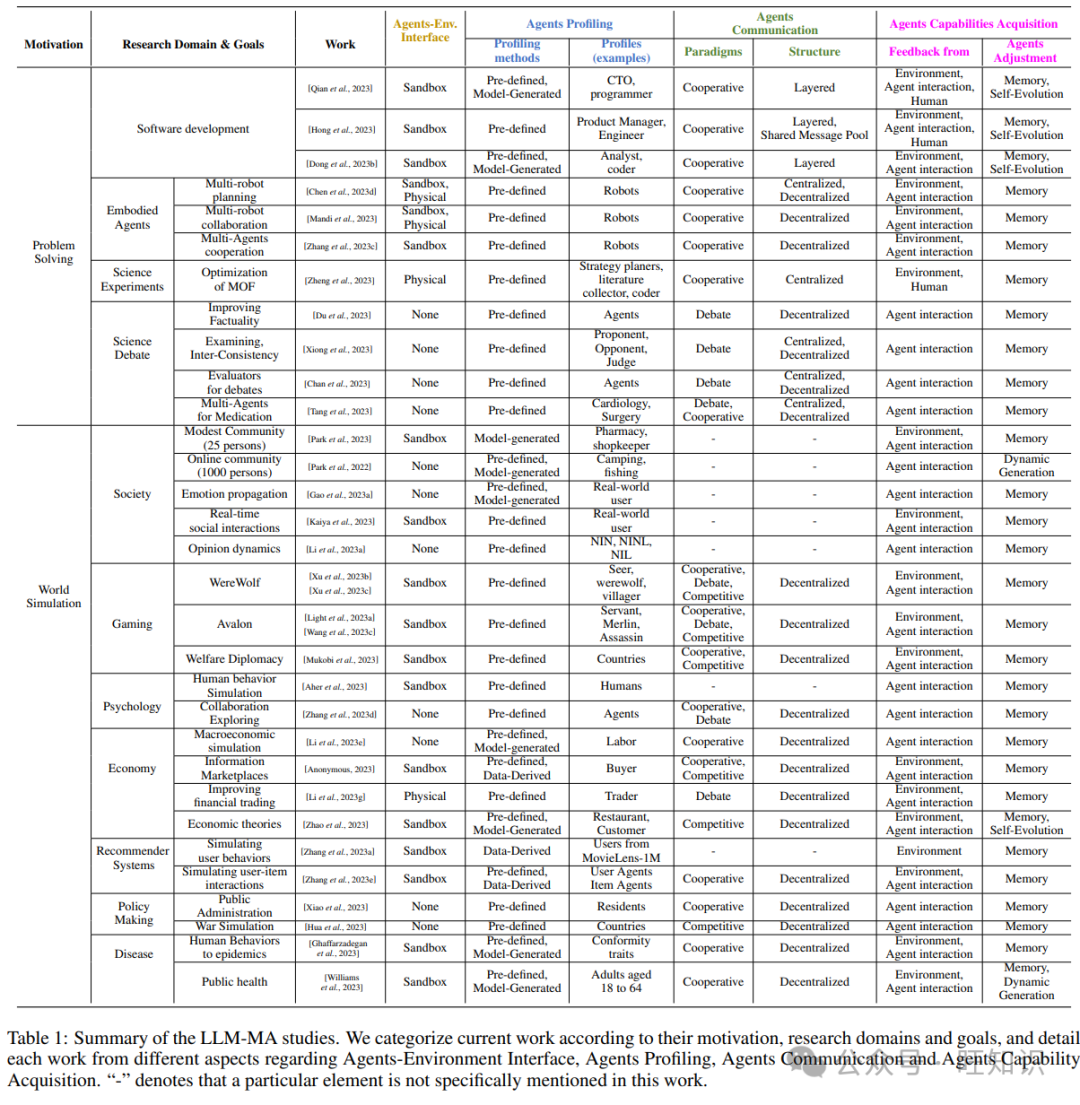 Table 1:Summary of LLM-MA Research.We classify current work based on their motivations, research domains, and objectives, detailing each work from different aspects of agent-environment interface, agent configuration, agent communication, and agent capability acquisition.“-” indicates that a specific element is not particularly mentioned in that work.
3.2 Agent Configuration
In LLM-MA systems, agents are defined by their traits, actions, and skills, all tailored to meet specific objectives. In different systems, agents take on various roles, each with a comprehensive description that includes features, capabilities, behaviors, and limitations. For example, in a game environment, agents may be configured as players with different roles and skills, each contributing to the game objectives in different ways. In software development, agents may take on the roles of product managers and engineers, each responsible for guiding the development process with their expertise. Similarly, in debate platforms, agents may be designated as supporters, opponents, or judges, each with unique functions and strategies to effectively fulfill their roles. These configurations are crucial for defining interactions between agents and their effectiveness in their respective environments. Table 1 lists the agent configurations in recent LLM-MA work. Regarding agent configuration methods, we categorize them into three types: predefined, model-generated, and data-driven. In predefined cases, agent configurations are explicitly defined by system designers. The model-generated approach creates agent configurations through models (e.g., large language models). The data-driven approach builds agent configurations based on pre-existing datasets.
3.3 Agent Communication
Communication among agents in LLM-MA systems is a key infrastructure supporting collective intelligence. We analyze agent communication from three perspectives: 1) Communication paradigms: the styles and methods of interaction among agents; 2) Communication structures: the organization and architecture of communication networks within multi-agent systems; and 3) The content exchanged in agent communication.
Communication Paradigms:Current LLM-MA systems mainly adopt three communication paradigms: cooperation, debate, and competition. Cooperative agents work together to achieve shared goals or objectives, often exchanging information to enhance collective solutions. The debate paradigm is used when agents engage in argumentative interactions, presenting and defending their viewpoints or solutions while criticizing others. This paradigm is suitable for reaching consensus or refining solutions. Competitive agents strive to achieve their own goals that may conflict with those of other agents.
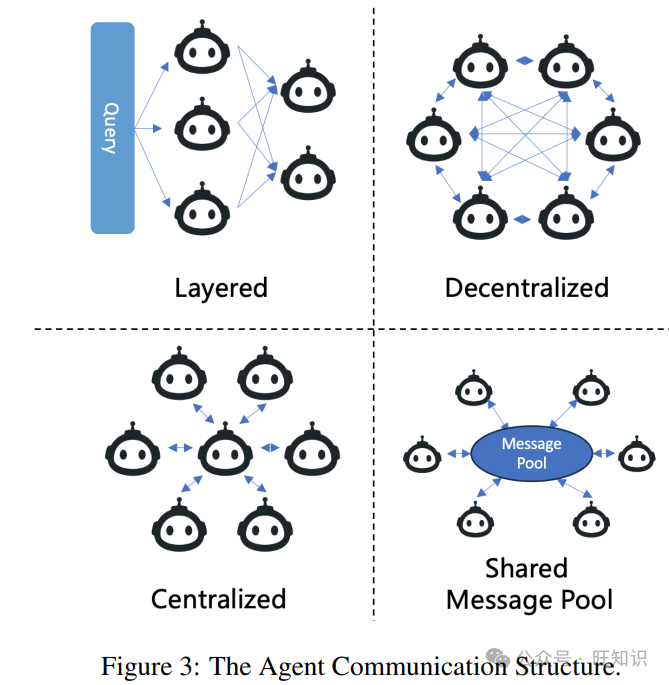
Communication Structure:Figure 3 illustrates four typical communication structures in LLM-MA systems. Hierarchical communication is structured in layers, with agents at each level having different roles, primarily interacting within their own layer or with adjacent layers.[Liu et al., 2023] introduced a framework called Dynamic LLM-Agent Network (DyLAN), which organizes agents in a multi-layer feedforward network. This setup facilitates dynamic interactions and includes features such as agent selection during reasoning and early stopping mechanisms, collectively improving cooperation efficiency among agents. Decentralized communication operates on a peer-to-peer network, where agents communicate directly with each other, a structure commonly seen in world simulation applications.Centralized communication involves a central agent or a group of central agents coordinating the communication of the system, with other agents primarily interacting through this central node.Shared message pools were proposed by MetaGPT [Hong et al., 2023] to enhance communication efficiency. This communication structure maintains a shared message pool where agents post messages and subscribe to relevant messages based on their configurations, thus improving communication efficiency.
Communication Content: In LLM-MA systems, communication content typically exists in text form. The specific content varies widely, depending on the particular application. For example, in software development, agents may communicate about code snippets. In game simulations like werewolf, agents may discuss their analyses, suspicions, or strategies.
3.4 Agent Capability Acquisition
Agent capability acquisition is an important process in LLM-MA that enables agents to learn and evolve dynamically. In this context, there are two fundamental concepts: what types of feedback agents should learn from to enhance their capabilities, and how agents adjust their strategies to effectively solve complex problems.
Feedback: Feedback is critical information received by agents about the outcomes of their actions, helping agents understand the potential impacts of their actions and adapt to complex and dynamic problems. In most studies, the format of feedback provided to agents is text. Depending on the source from which agents receive such feedback, it can be classified into four types.
1) Feedback from the environment, such as from real-world environments or virtual environments [Wang et al., 2023b]. This is common in most LLM-MA problem-solving scenarios, including software development (agents receive feedback from code interpreters) and embodied multi-agent systems (robots receive feedback from real-world or simulated environments).
2) Feedback from agent interactions means feedback comes from judgments made by other agents or from communication among agents. This is common in problem-solving scenarios like scientific debates, where agents learn to critically evaluate and refine conclusions through communication. In world simulation scenarios (such as game simulations), agents learn to refine strategies based on previous interactions among other agents.
3) Feedback from humans comes directly from humans and is crucial for aligning multi-agent systems with human values and preferences. This type of feedback is widely used in most