AI Agents aregoal-driven, minimally human-intervention autonomous software entities, distinct from traditional static rule automation, AI copilots that require prompts, and analytical tools that only provide insights. They can achieve a shift from passive response to proactive defense through contextual awareness. This article focuses on theirsix core use cases in SOC (automated alert triage, autonomous incident investigation, proactive threat hunting, adaptive response, automated MITRE ATT&CK mapping, automated documentation reporting), while also analyzing the four challenges faced during deployment: trust and explainability, human-machine supervision balance, risk of over-reliance, and integration with existing workflows. Finally, it mentionsRadiant Security’s intelligent AI solution, which helps SOCs move towards automated operations through open integration, fully transparent auditing, and autonomous processing capabilities.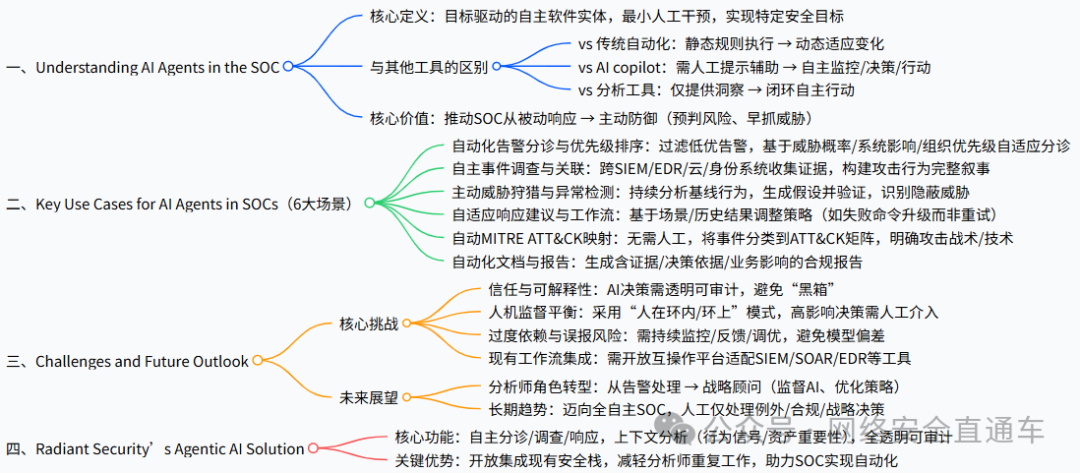
Detailed Summary
1. Understanding AI Agents in the SOC: Redefining SOC Automation
-
Core Definition of AI Agents In the context of cybersecurity operations, AI Agents aregoal-driven autonomous software entities, designed to achieve specific security objectives (such as reducing false positives, accelerating response, and proactively identifying threats) with minimal human intervention. Their core features include:
- Contextual awareness: They can adjust their behavior based on environmental dynamics (such as system impact and organizational priorities);
- Adaptive learning: They iteratively optimize based on historical outcomes rather than relying on static rules;
- Closed-loop action: They can independently complete the entire process of “monitoring → analysis → decision-making → action” without human triggering.
Core Differences from Traditional SOC Tools The table below clearly compares the differences between AI Agents and traditional automation, AI copilots, and analytical tools:
| Tool Type | Core Working Mode | Autonomy | Applicable Scenarios |
|---|---|---|---|
| AI Agents | Goal-driven, dynamically adapting to the environment, closed-loop autonomous action | High (no human triggering required, independent decision-making) | Full-process threat detection/investigation/response |
| Traditional Automation | Executing predefined rule-based workflows (e.g., “alert if port scanning is detected”) | Low (only executes according to rules, prone to failure in complex scenarios) | Repetitive simple tasks (e.g., regular log backups) |
| AI Copilot | Requires human prompts for assistance, such as helping analysts write queries or prioritize | Medium (depends on human triggering, lacks autonomous action capability) | Assists analysts in improving efficiency |
| Analytical Tools | Identifying anomalies/patterns from logs, providing insights only (e.g., “abnormal access frequency from a certain IP”) | Low (no action capability, requires human follow-up) | Initial screening of threat signals |
Transformation of SOC Operational Models Traditional SOCs primarily focus onpassive response (analysts monitor alerts → handle according to fixed manuals), making it difficult to cope with rapidly evolving threats; AI Agents drive SOCs towardsproactive defense:
- Proactive hunting: Continuous analysis of user/endpoint/network baseline behavior to identify hidden threats without alert triggers;
- Accelerated response: Reducing incident handling time from “hours” to “minutes”;
- Mitigating manpower gaps: Filling the gap between automation and intelligence in scenarios with surging alert volumes and insufficient analyst capacity.
2. Key Use Cases for AI Agents in SOCs: Six Core Application Scenarios
AI Agents become capability amplifiers for teams by addressing key pain points in SOC operations, as shown in the table below:
| Application Scenario | Core Pain Point | AI Agents Solution | Value Realization |
|---|---|---|---|
| 1. Automated Alert Triage and Prioritization | Alert overload (high proportion of low-priority alerts), analyst fatigue, real threats being drowned out | Autonomously filtering noise, clustering related events based onthreat probability, system impact, organizational priority, only escalating alerts that require human handling | Releases 80% of alert handling time, focusing on high-risk threats |
| 2. Autonomous Incident Investigation and Correlation | Manual cross-tool (SIEM/EDR/cloud) log retrieval, low correlation efficiency, easy to miss attack links | Automatically collects multi-source evidence, constructsattack narrative (e.g., lateral movement paths, root cause identification), generating actionable conclusions | Investigation time reduced by 70%, conclusion consistency improved |
| 3. Proactive Threat Hunting and Anomaly Detection | Relying on analyst experience, difficult to detect hidden threats without alerts (e.g., insider threats) | Continuously learning baseline behavior, generating threat hypotheses and validating through log queries, only escalating when credible threats are found | Captures 30% of threats missed by traditional methods |
| 4. Adaptive Response Recommendations and Workflows | Static playbooks are difficult to adapt to complex scenarios (e.g., frequent failures of isolation commands for certain devices) | Adjusting strategies based oncontextual scenarios and historical results (automatically escalating failed commands, reinforcing effective steps) | Response success rate improved by 50%, reducing ineffective operations |
| 5. Automated MITRE ATT&CK Mapping | Manual mapping of attack tactics/techniques is time-consuming, affecting threat intelligence implementation and red team exercises | No manual input required, automatically classifying events into the MITRE ATT&CK matrix, clarifying “how the attack occurred” | Mapping efficiency improved by 90%, supporting threat-informed defense |
| 6. Automated Documentation and Reporting | Manual organization of compliance reports (including evidence/timelines/remediation) after incidents is time-consuming and error-prone | Automatically generates reports that meet organizational needs, includingevidence links, decision basis, business impact, supporting audits and reviews | Report generation time reduced from “days” to “minutes” |
3. Challenges and Future Outlook: Deployment Challenges and Future Trends
-
Core Deployment Challenges
- Trust and Explainability: The decisions made by AI Agents (e.g., isolating devices, disabling accounts) need to be traceable to avoid the “black box” problem; the solution is to build a system with “transparent design” that generates auditable action logs and decision bases.
- Human-Machine Supervision Balance: Full autonomy may lead to unexpected risks (e.g., mistakenly isolating core servers); mainstream solutions involve adopting a “Human-in-the-Loop” or “Human-on-the-Loop” model, where high-impact decisions (e.g., deleting data) require human approval.
- Over-reliance and False Positive Risks: If the model training data is insufficient or the environmental adaptation is poor, it may lead to false positives (non-threats marked as threats) or missed detections (real threats not identified); acontinuous feedback mechanism needs to be established to regularly monitor AI performance and fine-tune the model.
- Integration with Existing Workflows: Most SOCs have already deployed tools like SIEM, SOAR, and EDR, and AI Agents need to adapt to complex toolchains; they should be designed based on open, interoperable platforms to achieve data normalization and cross-tool action triggering.
Future Trends: Evolution of Analyst Roles and SOC Models
- Transformation of Analyst Roles: From “alert handlers” to “AI supervisors and strategic advisors“, core tasks include: monitoring AI Agents’ operations, optimizing detection strategies, and guiding AI objectives based on business priorities.
- Skill Demand Upgrade: Analysts need to master skills such as AI model tuning and threat intelligence interpretation, rather than just relying on tool operations.
- Long-term Goal: Fully Autonomous SOC: In the future, AI Agents will take on the majority of daily operational tasks (detection/investigation/response), with human intervention only in exceptional scenarios (e.g., new unknown threats), compliance audits, and strategic decisions (e.g., security resource allocation).
4. Radiant Security’s Agentic AI Solution: Targeted Solutions
Radiant Security’s intelligent AI solution is specifically designed for SOC scenarios, with core capabilities as follows:
- Full-process Autonomous Operations: No reliance on static rules or human intervention, capable of independently completing the entire process of alert triage, incident investigation, and response triggering.
- Contextual Awareness Analysis: Evaluating threats by combiningbehavioral signals, asset importance, and global environmental data to avoid isolated judgments.
- Fully Transparent and Auditable: Generates detailed action logs and decision bases, addressing the pain points of “trust and explainability” and meeting compliance requirements.
- Open Integration Capability: Seamlessly integrates with existing security stacks (SIEM/SOAR/EDR/cloud monitoring) without the need to reconstruct SOC workflows.
- Analyst Empowerment: Reduces repetitive tasks (e.g., alert filtering, report writing), allowing teams to focus on strategic defense (e.g., optimizing threat hunting strategies).
Key Questions
Question 1: What are the core differences between AI Agents and traditional automation tools, and AI copilots in SOC scenarios? How do these differences address the limitations of traditional tools?
Answer: The core differences among the three lie in “autonomy” and “adaptability”, as detailed below:
- Differences from Traditional Automation Tools: Traditional automation relies onstatic rules (e.g., “alert if abnormal access to port 22 is detected”), only able to handle predefined scenarios, while complex or changing threats can lead to failure; AI Agents are based ongoal-driven principles, dynamically adapting to the environment (e.g., automatically escalating when a certain device isolation command fails, rather than repeating execution), addressing the issue of traditional tools being “rigid and inflexible”.
- Differences from AI Copilots: AI copilots requirehuman prompts (e.g., analysts requesting “prioritize this batch of alerts”), lacking autonomous action capability; AI Agents canoperate autonomously in a closed loop (monitoring → analysis → decision-making → action), requiring no human intervention, thus overcoming the limitations of copilot as a “passive assistant” and alleviating the manpower gap for analysts.
These differences enable AI Agents to address core pain points such as “alert overload, complex threats, and manpower shortages” that traditional tools cannot handle, driving SOCs from “passive response” to “proactive defense”.
Question 2: Among the six major use cases of AI Agents in SOCs, which use cases provide the most significant value in alleviating “analyst fatigue” and “improving response speed”? Please explain with specific scenarios.
Answer: The use cases that provide the most significant value in alleviating “analyst fatigue” and “improving response speed” are **”automated alert triage and prioritization”** and **”autonomous incident investigation and correlation”**:
-
Automated Alert Triage and Prioritization:
- Alleviating Fatigue: In SOCs, the proportion of low-priority alerts typically exceeds 80%, requiring analysts to check each one, leading to fatigue; AI Agents can autonomously filter noise, only escalating high-risk alerts (e.g., threats affecting core servers), freeing analysts from the burden of “sifting through massive alerts”.
- Improving Speed: Traditional manual triage requires “viewing alert details one by one → determining priority”, which is time-consuming and error-prone; AI Agents can triage alerts in real-time based on threat probability, system impact, etc., reducing alert handling cycles from “hours” to “minutes”.
Autonomous Incident Investigation and Correlation:
- Alleviating Fatigue: Manual investigations require pulling logs across SIEM, EDR, cloud platforms, and manually correlating attack links, which is repetitive and cumbersome; AI Agents automatically collect multi-source evidence, constructing a complete attack narrative (e.g., lateral movement paths, root causes), eliminating the need for manual operations by analysts.
- Improving Speed: Traditional investigations of certain ransomware incidents may take 4-6 hours; AI Agents can complete evidence collection and correlation in 10-15 minutes, generating actionable conclusions and significantly compressing response time.
Question 3: How can organizations balance “automation efficiency” and “risk control” when deploying AI Agents in SOCs? Please explain with reference to the challenges and solutions mentioned in the article.
Answer: Balancing “automation efficiency” and “risk control” requires focusing on three core areas: “trust building, human-machine collaboration, and continuous optimization”, with specific measures as follows:
-
Building Trust through “Transparent Auditing” to Avoid Blind Automation:
- Challenge: The “black box” decisions of AI Agents (e.g., suddenly isolating core devices) may pose risks;
- Solution: Choose AI Agents with “transparent design” (e.g., Radiant Security’s solution), generating audit logs that include “action content, decision basis, associated evidence”, ensuring that every operation is traceable, allowing analysts to understand AI logic rather than relying blindly.
Adopting a “Human-Machine Collaboration” Model to Control High-Risk Operations:
- Challenge: Full autonomy may lead to unintended consequences (e.g., mistakenly deleting business data);
- Solution: Implement a “Human-in-the-Loop / Human-on-the-Loop” strategy — routine low-risk operations (e.g., alert triage, regular reporting) are completed autonomously by AI; high-impact decisions (e.g., isolating core systems, disabling admin accounts) require human approval, preserving automation efficiency while avoiding critical risks.
Establishing a “Continuous Feedback Mechanism” to Optimize AI Performance and Reduce False Positives:
- Challenge: If AI models are inadequately trained or poorly adapted to the environment, they may produce false positives (interfering with analysts) or missed detections (overlooking threats);
- Solution: Regularly monitor the performance of AI Agents (e.g., false positive rate, missed detection rate), fine-tuning models through analyst feedback (e.g., marking false positive events, supplementing new threat features), upgrading AI from a “one-time deployment” to a “continuously evolving system”, dynamically balancing efficiency and risk.