When the industry is caught in a cycle of competition, true disruptors are using a combination of strategies to open up new opportunities.
By / Da Xiang Talks Smart Home
In conversations with many founders, product managers, and investors in the smart home industry, I often sense a common anxiety: knowing that the industry is rapidly developing, yet struggling to find a precise point of leverage; witnessing a plethora of new technologies emerging, yet unsure how to translate them into sustainable competitive advantages.
After 25 years of deep engagement and practice in the smart home field, I have distilled my observations and thoughts into three core viewpoints, each corresponding to breakthrough strategies at the product, enterprise, and industry levels. These three viewpoints form a complete strategic system, aiming to provide clear pathways for companies at different stages of development.
01 Perceptual Interaction: Elevating Products from “Function Stacking” to “Value Creation”
My first core viewpoint is:A healthy smart home requires a tenfold deployment of sensors, and human-computer interaction must be more emotionally rich and incorporate elements of Chinese culture.
This viewpoint directly addresses the core pain point of current smart home products—severe homogenization and thin user experience. While most companies are still competing on who can connect more devices and who has a more comprehensive app, we need to think about the true value of the next generation of products.
The core value lies in two transformations:
-
Shifting from “passive control” to “active care,” by deploying ten times the current level of sensors, allowing the home environment to truly understand the user’s health status and needs;
-
Transitioning from “cold commands” to “emotional resonance,” by integrating elements of Chinese culture into interaction design, creating a user experience that is warm and relatable.
This viewpoint not only points the way for product development but, more importantly, redefines the value measurement standard of smart homes—not by the number of connected devices, but by the health and emotional value created for users.
For a detailed analysis, please refer to: “The Smart Home Upgrade War: Reconstructing the Future Home with ‘Tenfold Sensors’ and ‘Emotional Interaction'”https://smarthome.qianjia.com/html/2025-11/29_421273.html
02 Innovative Invention: From “Price Competition” to “Value Competition” as the Enterprise Moat
My second core viewpoint is:Innovative invention is the core element for achieving differentiated competition.
In today’s highly mature smart home supply chain, micro-innovations based on public version solutions can no longer form effective competitive barriers. The essence of price wars is a lack of innovation; when companies cannot win the market through unique value, they are forced into a vicious cycle of cost competition.
The industry value of this viewpoint lies in:
-
Providing companies with a concrete path to escape price wars—building a technological moat through patent layout;
-
Redefining the core competitiveness of smart home companies—not as cost control ability, but as continuous innovation capability;
-
Offering investors a new valuation perspective—patent quality, rather than just financial metrics, should become an important basis for assessing corporate value.
As an inventor with over 120 patents, I understand the complete path from idea to patent, from patent to product, and from product to market. Innovative invention is not an unattainable ideal, but a business model that can be systematically practiced.
For a detailed analysis, please refer to: “The Dead End of Price Wars! The Breakthrough Points Behind 120 Patents in Smart Home”https://smarthome.qianjia.com/html/2025-11/29_421274.html
03 Strategic Mergers: From “Linear Growth” to “Leapfrog Development” in Industry Reconstruction
My third core viewpoint is:It is the right time for home appliance companies to acquire smart home companies.
This viewpoint primarily targets traditional home appliance companies, building material companies, real estate developers, and other industry participants seeking intelligent transformation. In the context of rapid AI technology evolution and accelerated industry restructuring, achieving capability completion and ecological layout through mergers and acquisitions has become the most realistic and efficient path.
The practical significance of this viewpoint lies in:
-
Providing traditional enterprises with a clear transformation path and time window;
-
Solving the industry pain point of valuation difficulties for smart home companies;
-
Indicating the direction and rhythm of industry integration.
Based on my accumulation at the Qianjia Brand Laboratory, the “Three-Dimensional Dynamic Valuation Model” I proposed is helping multiple companies complete merger transactions. The core insight of this model is that the value of smart home companies depends not only on their financial performance and technological reserves but also on the degree of alignment with the strategic needs of the buyer.
For a detailed analysis, please refer to: “Only 24 Months Left in the M&A Window! The Life-and-Death Choices of Home Appliance Giants”https://smarthome.qianjia.com/html/2025-11/29_421275.html
04 Upgrading Thinking: The Strategic System Behind Three Keywords
These three viewpoints may seem independent, but they actually form a complete strategic system. For ease of memory and dissemination, I can simplify them into three keywords:Perceptual Interaction—Innovative Invention—Strategic Mergers.
These three keywords correspond to:
-
Building Product Competitiveness (Perceptual Interaction)
-
Creating Enterprise Moats (Innovative Invention)
-
Reshaping Industry Landscape (Strategic Mergers)
For smart home startups, the focus should be on the first two dimensions, creating unique product value and competitive barriers through innovative perceptual interaction and patent layout. For traditional home appliance companies, the third dimension should be the entry point, quickly filling capability gaps through strategic mergers to seize the initiative in industry transformation.
The industry contribution of these three viewpoints lies in:providing a clear thinking framework and action path for companies at different positions and stages of development, helping everyone find their breakthrough point in a complex market environment.
Conclusion
The smart home industry is transitioning from “connectivity competition” to “experience competition,” “innovation competition,” and “ecological competition.” In this process, there is no universally applicable formula for success, only precise breakthroughs based on one’s positioning.
Perceptual interaction defines product value, innovative invention builds enterprise barriers, and strategic mergers reshape the industry landscape—these three levels of thinking may help everyone find their direction in the deep waters of smart home.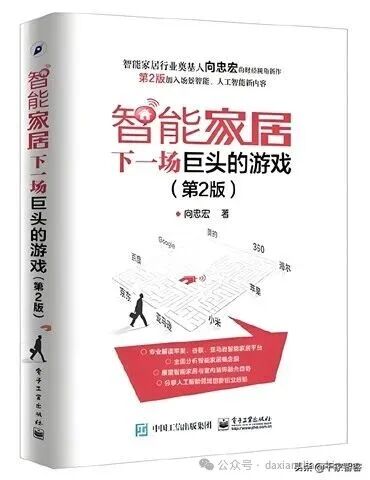
(Author: Da Xiang Talks Smart Home)[Personal Profile]Xiang Zhonghong, known in the industry as “Da Xiang,”the guide for healthy smart homes,focused on: smart home innovative inventions, business models, investment, and mergers.Author of “Smart Home, The Next Game of Giants,”and advocate for healthy smart homes.