Introduction
With the advancement of Industry 4.0, the Internet of Things (IoT), and smart manufacturing, standalone PLCs can no longer meet the complex production demands. They need to efficiently and reliably exchange data with more devices and higher-level management systems. At this point, a key “network hub”—the industrial switch—takes center stage.
Many people believe that connecting a PLC to the internet is sufficient; why add a switch? In fact, this is akin to a city with only one road where every household can pass directly. However, as the number of vehicles (data) increases and intersections (devices) multiply, it becomes necessary to build overpasses and roundabouts (switches) to manage traffic and ensure smooth flow throughout the city (automation system).
This article will delve into specific scenarios where PLC systems must utilize switches, illustrated with examples to help you better understand their core value in industrial networks.
 Key Applications of Switches in Industrial and Everyday Scenarios
As the core device for network communication, switches play an irreplaceable role in many fields, acting as the “traffic hub” of the network, enabling multiple devices to efficiently and stably exchange data. Below, we will detail good examples of using switches in industrial production, smart buildings, intelligent transportation, and education.
1. Automotive Manufacturing Plants
In modern large-scale automotive manufacturing plants, production processes are highly automated and intelligent, involving numerous complex devices and systems that require real-time data exchange with a central control system, where switches serve as the critical link.
For instance, in a body welding production line, the PLC is responsible for precisely controlling the actions of welding robots to ensure the accuracy and quality of the welds. Touch screens are installed at the operators’ control consoles, allowing them to monitor welding parameters such as welding current, voltage, and time in real-time and make necessary adjustments.
At the same time, the management team needs to remotely monitor and manage the entire production process via computers, obtaining production data, analyzing production efficiency, and formulating production plans.
By using switches, the PLC, touch screens, and computers are connected into a local area network. During operation, the welding robots send their operational status and welding parameters to the PLC in real-time.
After processing and analyzing this data, the PLC controls the robots for the next steps based on preset programs and sends critical data to the touch screens and computers via the switch.
Operators can visually see various parameters of the welding process on the touch screens, promptly identifying issues and making adjustments; meanwhile, management can view the operational status of the entire production line on their computers, optimizing and making decisions regarding the production process. Thus, the switch facilitates efficient communication between devices, enhancing production efficiency and product quality in automotive manufacturing.

2. Chemical Production Workshops
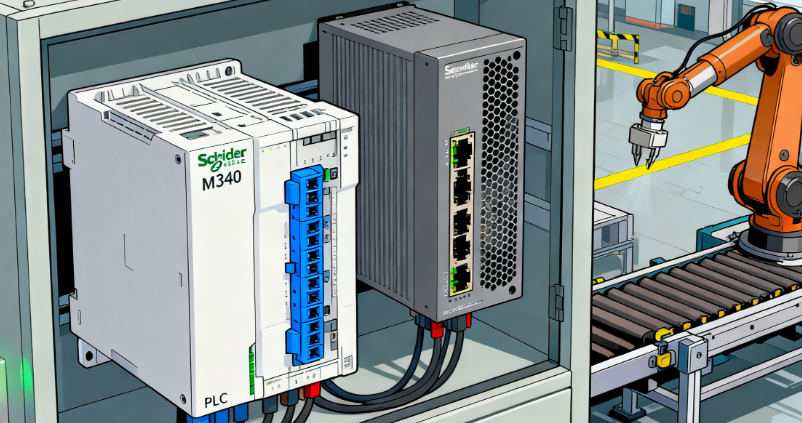
The chemical production process typically features high temperatures, high pressures, and flammable or explosive materials, necessitating stringent control and monitoring of production equipment. In chemical production workshops, various sensors, controllers, and monitoring devices need to collect and transmit data in real-time to ensure the safety and stability of the production process.
For example, during the production process in a chemical reactor, temperature sensors, pressure sensors, and level sensors continuously collect parameters such as temperature, pressure, and liquid level within the reactor and send this data to the PLC.
The PLC controls the operation of heating devices, cooling devices, and feed valves based on these parameters to ensure that the reaction occurs under suitable conditions. Additionally, to achieve remote monitoring and safety management of the production process, computers need to be set up in the workshop’s monitoring room to display the operational status and parameters of the reactor in real-time.
By using switches to connect sensors, PLCs, and computers, a reliable network is formed. The data collected by the sensors is transmitted quickly and accurately to the PLC via the switch, and the processed data is then sent to the computers through the switch.
This way, operators can monitor the reactor’s operational status in real-time from the monitoring room, and if any anomalies are detected, they can take timely measures to prevent accidents, ensuring the safety of chemical production.