Recently, I have dedicated all my time to writing practical tutorials on Structured Text (ST). Why write another book titled “Practical Guide to PLC Programming in Structured Text Language”? In this process, I strive for more data collection and organization, refining each chapter based on my own experiences and summaries.
To document the entire process, I will share some of the content and collected materials in our Hello Industrial Control community.
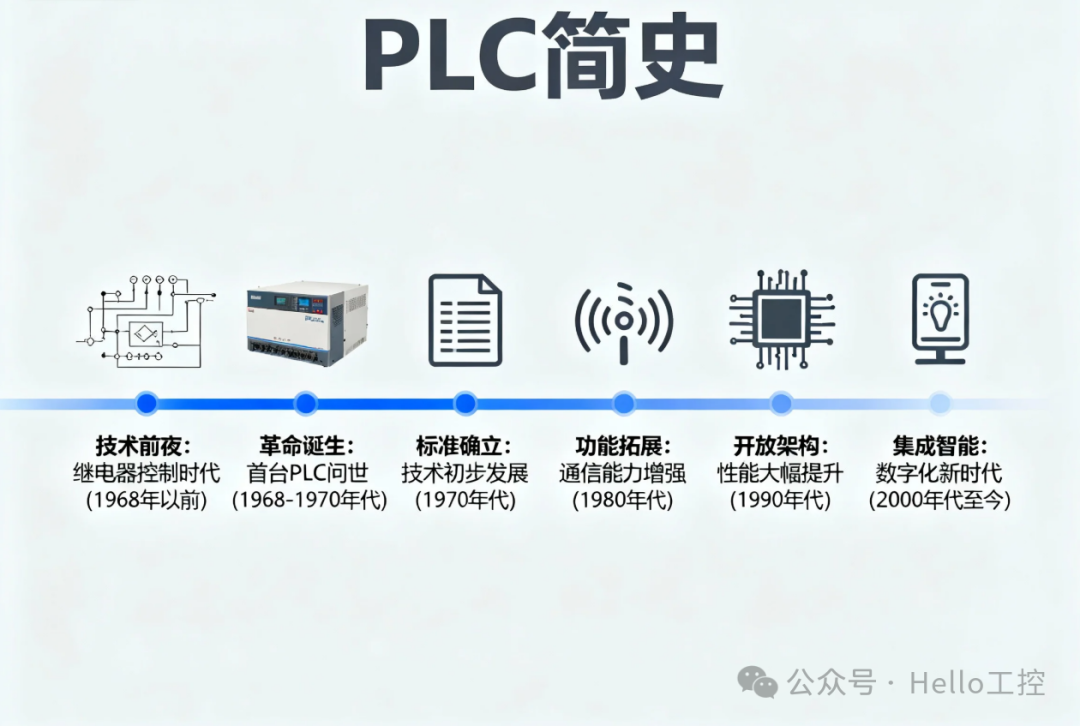
In this issue, we discuss the brief history of PLCs! Let’s talk about where PLCs came from. One of the most important experiences to share in this process is: All technologies and inventions are rough in their early stages, which is a normal pattern. The most important thing is to be brave! At least take the first step.
 Survey
Before we begin our introduction, below is a simple survey about PLCs:

History of PLCs
Undoubtedly, PLCs are one of the core components of machine operation. They are involved in almost every industry in industrial manufacturing, whether in traditional agriculture or modern automotive manufacturing, PLCs are a core part.
To review the history of PLCs, we need to understand the period before 1968, when there were no PLCs. Control systems were not only complex but also fraught with problems, making troubleshooting and maintenance exceptionally difficult.
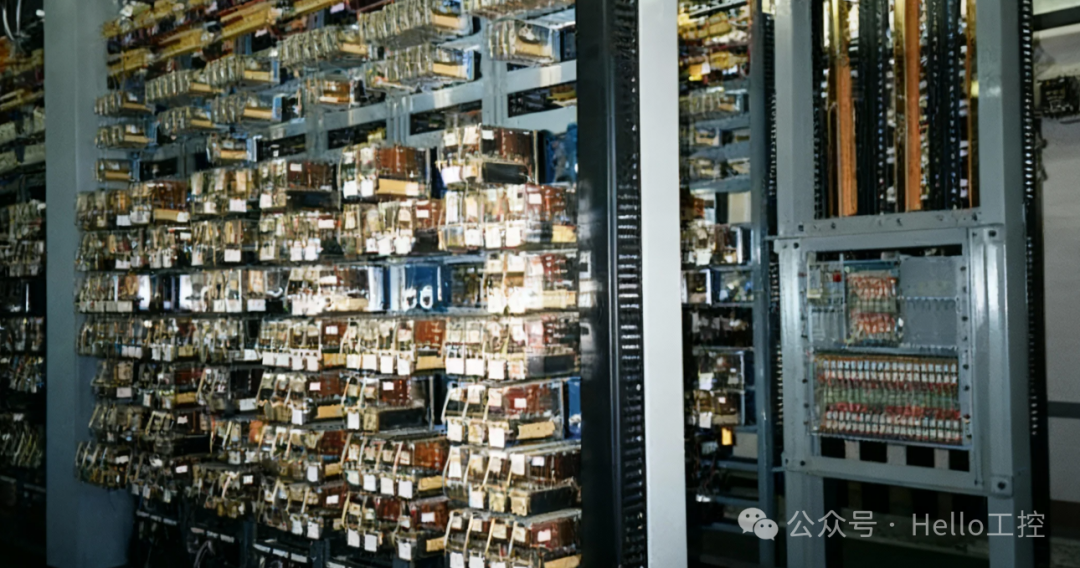
For friends of our age, we basically did not use the method shown in the picture to design the entire control system of the equipment. However, the reality is that before the advent of PLCs, complex control was almost entirely achieved through relay cabinets. Once production requirements changed, the control system had to change as well. When changes were frequent, this became very expensive. Since relays are mechanical devices, they also have a limited lifespan, requiring strict adherence to maintenance schedules.
When many relays are involved, troubleshooting becomes very cumbersome. Now imagine a machine control panel that may contain hundreds or thousands of individual relays, which could be incredibly large. Is the initial wiring of so many individual devices complex? Yes, it is! These relays would be wired individually to produce the desired results. Are there problems? Of course!
Industry demands speed, stability, and ease of maintenance. Based on the aforementioned relay solutions, whether in wiring or debugging, they are certainly not as effective as today’s PLC solutions.
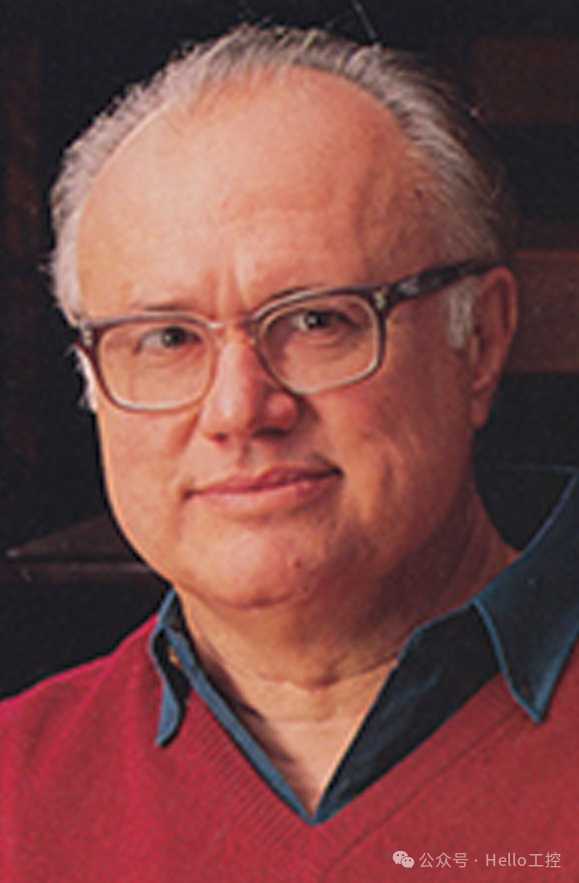
To address these issues, the most prominent solution was proposed by Richard E. Morley, widely known as the “Father of PLCs”.

Richard Morley, the “Father of PLCs”.
Regarding the birth of PLCs, there is a broad saying that in the late 1960s, General Motors sought to upgrade their facilities with solid-state controllers to solve such problems. They proposed a list of requirements for a “standard machine controller”. Dick Morley and his company, Bedford Associates (Bedford, MA), developed the first concept of a PLC in response to this demand. In addition to replacing relay systems, General Motors’ requirements for the controller included:
-
It must be a solid-state system with computer-like flexibility, while being competitively priced with similar relay logic systems.
-
It should be easy to maintain, and the programming method must conform to the widely accepted relay ladder logic method.
-
It must operate reliably in industrial environments filled with dust, moisture, electromagnetic interference, and vibration.
-
It should adopt a modular design for easy component replacement and system expansion.
In fact, at that time, other companies also provided computer-based solutions for this demand, one of which was DEC (Digital Equipment Corporation), which developed the first programmable controller, the PDP-14, in 1969, successfully trialed on General Motors’ production line.
However, Dick Morley’s proposal deliberately omitted the term “computer” to emphasize that it is a Controller, not a Computer. Indeed, from the perspective of PLC development, some PCs can currently replace PLCs to achieve the same functions. However, at that time, the technology and stability of computers were not suitable for complex industrial applications, so the PLC solution was ultimately adopted.
Therefore, after understanding this background, the reason Morley is called the “Father of PLCs” rather than the “Inventor of PLCs” is mainly because he was not the only one involved in the invention. However, due to his core leadership role, he is widely referred to as the “Father of PLCs”!

The First PLC: Modicon 084
The name Modicon comes from the abbreviation of Modular Digital Controller.
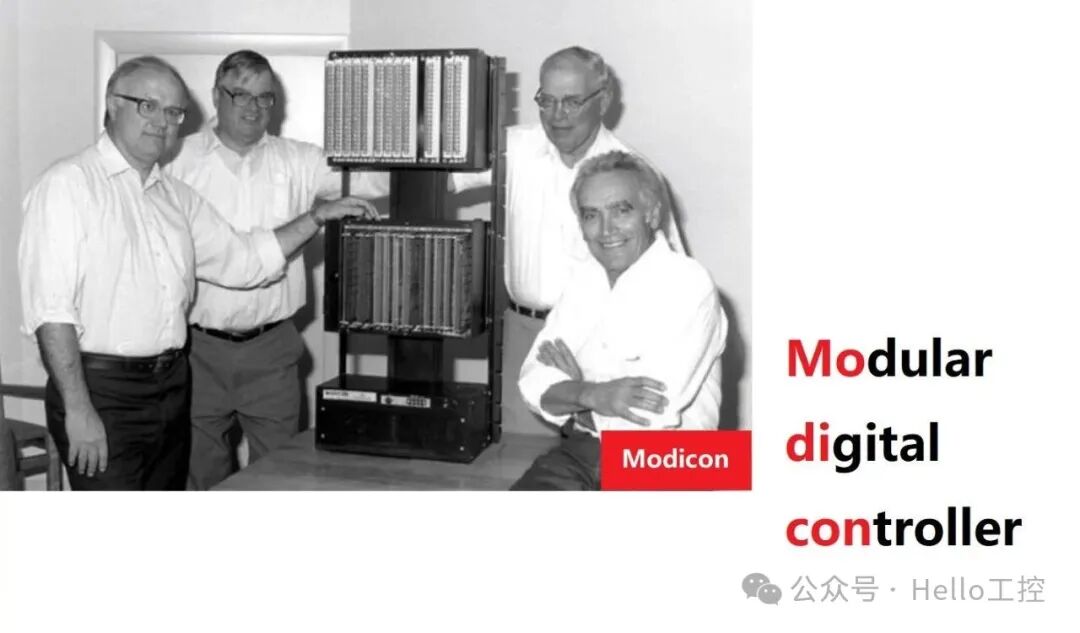
The reason for the 084 model number is that it was the 84th project of Morley’s company, Bedford Associates. To get the project started and operational, the team had to find some financial backers to invest in the project, leading to the establishment of a new company, Modicon (founded on October 24, 1968). Morley remained responsible for the entire Modicon project.
After learning about the project Modicon was undertaking, General Motors eventually ordered PLCs worth one million dollars from Modicon. General Motors received their first batch of programmable logic controllers (PLCs) in November 1969, just a year after Modicon was established and began developing the 084 model.
Shortly thereafter, General Motors decided to order some new programmable controllers. They wanted to label them and sell them as their own OEM units. Ultimately, Bedford Associates disbanded due to tax issues after Modicon truly took off, and later, Modicon was completely sold to Schneider Electric.

Definition of PLC
Here we adopt the definition of a programmable controller (PLC) from the National Electrical Manufacturers Association (NEMA), as follows:
A programmable controller (PLC) is a digital electronic device equipped with programmable memory for storing instructions, which executes specific functions such as logic operations, sequential control, timing, counting, and arithmetic operations to control machines and production processes.
Finally, regarding the historical review of PLCs, do you have more interests? Please leave a message in the comment area!
In the next issue, we will focus on sharing the interview transcript of Dick Morley, the Father of PLCs, including personal experiences, business management, self-evaluation, and life philosophy, etc. Although he has passed away, his name and achievements have long been established as an immortal monument in the automation industry. Stay tuned!

- 【Video Course】Introduction to Codesys V3.5 Series(160 people have learned)
- 【Video Course】Basics of Codesys SoftMotion Control(49 people have learned)
- 【Video Course】Codesys SoftMotion Electronic Gear Course(19 people have learned)
- 【Video Course】Codesys SoftMotion Electronic Cam Course(16 people have learned)
- 【Video Course】Creating Custom Libraries in Codesys(26 people have learned)
-
Efficient, Real-time, Flexible: In-depth Analysis of EtherCAT Bus Technology (Final Part)
-
Comprehensive Analysis of RS232, RS422, and RS485 Serial Communication Technologies (Final Part)
-
Comprehensive Analysis of Modbus Protocol (Final Part)
-
Comprehensive Analysis of Profibus Technology (Final Part)
-
Comprehensive Analysis of Profinet Technology (Final Part)
-
Comprehensive Analysis of EtherNet/IP Technology (Final Part)
-
Comprehensive Analysis of CAN and CANopen Bus Technology (Final Part)
-
Comprehensive Analysis of OPC UA Communication Technology (Final Part)

——–END——–
 Please share and “like” this article if you enjoyed it
 and “see it”