
In the past two years, the rapid advancement of AI technology has provided strong momentum for the development of smart glasses, ushering in an unprecedented period of rapid growth in the AI glasses industry, with global tech giants making their moves. According to IDC data, the global smart glasses market is expected to ship 4.065 million units in the first half of 2025, a year-on-year increase of 64.2%, making it a new favorite in the consumer electronics market. In this fierce market competition, the emergence of Quark AI glasses is truly eye-catching. It includes two series, S1 and G1, with a total of six products, all equipped with Alibaba’s latest Qianwen AI assistant. The former focuses on high performance and all-scenario intelligent interaction, integrating lightweight design, dual battery replacement, dual optical display, and deep integration with the Alibaba ecosystem; the latter emphasizes fashion and portability, lacking a display but sharing the same hardware configuration in terms of chips, acoustics, and photography as the S1.
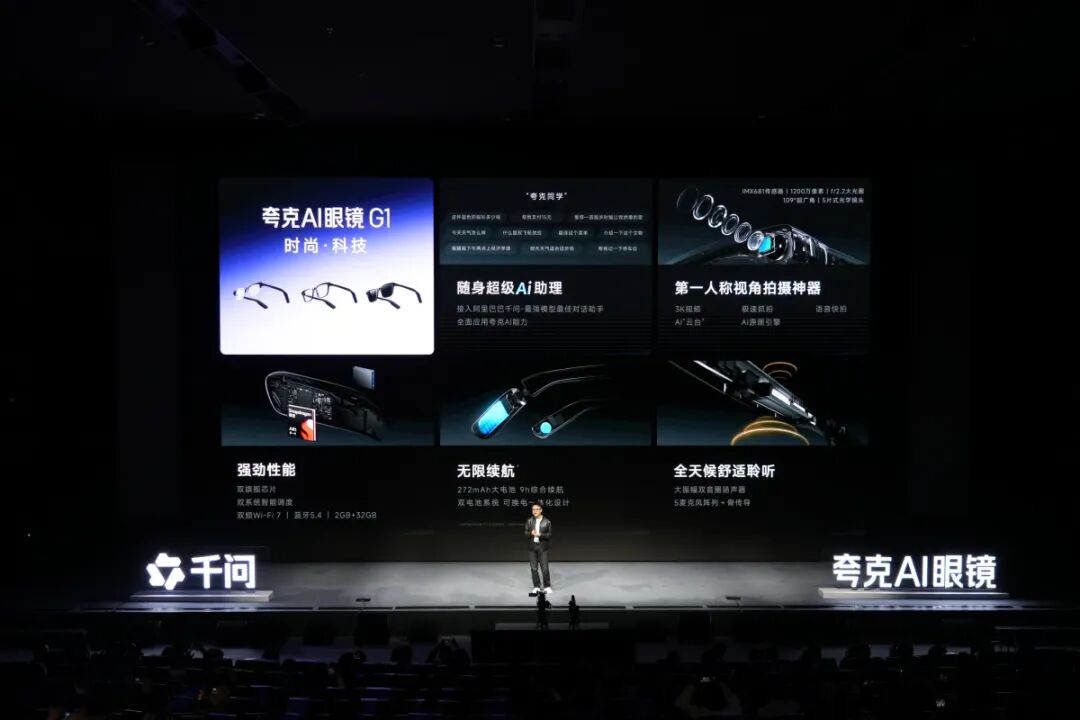
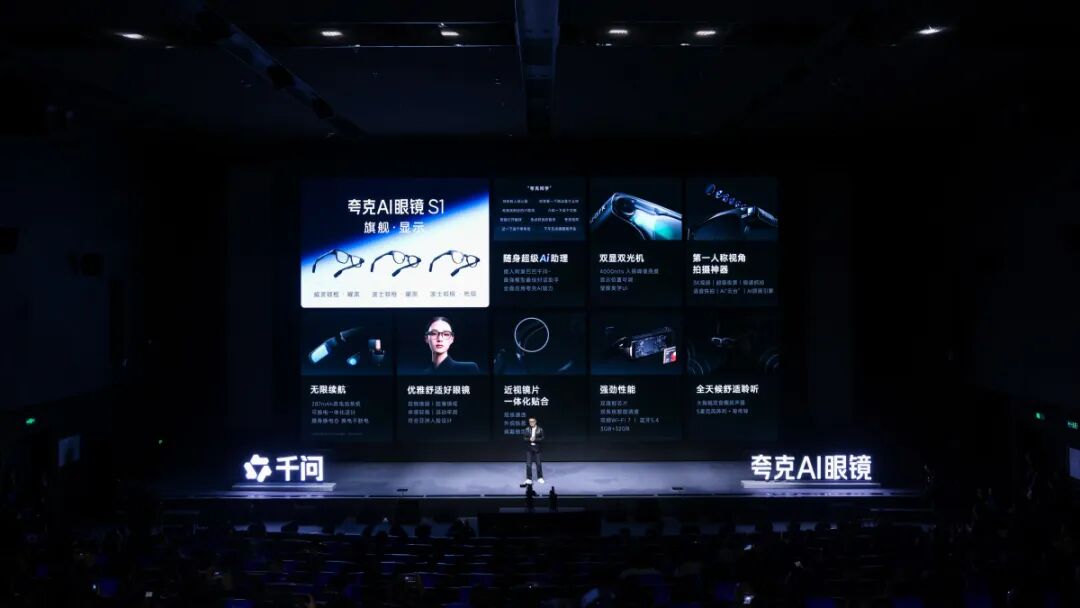
Today, I will focus on the S1 and discuss the highlights and advantages of Quark AI glasses, explaining why they have garnered widespread attention from both the industry and consumers.
Multi-dimensional Optimized Design + Integrated Fitting Lenses
Creating an Ultimate Comfortable Wearing Experience
A good pair of AI glasses must first be comfortable to wear, as they are devices that need to be worn for extended periods. Therefore, the Quark team has put in significant effort to fully consider user comfort and aesthetics.
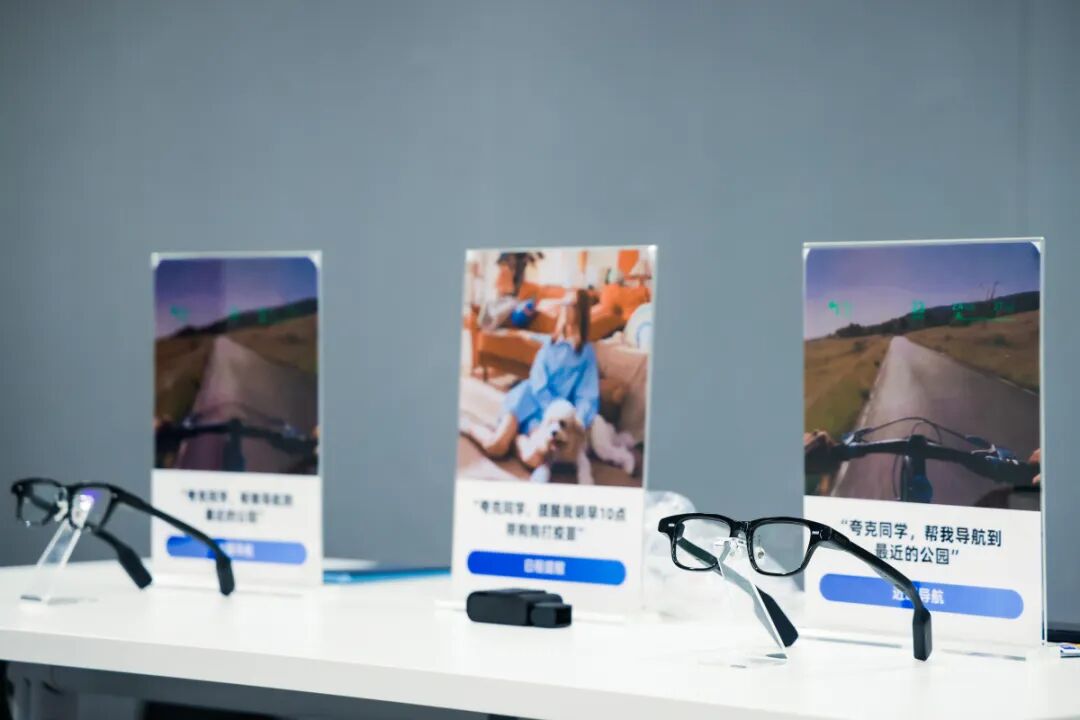
The Quark AI glasses S1 features an ultra-thin temple and frame design, utilizing custom-developed miniaturized speakers and ultra-narrow integrated FPC, resulting in temples that are only 7.5mm wide and a frame that is just 3.3mm thick, making them visually closer to regular glasses. The nose pads and ear bends are designed with a bionic approach, closely matching human curves, and the titanium alloy temples are molded in one piece specifically for Asian head shapes. Additionally, through precise structural optimization, the product achieves a balanced weight distribution of 1:1 front to back, effectively avoiding the “top-heavy” issue, ensuring that even with prolonged wear, the nose bridge does not bear excessive pressure.
In terms of lenses, unlike traditional clip-on or magnetic “external” methods, the Quark AI glasses S1 offers ultra-thin integrated fitting lenses, allowing myopic users to directly overlay their prescription on the lenses, effectively reducing distortion and ghosting, enabling a more comfortable wearing and usage experience for those with myopia.
Flagship Dual Chip + Dual Display Dual Optical Engine
Setting the Benchmark for the AI Glasses Industry
On the hardware front, the Quark AI glasses S1 can be considered an industry benchmark. It adopts a dual-chip architecture with Qualcomm Snapdragon AR1 and Hengxuan BES2800, where the former is a professional-grade processor for mixed reality devices, boasting powerful graphics rendering capabilities and AI computing performance, efficiently supporting real-time calculations for complex AR scenarios; the latter is a low-power voice interaction and sensor fusion co-processor, with a highly integrated design that significantly reduces power consumption while providing strong application processing capabilities. Through software and hardware collaborative scheduling, it achieves a balance between performance and battery life. This dual-chip solution not only ensures a smooth experience in multitasking and AR interactions but also guarantees battery life.
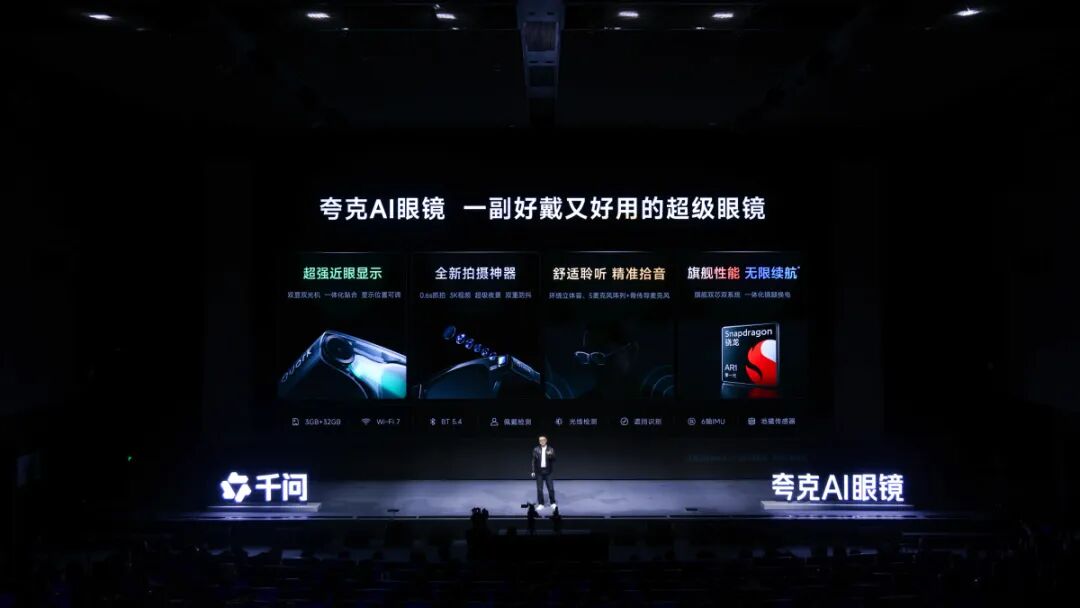
Notably, addressing the pain point of battery life, the Quark AI glasses S1 also innovatively features a dual battery and replaceable design, supporting ultra-fast plug-and-play battery replacement, paired with a MiniBag battery replacement case to achieve seamless “one in, one out” operation, thus ensuring all-day battery performance.
Regarding display, the device is equipped with a JBD single green Micro-LED light engine and a Zhige Technology diffraction optical waveguide, employing a dual optical engine dual-eye display design that conforms to human binocular vision habits, pioneering adjustable image distance and distance settings, with brightness reaching up to 4000 nits, clearly presenting navigation arrows, translated text, and other key information even in bright environments. It also features five microphone arrays and bone conduction technology, enabling more accurate voice pickup and filtering of environmental noise, allowing users to naturally converse with Qianwen in noisy settings like subways and streets.
In terms of imaging, the Quark AI glasses S1 is equipped with a Sony IMX681 flagship sensor and a 12-megapixel ultra-wide-angle lens, allowing the Quark AI glasses S1 to serve as your life recorder. It can achieve rapid capture in 0.6 seconds, 3K video recording, and output 4K video after super-resolution and super-framing, supporting dual stabilization to ensure stable and smooth first-person perspective shooting. Moreover, it introduces Super Raw low-light enhancement technology, bringing mobile-level imaging technology into smart glasses, capturing photos with rich details and true colors.
It can be said that in terms of performance, display, and imaging, the Quark AI glasses S1 does not compromise, setting a benchmark for the AI glasses industry.
Hardware + Large Models + Ecosystem Integration
Becoming a Super Intelligent Assistant
As a smart device, the hardware and technology it carries must ultimately serve the user to be meaningful. Therefore, the Quark AI glasses S1 is deeply integrated with the Alibaba ecosystem. The device is built with the Tongyi Qianwen large model and integrates Quark AI capabilities, supporting natural language interaction, connecting core applications such as Alipay, Amap, Taobao, and Fliggy, creating a full-scenario service covering payment, travel, shopping, and entertainment, becoming your personal super intelligent assistant.
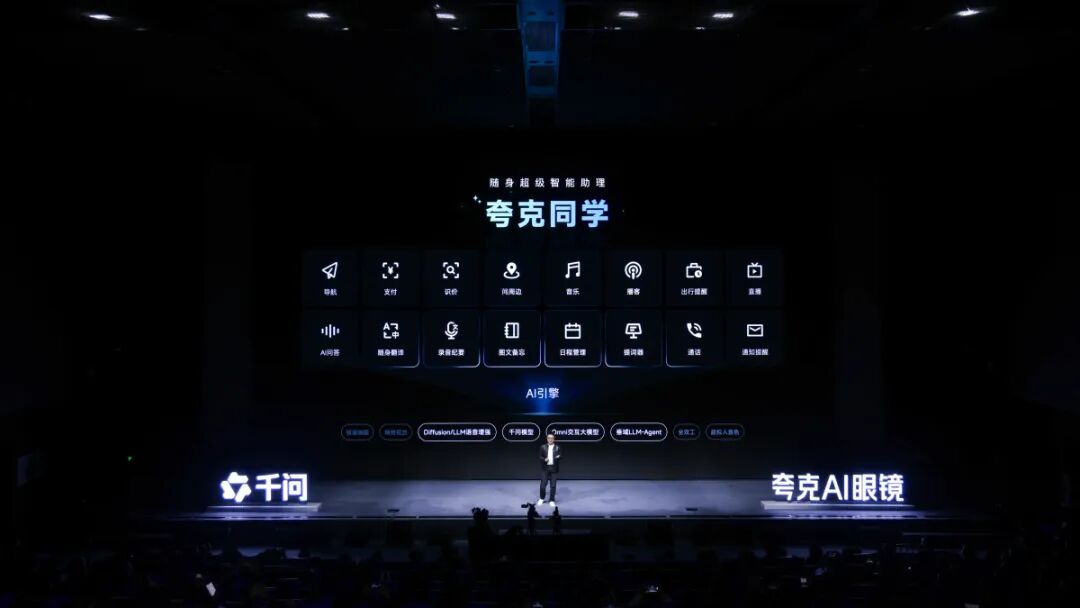
It supports AI Q&A, enabling very natural voice interaction, providing accurate answers, and utilizing the camera for image recognition and image Q&A it can record meeting minutes and supports transcription and translation in four languages, accurately distinguishing speakers, along with intelligent AI summarization for more efficient note organization; it can serve as a memo, allowing for voice dictation and quick photo notes, and can be queried quickly via voice; it supports schedule reminders, allowing you to create multiple schedules with a single sentence, supporting keyword and time-based queries, and adjusting schedules with a single sentence, ensuring you don’t miss anything; the intelligent prompt function allows text to scroll with the voice, compatible with various document formats; it enables first-person perspective live streaming, providing clear and stable visuals for a stronger immersive experience;
In collaboration with Amap, deep customization has been developed to allow navigation to be projected onto the glasses, with directional arrows providing more intuitive guidance, and voice interaction eliminating the need to look down at the phone, making it more convenient and safer; it can also easily search for nearby information through voice, querying surrounding dining, entertainment, and other services; it uniquely integrates the “Pailitao” capability, matching and comparing products on Taobao after recognition; Fliggy itinerary reminders can synchronize flight dynamics, gate changes, and other information to avoid missing flights; Alipay’s “Look and Pay” feature allows for contactless payment by simply gazing at the QR code, completed through bone conduction units and voiceprint verification; it deeply integrates with NetEase Cloud Music and QQ Music to provide a wealth of content for on-the-go listening.
The Quark AI glasses S1, through hardware innovation, large model empowerment, and deep integration with the Alibaba ecosystem, forms a closed loop of “hardware + large model + ecosystem,” becoming a technical benchmark and ecological integration model in the AI glasses field, establishing its differentiated competitive advantage in the AI glasses market.
Final Thoughts
In the wave of AI technology, AI glasses have become a new trend in consumer electronics, and the Quark AI glasses S1 has made its debut with an innovative posture. Through multi-dimensional optimized design, ultra-thin temples, ultra-thin frames, and bionic ergonomic structures, it achieves a comfortable wearing experience, while the integrated fitting lenses allow myopic users to say goodbye to the cumbersome feeling of external clip-ons. On the hardware side, the dual-chip architecture and dual display dual optical engine technology break through performance bottlenecks, complemented by the dual battery replaceable design, balancing computing power and battery life; in imaging, the flagship sensor and low-light enhancement technology make first-person perspective shooting comparable to mobile phone quality. Relying on the Alibaba ecosystem, the deep integration of the Tongyi Qianwen large model and core applications covers payment, travel, shopping, and more, transforming into a personal intelligent assistant. The Quark AI glasses S1, with its closed loop of “hardware + large model + ecosystem,” not only showcases the hard power of technological integration but also centers on user needs, paving the evolutionary path of AI glasses from tools to life partners.
In my personal opinion, the biggest challenge currently facing AI glasses is not technology, but how to truly integrate them into users’ lives, meeting practical usage needs in different scenarios. Simply put, they should not just be a high-tech toy but a very handy tool, transitioning from “geek toys” to “essential tools.” The practice of Quark AI glasses S1 provides a breakthrough idea for the industry, and I hope they can bring more surprises in the future. Looking ahead, as product forms continue to innovate and application scenarios expand, AI glasses are expected to become the next generation of human-computer interaction interfaces. Beyond improvements in display, performance, and imaging, the interaction methods will also evolve from the current model where humans actively seek services and devices passively execute, gradually moving towards devices proactively providing more services, anticipating and meeting needs, thus reconstructing the human-computer interaction relationship from “people seeking services” to “services seeking people.”
