Click the above “Mechanical and Electronic Engineering Technology” to follow usWhen it comes to AI servers, many people may find them mysterious, but in fact, they are composed of various components just like the electronic devices we use in our daily lives, including PCBs—printed circuit boards. PCBs are as crucial in electronic devices as the human nervous system, responsible for connecting electronic components and facilitating electrical and signal transmission. As representatives of high-performance computing, the demand for PCBs in AI servers is naturally on the rise.
Let’s start with a basic concept. A PCB, or printed circuit board, provides electrical connections for electronic components. It is made using electronic printing technology, forming conductive patterns on an insulating substrate according to a predetermined design, ultimately creating electrical connections between electronic components and other parts. In simple terms, a PCB is the nervous system of electronic devices; without it, no electronic device can function properly.
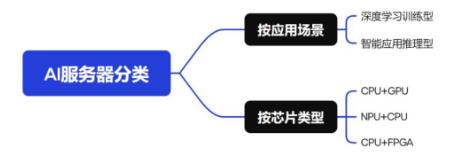
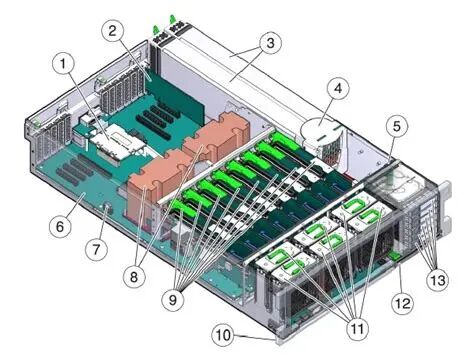
AI servers differ significantly from regular servers in terms of hardware architecture. Regular servers are primarily used for daily data storage, transmission, and application services, with relatively fixed hardware configurations and limited PCB requirements. In contrast, AI servers need to handle a large number of computational tasks, especially complex parallel computations, which require servers to have powerful computing capabilities and high-speed data transmission capabilities. Therefore, the hardware configuration of AI servers is much more complex, leading to a greater demand for PCBs.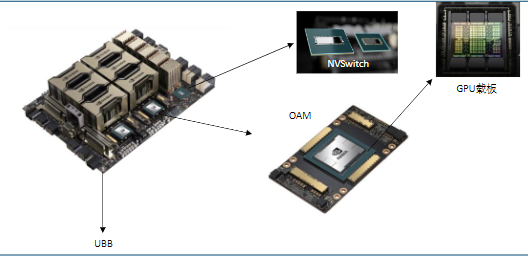 Taking NVIDIA’s DGX A100 as an example, this is a top-tier AI server. By disassembling and analyzing it, we can clearly see the distribution and quantity of its PCBs. The PCBs in the DGX A100 are mainly divided into three parts: GPU board group, CPU motherboard group, and accessories.
 The GPU board group is the core part of the AI server and the area with the highest PCB usage. The DGX A100 is equipped with 8 GPUs, which are connected and communicate through complex PCBs. Specifically, the PCBs in the GPU board group consist of GPU carrier boards, NVSwitch, GPU accelerator cards (OAM), and GPU module boards (UBB). Each GPU requires a carrier board to support it, which not only provides electrical connections between the GPU and the motherboard but also ensures the stable operation of the GPU. According to industry chain research, the value of a single GPU carrier board is approximately $100, so the total value of the GPU carrier boards in the DGX A100 is about $800, equivalent to approximately 5200 RMB (based on an exchange rate of 6.5).
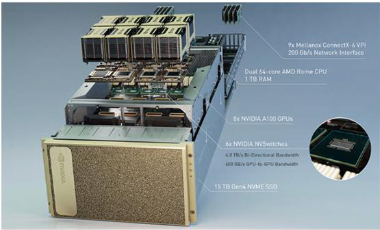
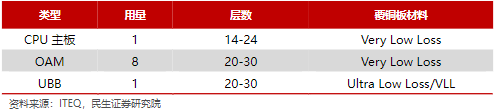
NVSwitch is a basic module used for communication between GPUs based on the NVLink standard. In the DGX A100, each GPU communicates with other GPUs via NVSwitch for high-speed data transmission, enabling efficient parallel computing. The DGX A100 is equipped with 6 NVSwitches, each valued at approximately 195 RMB, resulting in a total value of about 1170 RMB for NVSwitches. The GPU accelerator card (OAM) is a board used to carry GPU chips. In the DGX A100, each GPU has a corresponding GPU accelerator card. These accelerator cards are connected to the motherboard via high-speed interfaces, ensuring fast data exchange between the GPU and CPU. The GPU accelerator cards in the DGX A100 utilize advanced CCL materials and high-level HDI processes, with a unit price of approximately 2880 RMB (calculated based on area and unit price). The GPU module board (UBB) is the PCB board that supports the entire GPU platform. In the DGX A100, there is only one GPU module board, but it carries all GPU components and modules. This module board is designed very complexly, using multi-layer via PCBs and advanced CL materials, with a unit value of approximately 3000 RMB. In total, the value of the GPU board group PCBs in the DGX A100 is approximately 12250 RMB. Among these, the value of carrier board-level products is 6370 RMB, accounting for 52%; the value of PCB-level products is 5880 RMB, accounting for 48%. In terms of area, the PCB usage area of the GPU board group reaches 0.624 square meters, which is a significant proportion of the total PCB area of the machine. Next, let’s look at the CPU motherboard group. The CPU motherboard group is the core component of all servers, containing the CPU motherboard, system memory, network card, PCIE Switch, and other components. In the DGX A100, the PCB usage of the CPU motherboard group mainly consists of CPU carrier boards, CPU motherboards, and various functional boards. These boards not only provide electrical connections between the CPU and the motherboard but also carry various functional boards, such as system memory cards, network cards, expansion cards, and storage operating system driver boards.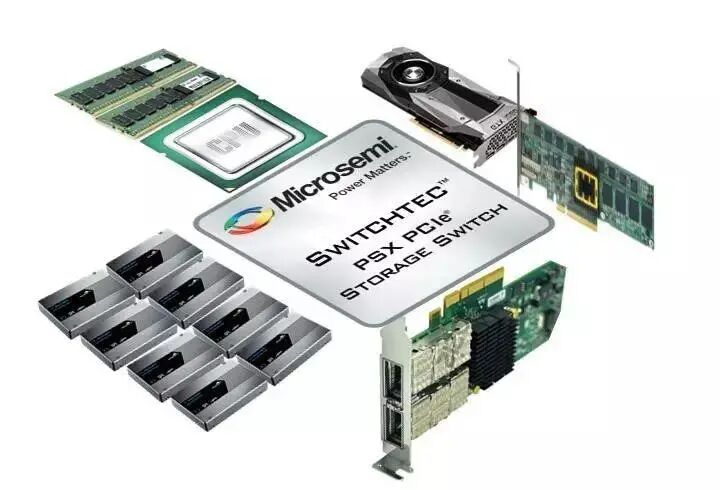 The CPU carrier board of the DGX A100 is similar in specifications to the GPU carrier board. If we calculate the value of a single CPU carrier board at $100 (the DGX A100 is equipped with 2 CPUs), the total value is approximately 1300 RMB. The CPU motherboard is mainly used to carry the CPU chip, PCIE Switch chip, PM module, and various functional boards. The CPU motherboard of the DGX A100 uses 10-12 layers of Low Loss grade CCL materials and via board design, with a unit price of about 1000 RMB/square meter. Based on the estimated size specifications of the DGX A100, the area of the CPU motherboard is 0.38 square meters, resulting in a unit value of 1140 RMB for the CPU motherboard. Adding the value of other functional boards, the total PCB value of the CPU motherboard group is approximately 2845 RMB. In addition to the GPU board group and CPU motherboard group, the DGX A100 also has other accessories, such as fan modules, hard drives, power modules, etc. Although these accessories do not directly participate in computational tasks, they are crucial for the stable operation of the server. The PCB value of these accessories is relatively low, totaling about 226 RMB. In summary, the total PCB usage area of the DGX A100 is 1.474 square meters, with a total unit value of 15321 RMB. The PCB value proportions of the GPU board group, CPU motherboard group, and accessories are 80%, 19%, and 1%, respectively. From the board-level classification perspective, the unit value of carrier board-level products is 7670 RMB, accounting for 50.1%, while the unit value of PCB-level products is 7651 RMB, accounting for 49.9%. A comparison shows that the PCB usage and value of AI servers far exceed those of regular servers. For instance, taking the advanced 2U regular server Huawei 2288HV6 (dual-socket server, PCIE4.0) as an example, we estimate the PCB usage area of a regular server to be 0.630 square meters, with a unit value of 2425 RMB. Comparing regular servers with AI servers represented by the DGX A100, the unit value of PCBs used in AI servers has increased by 532% compared to regular servers, with the incremental contribution mainly coming from computing power demand (95%) and concentration increase (5%). Among these, the unit value of carrier board-level products has increased by 490%, while the unit value of PCB-level products has increased by 580%.
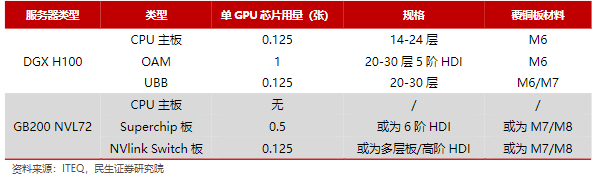
Now let’s look at the more advanced DGX H100 server. The DGX H100 is another top-tier AI server launched by NVIDIA, and its PCB value is even higher. We estimate the PCB usage area of the DGX H100 server to be 1.428 square meters, with a unit value of 19520 RMB. Among these, the unit value of the GPU board group reaches 15700 RMB, accounting for 81%, while the unit value of the CPU motherboard group is 3554 RMB, accounting for 18%, and the unit value of other accessories is 226 RMB, accounting for 1%. From the board-level classification perspective, the unit value of carrier board-level products is 10140 RMB, accounting for 51.9%, while the unit value of PCB-level products is 9380 RMB, accounting for 48.1%. Comparing the DGX A100 and DGX H100, the platform upgrade will increase the unit value of PCBs by 27%, with 83% of the incremental contribution coming from the GPU board group and 17% from the CPU motherboard group, where the unit value of carrier board-level products increases by 32% and the unit value of PCB-level products increases by 23%.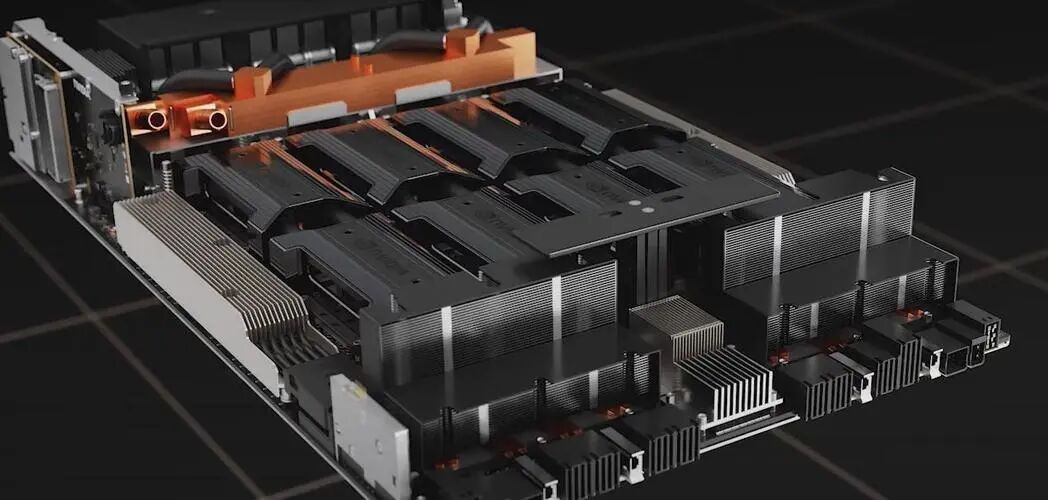 The supply relationships of PCBs in AI servers are also relatively complex. The GPU board group is usually designed entirely by GPU manufacturers, so the supply relationship of the corresponding PCBs is also determined by the GPU manufacturers. The CPU board group follows the existing supply chain relationships of server manufacturers, meaning that the CPU carrier boards are determined by CPU manufacturers, while the CPU templates and the expansion boards required for the entire system are determined by end customers. Other PCB boards with chips are usually designed based on customer requirements, and the functional component manufacturers decide on PCB procurement. Accessories are typically purchased directly from module manufacturers, although in some cases, customers may propose design requirements to accessory module manufacturers, but this does not affect the module manufacturers’ decision-making power regarding PCB procurement. From a market trend perspective, with the implementation of large AI models and applications, the demand for AI servers is increasing, and the market is set to expand. Research institution TrendForce has rapidly raised its forecast for AI server shipments, indicating the hot market for AI servers. Previously, it was expected that AI server growth would be about 8% in 2023, with a compound growth rate of 10.8% from 2022 to 2026, but it was later adjusted to a 15.4% growth in AI server shipments in 2023 and a compound growth rate of about 12.2% from 2023 to 2027. As AI servers accelerate their shipments, the significant increase in PCBs presents enormous opportunities for related companies. The large PCB usage and value in AI servers are closely related to their complex hardware architecture and strong computing demands. From the GPU board group to the CPU motherboard group and various accessories, every part relies on PCB support. As AI technology continues to develop, the hardware configurations of AI servers will become increasingly complex, leading to a growing demand for PCBs. Through the above analysis, we can see that the demand for PCBs in AI servers far exceeds that of regular servers. As the nervous system of electronic devices, the quality and performance of PCBs directly affect the operational efficiency and stability of AI servers. Therefore, when selecting AI servers, we should not only focus on their hardware configurations and performance parameters but also pay attention to the quality of their PCBs and suppliers. Only by choosing high-quality PCB suppliers and suitable hardware configurations can we ensure the stable operation and efficient computing of AI servers.
Want to know more?
Quickly scan the code to follow us