
1. Overview
Industrial robots are automated, reprogrammable, and versatile machines widely used in various industrial fields such as automotive manufacturing, electronics, metal products, and food and beverage for tasks like welding, handling, painting, assembly, and inspection. As a core equipment of intelligent manufacturing, industrial robots are an important indicator of a country’s manufacturing automation and intelligence level, and they are also a key force in promoting industrial upgrading and enhancing international competitiveness.
2. Industry Characteristics
-
Technology-Intensive Industry: It integrates cutting-edge technologies from multiple disciplines such as mechanical engineering, electrical engineering, computer science, and artificial intelligence, resulting in high technical barriers.
-
High Growth and Cyclicality: Benefiting from long-term demographic changes and manufacturing upgrades, the industry shows high growth potential; however, it is also subject to short-term fluctuations influenced by macroeconomic conditions and downstream investment cycles.
-
Expanding Application Fields: The industry is rapidly penetrating traditional automotive sectors into general industries (such as lithium batteries, photovoltaics, warehousing logistics, and semiconductors), continuously raising the ceiling for growth.
-
Strong Industry Chain Synergy: The upstream consists of core components (controllers, servo systems, reducers), the midstream focuses on manufacturing the robots themselves, and the downstream involves system integration, with each segment developing in a complementary manner.
3. Market Status
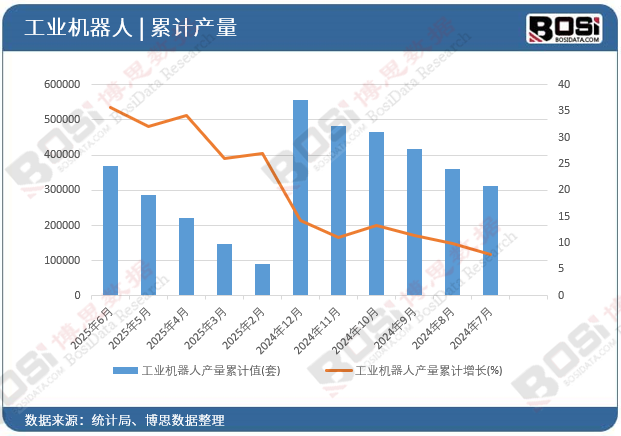
According to the report titled “Analysis of Hotspots and Investment Risk Avoidance in China’s Industrial Robot Market from 2025 to 2031″ published by Bosi Data, it indicates that by the first half of 2025, the cumulative production of industrial robots in China will reach 369,316 units, with a total increase of 35.6% compared to the previous year.
| Indicator | June 2025 | May 2025 | April 2025 | March 2025 | February 2025 |
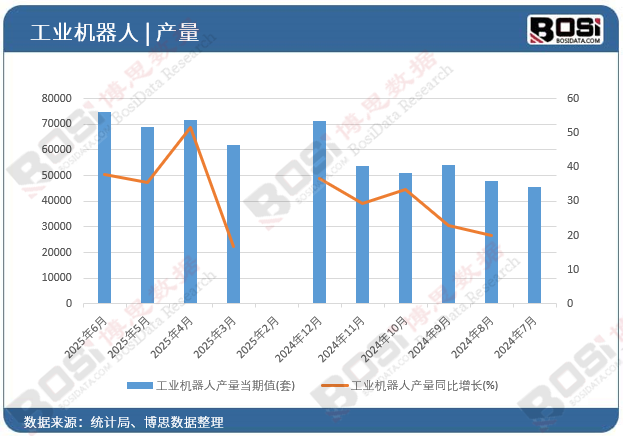
| Current Production of Industrial Robots (units) | 74,764 | 69,056 | 71,547 | 61,906 | |
| Cumulative Production of Industrial Robots (units) | 369,316 | 287,182 | 221,206 | 148,792 | 91,088 |
| Year-on-Year Growth of Industrial Robot Production (%) | 37.9 | 35.5 | 51.5 | 16.7 | |
| Cumulative Growth of Industrial Robot Production (%) | 35.6 | 32 | 34.1 | 26 | 27 |
| For more data, please visit 【Bosi Data Official Website http://www.bosidata.com】 | Data Source: Bosi Data Compilation |
-
High Prosperity and Strong Growth Momentum: The market is currently in a high-speed growth cycle. From January to June 2025, the cumulative production reached 369,316 units, with a significant year-on-year growth of 35.6%. Since the second half of 2024, the cumulative growth rate has continuously climbed from 7.9% to 35.6%, indicating an extremely strong growth momentum.
-
Monthly Production Reaches New Highs, Growth Rate Remains Elevated: Observing the monthly data, the production in April 2025 (71,547 units) was the peak for the first half of the year. The year-on-year growth rate for each month remained high, ranging from 16.7% to 51.5%, with June’s growth rate still reaching 37.9%, indicating strong market demand and a robust willingness for downstream automation investment.
4. Future Trends
-
Evolution of Intelligence and Flexibility: Industrial robots will deeply integrate with AI, machine vision, and force control sensors, evolving from repetitive tasks performed by “blind” robots to intelligent collaborative robots (Cobots) that are adaptive, perceptive, and capable of decision-making, to meet flexible manufacturing needs.
-
Accelerated Localization Replacement: Under the support of supply chain security and national policies, the market share of domestic robots in core components, manufacturing, and system integration will continue to rise, with significant potential for import substitution.
-
Emerging Application Scenarios Exploding: New industries such as electric vehicles, photovoltaics, lithium batteries, healthcare, and services will become new engines driving market growth.
-
Building the “Machine Intelligence+” Ecosystem: Competition among enterprises will shift from single machine sales to providing comprehensive intelligent manufacturing solutions that encompass robots, software, system integration, and services.
5. Challenges and Opportunities
Challenges:
-
Core Technologies Awaiting Breakthrough: There are still gaps in reliability, precision, and performance of some core components such as high-end reducers and high-performance servo motors compared to top foreign products.
-
Intensifying Market Competition: Domestic and foreign brands are competing on the same stage, leading to fierce price competition that challenges the profitability of enterprises.
-
Significant Talent Gap: There is a shortage of interdisciplinary and composite talents in research, application, and maintenance, which restricts innovation and development in the industry.
-
Fluctuations in Downstream Demand: A downturn in the macroeconomy may lead to tightened capital expenditures from some downstream customers, affecting short-term demand.
Opportunities:
-
Rigid Demand for Manufacturing Transformation and Upgrading: National strategies such as “Made in China 2025” continue to advance, and the decline of demographic dividends along with rising labor costs will continue to push the manufacturing industry towards automation transformation.
-
Huge Market Penetration Potential: The density of robots in China’s manufacturing industry still has significant room for improvement compared to developed countries, indicating that the market is far from saturated.
-
Technological Integration Creating New Demand: The integration of new technologies such as AI, 5G, and digital twins is continuously giving rise to new application scenarios and business models.
-
Opportunities for Global Layout: China’s industrial chain advantages are significant, and local enterprises are accelerating their international expansion, leveraging cost-effectiveness and rapid service response to participate in global competition.
6. Investment Recommendations
The industrial robot industry is currently in a golden development period. During this process, Bosi Data will continue to monitor industry dynamics and provide accurate and timely market analysis and recommendations for related enterprises and investors.
“The Analysis of Hotspots and Investment Risk Avoidance in China’s Industrial Robot Market from 2025 to 2031” is meticulously compiled by the authoritative industry research institution Bosi Data, providing a comprehensive analysis of the current industry status, competitive landscape, market trends, and future investment opportunities in the Chinese industrial robot market. This report aims to provide precise market insights and investment recommendations for investors, corporate decision-makers, and industry analysts, helping to avoid market risks and fully grasp industry dynamics.
For the complete table of contents of the report, please click on “Read the Original” below.