Cute plush toys that can change expressions and chat with users; a robotic dog that tells stories and answers questions in real-time, also serving as a “growth companion” for children… In the consumer market of 2025, these interactive and nurturing AI toys are quietly becoming favorites among young people and children. They not only inject new vitality into the traditional toy industry but also serve as a new pivot to tap into a billion-dollar market, attracting various “players” to actively position themselves.
Billion-Dollar New Track
On November 19, the Ministry of Industry and Information Technology held a press conference to introduce the revision of the GB 6675 “Toy Safety” series of mandatory national standards.
He Yaqiong, Director of the Consumer Goods Industry Department of the Ministry of Industry and Information Technology, stated at the conference that the application of artificial intelligence and large models has injected new soul into toy products, significantly enhancing the interactive experience of toys. AI toys that can interact, develop personalities, and have memories are favored by young people and have become a new competitive track in the industry. According to statistics, the market size of AI toys in China is expected to reach approximately 24.6 billion yuan in 2024, and is projected to increase to 29 billion yuan in 2025.
AI toys refer to toys that integrate artificial intelligence technology, enabling them to interact with users through functions such as voice recognition, natural language processing, and emotional analysis, providing personalized learning and entertainment experiences. These toys are not limited to traditional children’s toys but are characterized by intelligent interactivity, personalization, and educational functionality through the incorporation of AI technology.
According to a research report by Yongxing Securities, AI toys are presenting three main forms in the market: dolls/plush toys, smart accessories, and robots/robotic dogs. The doll and plush toy category highly integrates AI interaction functions, such as the “Eye-catching Bag” plush toy launched by ByteDance, which offers users a unique experience. The smart accessory form is more flexible, allowing ordinary toys to gain interactive capabilities when attached, facilitating user dialogue.
With technological advancements, AI toys are evolving from “talking and moving” to “emotional companions,” becoming a new choice for people of all ages seeking comfort and fun. For the children’s market, AI toys focus on intelligent dialogue and educational enlightenment; emotional companionship and nurturing trendy toys are favored by many Generation Z consumers; the elderly market has seen the emergence of companion products that can play old songs and tell historical stories, helping to alleviate memory decline.
“AI toys are not just simple toys; they utilize advanced large language models and multimodal interaction technologies to achieve natural dialogue and emotional interaction with humans,” pointed out a report by China International Capital Corporation. In the context of continuous technological iteration, increasingly diverse consumer demands are creating vast market space for AI toys.
Yongxing Securities believes that AI technology is driving the upgrade of traditional toys towards intelligence and emotionality. AI toys, through technologies such as voice recognition, natural language processing, and emotional computing, not only become companions for children but also take on multiple roles such as education, companionship, and psychological support.
Multiple Players Entering the Market
From an industry perspective, since 2025, the investment and financing heat in the AI toy field has been rising. Data from IT Juzi shows that as of November 17, there have been 21 investment and financing events in the AI toy sector this year, higher than 14 in 2024 and 3 in 2023. Among these, there were 3 billion-level and 9 million-level investments, attracting participation from leading investment institutions such as Sequoia China, GSR Ventures, Longfor Capital, and Shenzhen Capital Group.
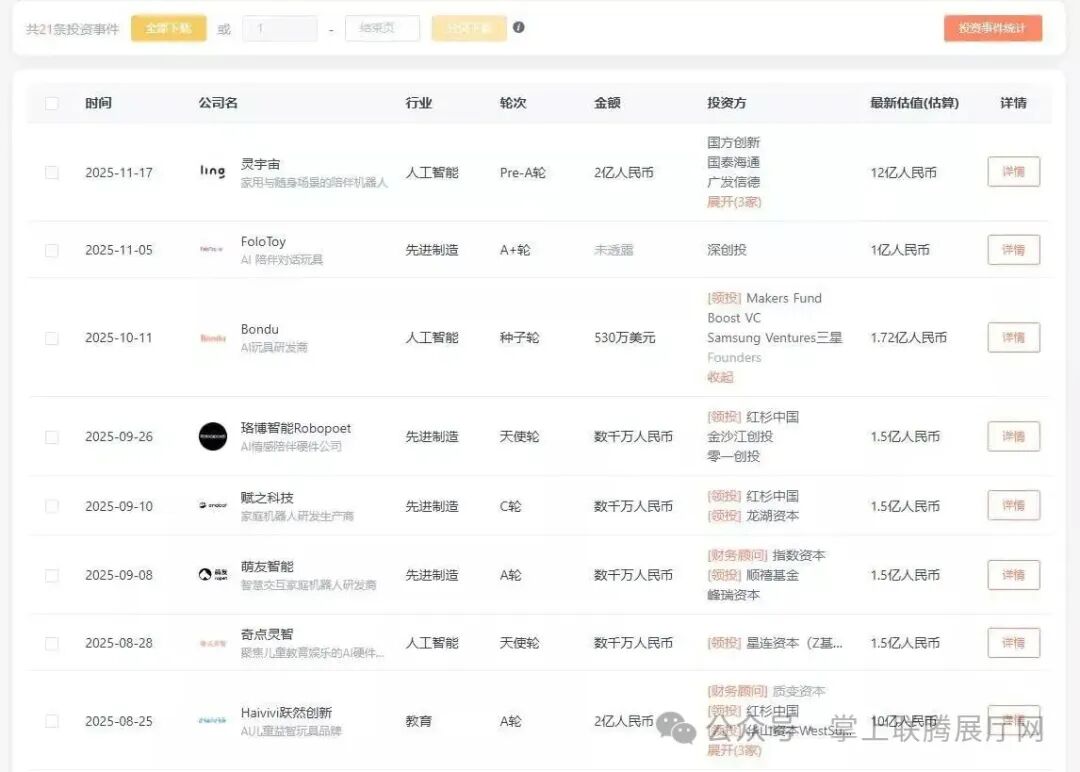
Image Source: Screenshot from IT Juzi official website
Among them, a representative AI toy company, Haivivi, announced in August this year that it had completed a 200 million yuan Series A financing round. This round of financing was led by funds under CICC, Sequoia China, Huashan Capital, and Joy Capital, with participation from Zhaoyin International and continued investment from existing shareholders such as Brizan Ventures, achieving a post-investment valuation of 1 billion yuan.
Public information shows that Haivivi was established in August 2021, and the company launched its first AI dialogue interactive accessory toy, BubblePal, in July last year, priced at 399 yuan. At the FORCE conference held in June this year, co-founder Gao Feng revealed that this toy has sold over 250,000 units.
In the context of the booming development of AI toys, several listed companies in the A-share market are also taking the lead in positioning themselves.
For example, Shifeng Culture, which started by producing toys, has now included “AI smart electric toys” as one of the three main product lines in its toy business. According to the investor relations activity record disclosed on November 18, the company has launched two AI toys, AI Magic Star and AI Flying Rabbit, primarily based on voice interaction.
Regarding AI products under development, Shifeng Culture stated that, with official authorization from Baidu, the company is jointly developing AI toys themed around the Year of the Horse with Baidu Intelligent Cloud; exploring a new model of cross-industry integration of “AI + IP,” deeply binding AI technology with popular IP characteristics such as “Good Baby” and “Piglet,” to create innovative toy products. At the same time, the company revealed that several AI toys compatible with multiple interactive forms, such as desktop AI robots and AI desktop pets, are set to be launched soon.
Companies with IP reserves are also exploring business development boosters through “IP + AI”. For instance, Talking Tom will launch its first-generation AI emotional companion robot product in late December 2024. Its semi-annual report for 2025 shows that the company is gradually building an “hardware + content + service” ecological closed loop based on its self-developed emotional companion vertical model combined with cutting-edge MoE architecture, embedded software, and intelligent hardware.
Alpha Animation, primarily engaged in animation IP and content creation, possesses numerous high-quality IP resources such as “Pleasant Goat and Big Big Wolf” and “Balala the Fairies.” The semi-annual report indicates that during the reporting period, the company mainly developed exclusive AI dolls for characters like Pleasant Goat and Lazy Goat; plans to launch a movable version of the intelligent and fun Big Big Wolf doll in the second half of the year, continuing to enhance the emotional companionship and intelligent attributes of IP characters, while optimizing interaction experience and functionality.
Rongxin Culture, focusing on the planning and publishing of children’s books, stated on October 13 on an interactive platform that it is actively promoting the launch of its self-developed AI smart interactive toys. The company’s AI construction system is accelerating the transformation from technical reserves to scenario-based applications, and the company will promote and sell AI smart interactive toys through various means to provide more families with a more intelligent and fun AI interactive experience.
In addition to toy manufacturers and IP operators targeting the consumer end, many chip and module manufacturers are also launching AI toy solutions, including Rockchip, Espressif Technology, and others.
On November 6, Rockchip stated on an interactive platform that its main chip products are general-purpose SoCs that can be applied to AI toy products, with multiple customers launching AI toy products based on Rockchip’s main control chip.
In January this year, Guanghetong announced the launch of an AI toy large model solution, which deeply integrates AI large models such as Doubao and includes Guanghetong’s Cat.1 module, assisting smart toys in achieving AI upgrades.
Policy Guidance to Promote High-Quality Development of the AI Toy Industry
The rise of AI toys relies not only on technological advancements and capital promotion but also on policy support and guidance.
In 2024, the “Artificial Intelligence +” initiative was first included in the “Government Work Report”; the “Special Action Plan to Boost Consumption” released in March this year explicitly proposed to promote “Artificial Intelligence + Consumption,” opening up a new track for high-growth consumption.
Local support policies have also been introduced. In April this year, the Beijing Economic and Technological Development Zone released the “Implementation Plan for Accelerating the Construction of an All-Area Artificial Intelligence City (2025),” proposing to “accelerate the industrialization of smart hardware such as AI toys and AI physiological monitoring devices in sports, health, education, entertainment, and office scenarios.”
In September 2025, Guangdong Province issued the “Action Plan for Accelerating the Promotion of Artificial Intelligence Empowering the Toy Industry (2025-2027),” clearly stating that by 2027, the province’s toy industry revenue will reach 100 billion yuan, with an AI toy penetration rate of over 30%, enhancing the competitiveness of industrial clusters and cultivating more than five internationally competitive leading AI toy enterprises in Shantou, Dongguan, Shenzhen, and other regions.
While the AI toy industry is ushering in new opportunities, it also faces certain controversies and challenges. CICC’s report highlights that the development of this market is accompanied by significant risks and challenges. The primary issue is the safety and privacy protection of children’s information; secondly, excessive reliance on AI toys by minors may affect their social skills and emotional cognition development.
He Yaqiong stated that the next step for the Ministry of Industry and Information Technology will be to strengthen collaboration with relevant departments to jointly promote the high-quality development of the AI toy industry. First, efforts will be made to ensure policy support. The ministry will work with relevant departments to formulate and release implementation plans to promote the adaptability of supply and demand for consumer goods, guiding toy companies to apply AI technology to create more new demands.
Second, efforts will be made to promote product innovation. Toy companies and AI technology companies will be encouraged to collaborate, integrating market demand insights and the advantages of new technology applications, incorporating more excellent traditional culture into toys, creating more AI toy hits, leading consumption trends, and allowing children to immerse themselves in AI technology and Chinese culture.
Additionally, regarding consumer concerns about data security and network security of AI toys, the Ministry of Industry and Information Technology will work with relevant departments to strengthen research and judgment, guiding toy companies to enhance technical protection while timely researching and formulating relevant standards to effectively ensure the quality and safety of AI toys and data privacy.
Image and Text Source:Network
Copyright belongs to the original author, thanks to the author for their hard work. If there are any copyright issues, please contact us. We will delete it immediately.