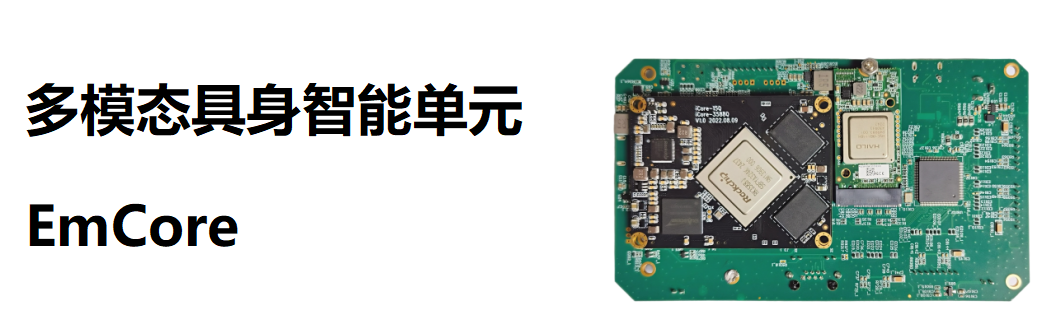

The multi-modal embodied intelligent processing unit EmCore is a high-performance edge computing platform designed for unmanned applications in various industries, offering a fully autonomous and controllable hardware and software ecosystem. This facilitates product companies to quickly implement embodied functionalities in scenarios such as drones, quadruped robotic dogs, humanoid robots, ground unmanned vehicles, unmanned boats, and robotic arms.
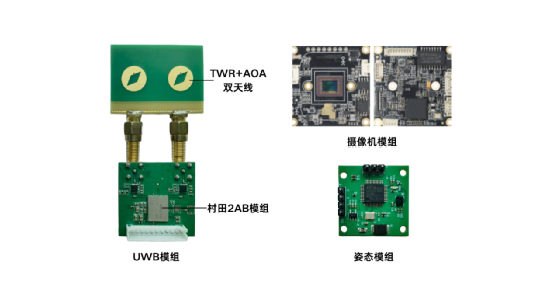
EmCore supports the integration of various perception modules, including mainstream flight control units, high-precision inertial navigation INS modules, UWB high-precision ranging and angle measurement modules, various visible light and thermal imaging cameras, LiDAR, and millimeter-wave radar. It supports real-time control of various intelligent agents, including drones, quadruped robotic dogs, humanoid robots, ground unmanned vehicles, unmanned boats, and robotic arms.
With an open development environment and modular design, an octa-core CPU, and up to 32 Tops of NPU computing power, it provides an edge AI algorithm integration framework, facilitating secondary development and embedding of edge AI algorithms. It offers standard device access API interfaces for quick integration into various unmanned application system management platforms.


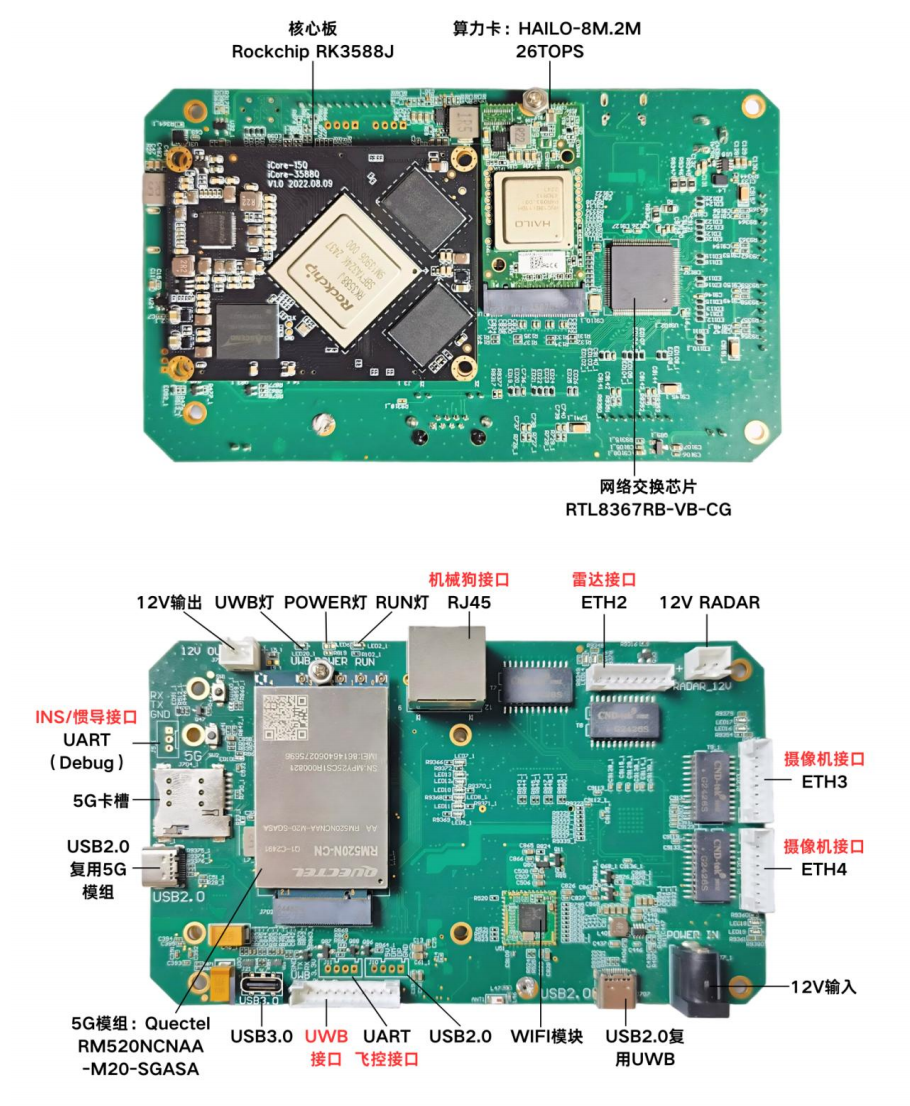
1. Rich interfaces: 4 Gigabit Ethernet ports, 2 USB 3.0, 2 USB 2.0, 2 UART; new version plans for CAN and GMSL2 interfaces.
2. Various wireless communications: 5G cellular, 1.4G/700M self-organizing network, WIFI.
3. Reliable hardware design: Industrial-grade (-25°-75°) / industrial wide temperature grade (-40°-85°) hardware design.
4. Powerful processing capability: Domestic embedded CPU chip with 8 cores/2.4G, built-in image processing and image encoding/decoding VPU, in addition to a built-in 6 TOPs NPU, expandable to 26 TOPs GPU computing card.
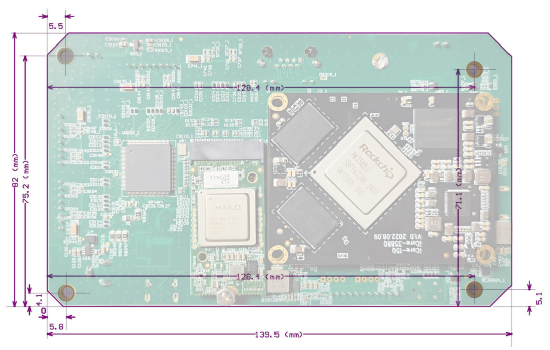
5. Optimal SWaP design: Size – 139.5*82 mm, weight – 100 grams, power consumption – motherboard power consumption 3.6-6W (Jetson Orin Nano 7-15W).
6. Convenience for secondary development: Provides board-level + driver, board-level + application & edge AI framework and external API interfaces, board-level + application & edge AI algorithms and SLAM algorithms and external API interfaces, and various cooperation modes.


1. High-performance edge AI computing power (6+26)T
² Supports mainstream AI model migration and deployment, providing localized AI processing capabilities suitable for tasks such as target recognition and abnormal behavior analysis. It offers an edge AI integration framework for third-party partners to quickly deploy their own algorithms.
2. Remote operation and debugging
² Based on RTTY, it enables remote command line access, file transfer (bidirectional transfer between local and remote), and remote command execution, supporting SSL encryption and device authentication.
3. Multi-scenario adaptation and customization
² Adaptable to industry drone requirements such as explosion-proof, long-range, and no GNSS positioning, supporting hardware and software custom development.
4. Fully domestically produced software and hardware ecosystem
² Processor, operating system (Ubuntu 20.04+ROS1.0), development tools (CMake), etc., all support domestic platforms, meeting autonomous controllability requirements.
5. Open development environment
² Supports cross-platform migration and embedded development (e.g., Jetson Orin, RK3588, etc.), providing friendly interfaces for third-party secondary development and algorithm integration.
6. Cloud collaborative services
² Supports HTTP, MQTT, OSS, streaming media, and other protocols, providing a free debugging software framework for cloud data management and communication.
7. Multi-modal perception and fusion capabilities
² Optional sensors such as LiDAR, visible light cameras, UWB, supporting image and point cloud fusion, AI target detection (e.g., YOLO, SegFormer), and dynamic spatial modeling.

|
CPU Core Board |
Rockchip RK3588J/Industrial grade, 8 cores, 2.4GHz main frequency |
|
Memory/Flash |
8G+64G |
|
NPU |
Supports 6.0T computing power ( core board built-in) Optional 26T computing power (HAILO-8M.2M 26TOPS) |
|
Wireless Communication |
5G cellular module (Quectel RM520NCNAA-M20-SGASA) 1.4G/700M self-organizing network Onboard WiFi-2.4G |
|
Network Switching |
Gigabit switch chip using RTL8367RB-VB-CG, RTL8367RB is a high-performance 5 + 2 port gigabit Ethernet switch in LQFP128 package. Integrated low-power Giga-PHY, each port supports full-duplex 10 / 100 / 1000M. Requires only 3.3V and 1.0V power supply. |
|
Storage |
2TB SSD |
|
Camera Interface |
LAN-2 GE (ONVIF), GMSL2 (planned) |
|
Radar Interface |
LAN-1 GE (ROS) |
|
INS/Inertial Interface |
UART-Serial port baud rate 9600-115200 |
|
UWB Interface |
UART+USB2.0 (TWR+PDOA) |
|
Flight Control Interface |
UART-Serial port baud rate 9600-115200, CAN (planned) MAVLink |
|
Robotic Dog Interface |
LAN-1 GE, TCP/UDP |
|
Indicator Lights |
1*RUN light, 1*POWER light, 1*UWB light |
|
Power Supply |
Power IN-DC 12V supports wide voltage (5V-26V) input Power Out-DC12V/5A terminal-IPC DC12V/7A-Radar |
|
Operating System |
Ubuntu20.04+ROS1.0 or ROS2.0 |
|
Size |
139.5*82mm |
|
Weight |
Approximately 100g |
|
Power Consumption |
Motherboard-3.6W; |
|
Operating Temperature |
-20~70℃ |
|
Operating Humidity |
10~95%@40°C, no condensation |