While your competitors are still competing on price with the same generic solutions, I have built an insurmountable moat with patent barriers.
Written by / Da Xiang Talks Smart Technology
Walking into any smart home showroom, you will feel a profound sense of fatigue: similar voice controls, identical APP interfaces, and almost the same smart panels. The industry seems to be trapped in a cycle of innovation “involution,” with companies struggling in a quagmire of homogenization, leading to continuously shrinking profits.
The root of the problem lies in the fact that too many companies are trapped in the cognitive inertia of “solution integration”, forgetting that the essence of smart homes is “value creation”. As an inventor with over 120 patents, my core viewpoint has always been clear: innovation and invention are the only effective core elements for achieving differentiated competition.
I, Da Xiang Talks Smart Technology, as a leader in healthy smart homes, focus on: smart home innovation, business models, investment, and mergers. In my view, the key to breaking free from price wars and starting a new growth curve lies in the hands of those companies that dare to engage in hardcore innovation.
01 Industry Diagnosis: The Essence of Homogenization is“Inventive Anemia”
The current market competition is a typical case of “pseudo-competition”. What everyone is competing on is not who has more advanced technology or a more unique experience, but who has lower supply chain costs and who has a louder marketing voice. This has led to an absurd phenomenon: the more widespread the technology, the more mediocre the products, and the thinner the profits.
At its core, it is an industry-wide “inventive anemia”.
Companies are accustomed to purchasing ready-made technology modules from solution providers for “assembly”. When an innovative feature appears (such as millimeter-wave radar presence detection), it will become a “standard configuration” for all high-end products within three months. This supply chain-based innovation is fast but fragile, and it cannot form any effective barriers.
The real breaking point lies in shifting to a mindset of “defining products through invention”. This means defining a brand new hardware form, an unprecedented human-computer interaction method, or a unique system approach through independent or joint invention and creation, thereby creating a new, niche market that belongs solely to you.
My patent layout is a practice of this idea. Covering smart homes, multimodal interaction, emotional perception, and virtual testing, they are not isolated functional points but rather an interconnected technological ecosystem. For example, a patent for an “intelligent panel interaction method based on Chinese character elements protects not just an appearance but an entire set of interaction logic and user experience that transforms Chinese cultural symbols into machine instructions. This is the core asset that competitors cannot simply replicate through procurement.
02 Case Analysis: How My Patents Build a“Technological Moat”
Theory is gray, but the tree of patents is evergreen. Let me break down how invention and creation can specifically build competitive barriers through several specific patent layouts.
· Technical Layout Case: Multimodal Emotional Perception System
o This invention is no longer a single technical point but a system architecture. It integrates data from microphone arrays (analyzing voice tone), non-contact sensors (such as millimeter-wave radar monitoring breathing rhythms), and environmental sensors (such as light and temperature) to comprehensively assess the user’s emotional state.
o Market Application: This system allows smart homes to evolve from “responding to commands” to “perceiving emotions”. When the system detects that the user is in an anxious state, it will automatically adjust the lighting to a soothing color temperature, play calming music, and even release relaxing aromatherapy. This invention endows smart homes with “emotional intelligence”, creating a huge product premium space.
· Market Application Case:“Carboniferous” Series Cultural Intelligent Panels
o This is not just a single patent but a patent portfolio. It covers appearance design, UI interaction design, and underlying control logic. We have solidified Chinese characters such as “Xu”, “Yue”, and “An” that contain specific scenes and emotions into an intuitive one-button interaction protocol.
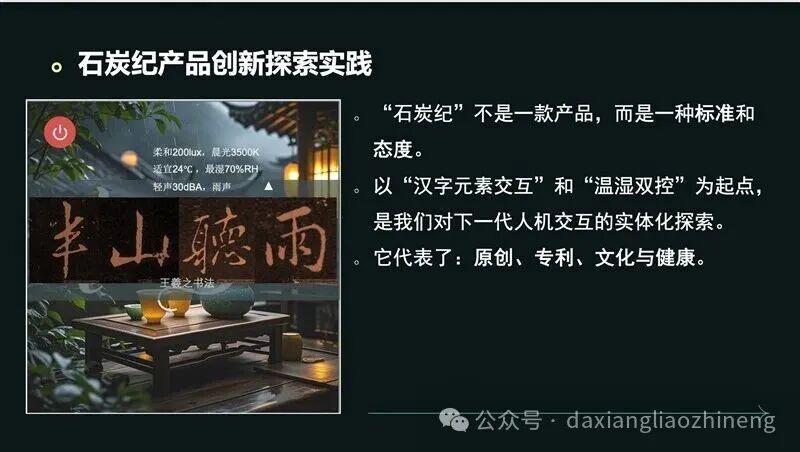
o Technical Value: It addresses the pain point of complex operations in smart homes while injecting a strong sense of cultural identity. For high-end residential and boutique hotel projects, this product, which combines extreme simplicity with cultural taste, is the most powerful weapon to break free from price wars. This is the cornerstone of our collaboration with partners to promote the “Healthy Smart Home Brand Plan”, where we deliver not just products but a unique market solution protected by intellectual property.
· System Method Case: Virtual Testing Method for Smart Home Systems
o This invention may seem far from the user, but it determines the innovation efficiency of enterprises. It constructs a digital twin home in a virtual environment to simulate various device interactions, user behaviors, and network conditions, thereby identifying logical flaws and experience gaps early in product development.
o Core Value: It shortens the product testing cycle from “months” to “days”, significantly reducing the cost of trial and error in innovation. This methodology is what I deeply share with core partners in the “Healthy Smart Home AI Innovation High-End Study Camp”, aiming to enhance the innovative foundational capabilities of the entire industry.
03 Path Planning: Differentiated Innovation Breakthrough Points for Three Types of Enterprises
Recognizing the importance of invention, companies need to find their own innovation paths. Depending on the size and resources of the enterprise, I usually recommend three strategies:
For startups and technology teams: Focus on breakthrough points to become “invisible champions”.You don’t need to do everything. You can focus on an extremely niche scenario (such as “children’s sleep health monitoring” or “kitchen safety automation”), and conduct in-depth application layer development based on one or a series of my foundational patents. Your task is to create a sharp “technical dagger”, not to build an aircraft carrier. Become the technology supplier that large companies or our “Brand Plan” are eager for, which is far more valuable than competing in the red ocean market.
For growing smart home companies: Build a patent portfolio and define your track.Once you have a certain market foundation, the strategic core should shift from “product thinking” to “ecosystem thinking”. What you need is no longer a single patent but a patent portfolio that can protect your business model. This includes core product patents, interaction method patents, and even business model patents. At this point, establishing a deep binding with me, inviting me to be your “Chief Strategic Partner for Healthy Smart Homes”, allows me to use all my technical insights and patent assets to safeguard your strategy, jointly planning the technology roadmap and building insurmountable barriers.
For home appliance giants seeking transformation: Quickly acquire innovation capabilities through strategic cooperation or mergers and acquisitions.Your advantages lie in brand, channels, and supply chains. Your disadvantage may be agility and culture in innovation. The most effective strategy is not to develop from scratch but to collaborate with innovative platforms like ours or directly acquire technology teams with core patents to internalize innovation capabilities. You can view me as your “external CTO” and “strategic telescope”, scanning technology trends, evaluating acquisition targets, and ensuring that every major decision you make is based on a solid intellectual property foundation.
Conclusion
The end of price wars is desolation, while the end of invention and innovation is an endless blue ocean. My 120 patents are not just certificates but navigational charts leading to different futures.
The competition in smart homes is that the first half is about “competition in connectivity””, while the second half is destined to be about “competition in invention and knowledge””. Only those companies that place innovation and invention at the strategic core will have the right to define market rules, rather than struggling to survive under rules set by others.
Now, it is time to reassess your strategic map.
(Author: Da Xiang Talks Smart Technology)【Personal Profile】Xiang Zhonghong, known in the industry as “Da Xiang”, leader in healthy smart homes, focused on: smart home innovation, business models, investment, and mergers. Author of The Next Game of Giants in Smart Homes, and advocate for healthy smart homes.