
Introduction: As one of the important components of the 2024 Service Trade Fair, the National Health Commission’s Health Channel (CHTV) will hold the “2024 Capital International Medical Conference Parallel Forum – Smart Medical and Medical Artificial Intelligence Innovation Forum” in Beijing on September 13. CHTV & Medical Forum Network will bring you a series of reports on AI empowering healthcare.
01
▼
Introduction by Academician Zhang Xu
On June 7, 2024, Academician of the Chinese Academy of Sciences, Professor Zhang Xu, Director of the Urology Department at the Third Medical Center of the PLA General Hospital, led a team to participate in the European Laparoscopic and Robotic Surgery Challenge Conference in Rome, Italy, where they successfully completed and demonstrated the“longest-distance” remote radical prostatectomy across the Eurasian continent. At the upcoming “2024 Capital International Medical Conference Parallel Forum – Smart Medical and Medical Artificial Intelligence Innovation Forum” in September, Academician Zhang Xu will deliver a keynote report titled “New Advances in Remote Urology and Artificial Intelligence“. Before the forum, let us learn about robotic surgery and Academician Zhang Xu’s achievements in this field.

Academician Zhang Xu
Academician of the Chinese Academy of Sciences, Chief Physician, Professor, Level 2 Professional Technician, Level 1 Civilian, Communist Party Member, Director of the Urology Department of the PLA General Hospital. Member of the Expert Group of the Central Health Care Committee, Incoming Chairman of the Urology Branch of the Chinese Medical Association. Founder of laparoscopic and robotic surgery in China, created a minimally invasive technology and theoretical system represented by laparoscopic techniques, widely promoted and applied both domestically and internationally, becoming the standard technology in the field of urology in China. Recipient of the National Outstanding Youth Science Fund, Leading Talent in Military Science and Technology, Chief Expert of the National High Technology Research and Development Program, and awarded two second-class prizes for National Scientific and Technological Progress.Every year, about 300 million surgeries are performed globally, but to meet population demands, an additional 143 million surgeries are needed. In emergencies, time is life. With the rapid development of 5G communication technology, remote surgery is no longer a concept from science fiction. It can provide timely interventions in emergencies, such as myocardial infarction and cerebrovascular events, which significantly impact patients’ lives and health. Since the transatlantic surgery in 2001, there have been many improvements in the field of remote surgery, and the introduction of 5G connectivity has provided new opportunities for remote surgery[1].According to an article published in Surg Endosc, titled “5G Ultra-Remote Robot-Assisted Laparoscopic Surgery in China”, the low latency and high bandwidth characteristics of 5G networks provide technical support for remote laparoscopic surgery. In this study, researchers successfully performed four ultra-remote laparoscopic surgeries on a pig model via a 5G network, including left nephrectomy, partial hepatectomy, cholecystectomy, and cystectomy. The average network latency during surgery was only 264 ms (Table 1), with a total intraoperative blood loss of 25 mL, and no complications occurred[2].Table 1 Delay Times for Remote Robotic SurgeryIn May 2024, Academician Zhang Xu’s team from the PLA General Hospital published a paper titled “Safety and Reliability of a Robot-Assisted Laparoscopic Telesurgery System: Expanding Indications in Urological Surgery” in the top international urology journal European Urology, reporting a series of successful remote surgeries. These surgeries were conducted between two hospitals in Beijing and Sanya, with a communication distance of over 6,000 km. The remote surgery system consists of a surgical robot system, a remote conferencing system, and a telecommunications system, providing communication through a dedicated AAA-grade optical transmission network, ensuring low latency and high reliability. The study involved six patients with conditions such as retroperitoneal ureter, renal cancer, prostate cancer, and adrenal tumors, all surgeries were successfully completed by two surgeons without switching to local robotic control. Postoperative recovery was good, and the QoR15 score showed results similar to local surgeries, with no complications above Clavien-Dindo grade II observed during a two-week follow-up. In terms of network latency, the real-time round-trip network latency remained between 48.37 and 52.20 ms, with video encoding and decoding latency stabilized around 20 ms, total latency ranged between 168.37 and 172.20 ms, with no frame loss or only one frame lost (Figure 1). Additionally, through the NASA Task Load Index and subjective perception tests on the remote surgery system, the remote surgical operation did not significantly affect the surgeons’ task load or subjective feelings[3].
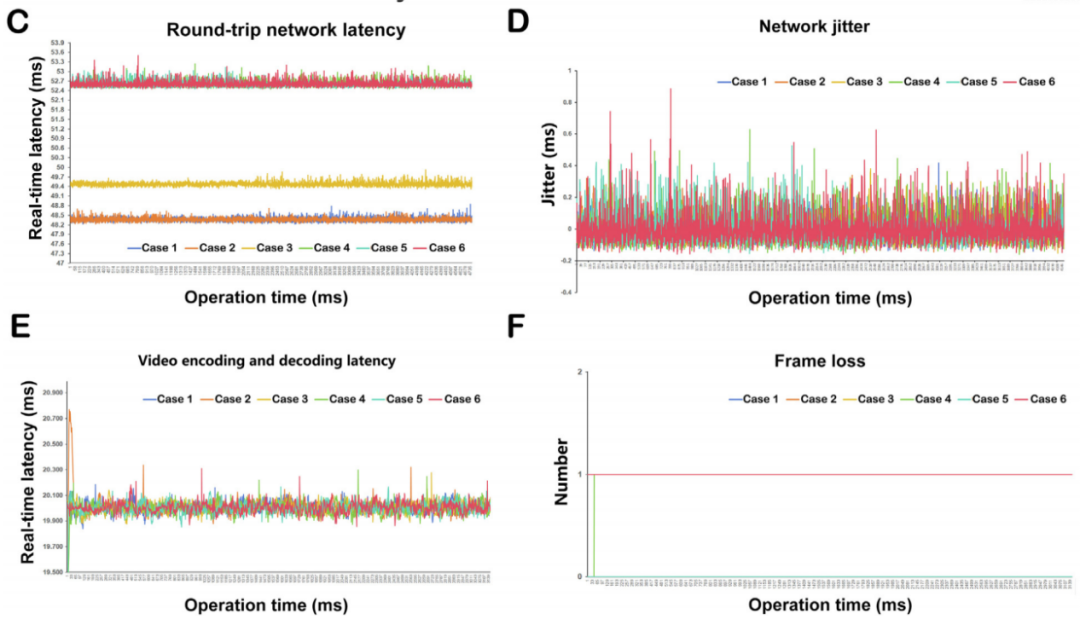 Note: (C) Real-time round-trip network latency is between 48.37 and 52.20 ms; (D) Network jitter < 1 ms; (E) Video encoding and decoding latency stabilized around 20 ms; (F) No frame loss or only one frame lost was observed.Figure 1 Stability and Reliability of Network Communication in Remote Surgery SystemsDespite the enormous potential of remote surgery, its widespread implementation still faces challenges in technology, economics, society, cybersecurity, licensing, legal, and policy aspects. For instance, although improvements in 5G and fiber optic networks have allowed for faster and more stable connections over long distances, surgical and telecommunications technologies still need to overcome latency and distance limitations[4]. Additionally, some countries and regions still require appropriate 5G and fiber optic infrastructure.
02▼ConclusionAs the 2024 Capital International Medical Conference approaches, we are filled with expectations for the innovative applications of artificial intelligence in the medical field. The Smart Medical and Medical Artificial Intelligence Innovation Forum, as an important platform for showcasing the latest medical intelligent technologies, will gather many top experts in this field. Academician Zhang Xu’s pioneering achievements in remote urology lead us to anticipate that remote surgery can become a bridge connecting different regions and populations. It allows high-quality medical services to no longer be limited by distance, enabling patients to receive timely and efficient medical assistance when needed. In the next issue, we will continue to delve into Academician Zhang Xu’s breakthroughs in robotic-assisted prostate cancer surgery.
References[1]PATEL V, MARESCAUX J, COVAS MOSCHOVAS M. The humanitarian impact of telesurgery and remote surgery in global medicine[J]. Eur Urol, 2024, 86(2): 88-89. DOI: 10.1016/j.eururo.2024.04.029.[2]ZHENG J, WANG Y, ZHANG J, et al. 5G ultra-remote robot-assisted laparoscopic surgery in China[J]. Surg Endosc, 2020, 34(11): 5172-5180. DOI: 10.1007/s00464-020-07823-x.[3]Wang Y, Ai Q, Zhao W, et al. Safety and reliability of a robot-assisted laparoscopic telesurgery system: expanding indications in urological surgery[J]. Eur Urol, 2024, 85(5): 506-507. DOI: 10.1016/j.eururo.2023.11.002.[4]PATEL V, MARESCAUX J, COVAS MOSCHOVAS M. The humanitarian impact of telesurgery and remote surgery in global medicine[J]. Eur Urol, 2024, 86(2): 88-89. DOI: 10.1016/j.eururo.2024.04.029.“Medical Forum Network” publishes research results and interpretations in the medical field for reference by professionals and does not serve as diagnostic standards; use should be evaluated based on specific circumstances.Editor: MintSecond Review: StoneThird Review: Clear SoundTypesetting: Half Summer