
 Abstract:The soft robot developed by Chung-Ang University in South Korea utilizes paper electrodes to achieve biomimetic crawling through asymmetric temperature gradients, opening new possibilities for flexible robot applications with low-cost, environmentally friendly materials (paper substrate + LCEs) and simple manufacturing processes.
1. Technical Background: The “Flexible Revolution” of Soft Robots and Existing Bottlenecks
Traditional rigid robots have limited adaptability in complex environments (such as narrow spaces and fragile scenarios), while biologically inspired soft robots, with their flexible structures and bio-inspired movement patterns, have become a research hotspot in the field of robotics. Among them, mimicking the crawling movements of caterpillars and earthworms requires solving two core issues: how to achieve directional and efficient bending deformation, and how to simplify the driving mechanism to reduce costs and energy consumption.
Previously, the driving methods of soft robots relied heavily on hydraulic, pneumatic, or complex circuitry, leading to issues such as heavy structures, complicated manufacturing, and high costs. For example, drives based on shape memory alloys require high energy consumption for heating, while those based on piezoelectric materials depend on precision control circuits. Professor Suk Tai Chang and Assistant Professor Changyeon Lee’s team at Chung-Ang University drew inspiration from the “wave-like crawling” of caterpillars to develop a novel soft robot based on paper electrodes, achieving directional crawling through asymmetric temperature gradients, thereby significantly simplifying the driving and manufacturing processes.
2. Core Technology: Bridging Biological Motion to Engineering Implementation
(1) Biomimetic Prototype: The Mechanical Essence of Caterpillar Crawling
The crawling of caterpillars relies on the asymmetric contraction and extension of body segments: when the muscles on one side of the body contract, the other side extends, achieving directional movement through alternating bending and resetting actions. The core of this movement pattern is the “spatiotemporal distribution of asymmetric forces,” which does not require complex joint structures and can be accomplished through gradient deformation of soft tissues.
The research team found that if this “gradient deformation” could be replicated in soft robots, efficient crawling could be achieved. The key challenge lies in how to produce controllable asymmetric deformation with a simple mechanism while reducing energy consumption and manufacturing difficulty.
(2) Core Principle: The “Temperature Gradient Magic” of Paper Electrodes
The solution proposed by the team is based on the thermal response characteristics of liquid crystal elastomers (LCEs) and the resistance gradient design of paper electrodes, with the specific principles as follows:
1. Material Selection:
-
Substrate: Cellulose paper material is used, whose porous structure not only facilitates electrode deposition but also possesses high mechanical deformation capability (able to withstand repeated bending without breaking), and is widely sourced, environmentally friendly, and biodegradable.
-
Driving Layer: LCEs are a type of temperature-responsive smart material that contracts in a specific direction when heated and returns to its original state when cooled, making them an ideal choice for achieving “thermal-mechanical” energy conversion.
2. Electrode Design and Temperature Gradient Generation:
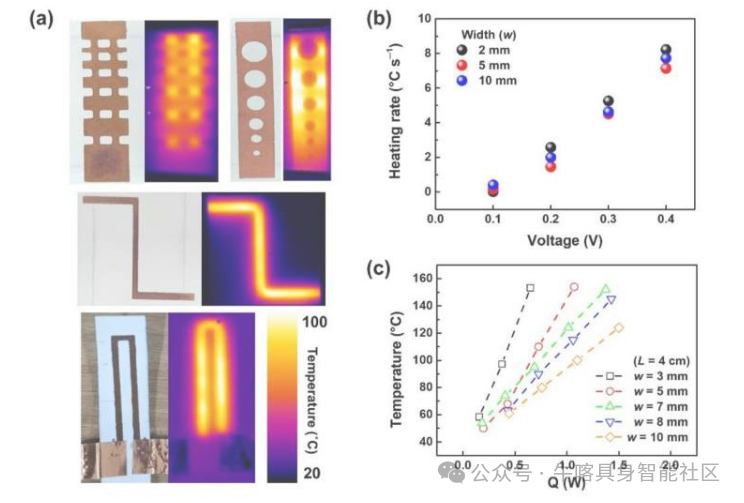
The team deposited copper electrodes on the paper substrate using electroless plating, with the core innovation being the “asymmetric design of electrode width”: along the length of the robot, the electrode width gradually changes (e.g., from 0.5mm to 2mm). According to the resistance formula (R=ρL/S, where ρ is resistivity, L is length, and S is cross-sectional area), an increase in width leads to an increase in cross-sectional area S, resulting in a decrease in resistance R.
When voltage is applied, the narrower electrode region with higher resistance generates more Joule heat (Q=I²Rt), forming a temperature gradient along the length direction (the temperature in the narrow electrode area is higher than in the wide electrode area). This temperature difference drives the LCEs layer to produce asymmetric contraction: the LCEs in the high-temperature area contract more significantly, while those in the low-temperature area contract less, causing the robot to bend towards the high-temperature side, achieving unilateral bending motion.
3. Synergistic Effect of the Double-Layer Structure:
The robot adopts a “paper substrate + LCEs driving layer” double-layer architecture: the paper substrate provides structural support, while the LCEs layer is responsible for deformation output. When the temperature gradient is generated, the asymmetric contraction of the LCEs layer drives the paper substrate to bend, and upon cooling, it resets, achieving a crawling motion similar to that of a caterpillar through a “bending-reset” cycle.
(3) Manufacturing Process: Simplified to “Printing-Level” Breakthroughs
The electrode preparation of traditional soft robots requires precision processes such as photolithography and etching, while this team has simplified the process into three steps:
1. Substrate Pretreatment : Hydrophilic treatment of cellulose paper enhances its adsorption capacity for metal ions;
2. Electroless Plating : The paper is immersed in a copper ion solution, and copper electrodes are deposited on the paper surface through a chemical reduction reaction without the need for an external power source, with patterns controlled by a mask (directly defining the variation in electrode width);
3. LCEs Composite : The pre-stretched LCEs film is bonded to the paper electrode layer to form a double-layer structure, completing the robot assembly.
The entire process requires no complex equipment and can be produced in bulk through a “printing-style” method, with the manufacturing cost of a single robot being less than 1 USD, far lower than traditional soft robots (which can range from tens to hundreds of dollars).
3. Performance Parameters and Core Advantages
(1) Key Performance Indicators
-
Driving Voltage : Only requires a 3-5V DC voltage, which can be powered by a standard button battery, with energy consumption reduced by over 60% compared to traditional thermal-driven robots;
-
Movement Speed : At 25°C, the crawling speed can reach 0.5mm/s (0.2 times its own length per second), comparable to the movement speed of small caterpillars;
-
Deformation Frequency : The bending-reset cycle is approximately 5 seconds, and the frequency can be adjusted by changing the voltage (which alters the temperature gradient);
-
Weight : The total weight is only 80mg (including substrate and driving layer), classifying it as a typical “milligram-level” soft robot.
(2) Advantages Compared to Traditional Technologies
1. Environmentally Friendly Materials and Sustainability
Using cellulose paper as the substrate, sourced from plant fibers, it is naturally biodegradable, avoiding the environmental pollution issues associated with traditional plastic substrates; copper electrodes can be recovered through simple chemical methods, aligning with the trend of “green robotics”.
2. Extremely Simplified Manufacturing Process
Electroless plating + printing-style pattern definition, without the need for precision equipment such as photolithography or vacuum deposition, making it suitable for rapid iteration in laboratories and large-scale production, with manufacturing costs only 1/20 of traditional silicone-based soft robots.
3. Low Energy Consumption and High Safety
3-5V low-voltage drive avoids the safety hazards of high-voltage circuits, allowing use near humans or in flammable and explosive environments; the Joule heat power is only 0.1-0.3W, with energy conversion efficiency (thermal-mechanical) reaching 35%, higher than pneumatic drives (approximately 20%).
4. Flexibility and Adaptability
The composite structure of the paper substrate and LCEs can withstand ±90° bending without damage, allowing it to pass through narrow passages with a diameter of 5mm, suitable for pipeline inspection, debris rescue, and other confined spaces.
4. Existing Technical Limitations and Challenges
1. Insufficient Durability of the Substrate
Paper materials are easily affected by humidity and liquids: in humid environments, the mechanical strength of paper decreases by over 50%, and the copper electrodes may fail due to oxidation; if exposed to water or corrosive liquids, the robot will quickly deteriorate, limiting its application in complex outdoor environments (such as rainy days or humid caves).
2. Limited Precision in Temperature Gradient Control
The resistance gradient caused by the variation in electrode width is difficult to achieve continuous adjustability, leading to “stair-step jumps” in temperature distribution, which may cause a jerky feeling in bending actions, affecting movement smoothness; additionally, fluctuations in ambient temperature (such as room temperature changes of ±5°C) can interfere with the stability of the temperature gradient, requiring additional temperature control modules for compensation.
3. Weak Movement Speed and Load Capacity
The current speed of 0.5mm/s is only suitable for low-speed scenarios, far below that of rigid robots (such as wheeled robots that can reach meters per second); the maximum load is twice its own weight (160mg), making it difficult to carry additional devices such as sensors, limiting functional expansion.
4. Unidirectional Motion Dependency
The crawling direction is entirely determined by the direction of the temperature gradient; if reverse motion is required, the electrode width distribution must be redesigned, and real-time software control is not possible, making it less flexible than soft robots with multiple degrees of freedom.
5. Application Prospects: Potential from Environmental Monitoring to Special Operations
Despite its limitations, this technology still provides low-cost solutions for multiple fields:
1. Environmental Monitoring
Can be deployed in bulk in fields, forests, etc., carrying miniature humidity and pH sensors to crawl and collect data from soil or plant surfaces; the paper substrate can naturally degrade, avoiding the challenges of equipment recovery.
2. Narrow Space Inspection
With its flexible structure, it can enter pipes, machine gaps, and other areas difficult for humans to reach, detecting cracks, corrosion, and other defects, especially suitable for non-destructive testing of old buildings or industrial equipment.
3. Education and Popular Science
Low cost (less than 1 USD per unit) and simple manufacturing make it an excellent teaching tool to demonstrate robotic principles, helping students understand the relationship between “materials – structure – function.”
4. Biomedical Assistance
In low-risk scenarios (such as drug delivery model research), it can serve as a micro-carrier moving in simulated human cavities (such as esophagus models), exploring the possibilities of targeted drug delivery (further optimization of biocompatibility is required).
6. Insights from Technological Breakthroughs: The Innovative Value of “Minimalist Design”
The core breakthrough of this research lies in replacing complex control with material properties: simplifying electrode deposition through the porosity of the paper substrate, using resistance gradients instead of precision temperature control circuits, and achieving “passive deformation” through the thermal response of LCEs. This “structure as control” approach provides a new paradigm for the cost reduction of soft robots—compared to pursuing high complexity in drives, utilizing the physical properties of materials themselves may be a more efficient path.
In the future, if the durability of the paper substrate can be enhanced through surface modification (such as coating with waterproof films) or if flexible electronic technologies can be combined to achieve dynamic reconstruction of electrodes, this technology is expected to overcome existing limitations and become one of the mainstream solutions for environmentally friendly, low-cost soft robots.
For more details, please refer to the original article: In Hyeok Oh et al, Crawling Soft Robotic Locomotion via Asymmetric Temperature Distribution on Paper‐Based Electrodes, Advanced Functional Materials (2025). DOI: 10.1002/adfm.202512328
END
 Click “Read Original” for more