When discussing edge computing gateways, many engineers still envision a scenario where they collect Modbus data, connect a few sensors, and push the data to the cloud, thinking their task is complete.However, in recent years, in more and more intelligent equipment sites, you will notice a significant change—the gateway is no longer just a “bystander”; it has begun to truly “participate in control.”
A key technology is quietly playing a leading role in this change: EtherCAT. When EtherCAT is combined with the ARMxy series based on barium-rhenium technology, a new scenario unfolds.
Today, this article will discuss: What can the ARMxy supporting EtherCAT actually do? Why is it becoming the choice of more and more engineers?
1
Not Just Simple “Protocol Support”, But an Elevated Capability
In the automation circle, EtherCAT has always had a clear positioning: High-performance real-time Ethernet bus..
Traditional field buses (Modbus, CAN, Profibus) have struggled with data exchange speed and synchronization, while industrial robots, manipulators, and laser equipment have increasingly high real-time requirements, making EtherCAT the most suitable “underlying language.”
Therefore, adding EtherCAT functionality to ARMxy is not just about adding another protocol, but adding a capability:
Transforming from “connecting devices” to “controlling devices.”
This difference can only be truly appreciated by those who have worked on automation projects.
2
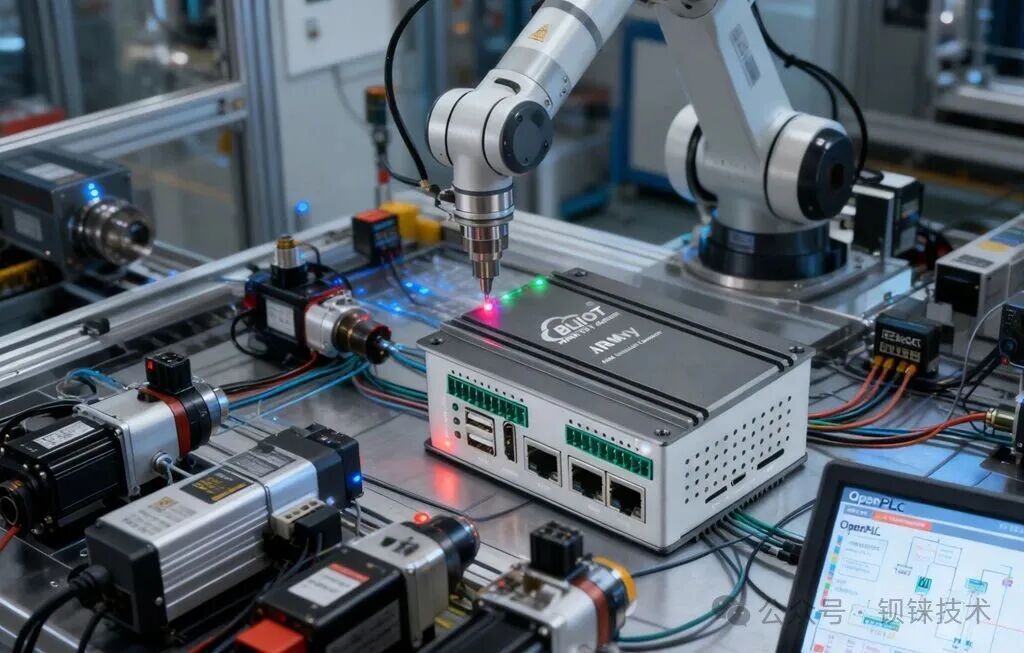
ARMxy as EtherCAT Master: From Data Collector to Controller
Traditional gateways resemble “auditors”; they collect data, read what they can, and upload it based on how others provide the data.
However, when ARMxy acts as the EtherCAT master, it suddenly becomes the “conductor.”
It can:
-
Automatically identify EtherCAT slaves (I/O, servos, frequency converters, pneumatic valve islands, etc.);
-
Periodically scan PDO at high speed;
-
Complete parameter configuration via SDO;
-
Participate in motion control tasks, achieving millisecond-level synchronized actions.
What does this mean?
For example: Previously, controlling a manipulator required a PLC or a dedicated motion controller. Now, an ARMxy can accomplish basic motion planning and coordinated control.
This change is crucial for equipment manufacturers pursuing lightweight, low-cost, and rapid deployment solutions.
Not only does it reduce costs, but it also simplifies the structure and significantly shortens the development cycle.
3
EtherCAT × Multi-Protocol Fusion: The “Universal Adapter” in the Field
In real factories, a perfect scenario of “all EtherCAT” will never exist. There will always be Modbus, CAN, IO-Link, and even LoRa, BLE, and serial instruments alongside EtherCAT.
The advantage of ARMxy is precisely reflected here:
It can handle multiple heterogeneous protocols simultaneously.
You can network like this:
-
EtherCAT controlling servos + RS485 collecting electric meters
-
EtherCAT I/O + MQTT for cloud
-
EtherCAT robots + CANopen actuators
-
EtherCAT production lines + LoRa environmental monitoring sensors
All data and logic are processed in one device.
What value does this bring to actual projects?
In one sentence: Finally, there is no need to place a bunch of “black boxes” to ensure compatibility with different devices.
This means fewer failure points for field engineers, simplified wiring, and improved stability.
4
EtherCAT × Node-RED: The Power of Rapid Development and Visualization
The ARMxy series has a very distinct feature—Using Node-RED for logic orchestration, dashboard creation, and process automation.
If you have worked with PLCs, you know: Modifying logic, recompiling, downloading, and debugging is very time-consuming.
Node-RED, on the other hand, is visual and drag-and-drop, with clear processes and flexible modifications, allowing many field engineers to work smoothly even without coding experience.
For example:
-
Directly drawing the upper computer interface using Dashboard
-
Real-time monitoring of EtherCAT I/O using nodes
-
Alarm logic can be modified in 5 minutes
-
Production line processes can be visualized and debugged at any time
-
Data cleaning and edge computing are clear at a glance
This capability is extremely valuable for the discrete manufacturing industry, which requires frequent changes in control strategies.
5
EtherCAT Data to the Cloud: From Real-Time Control to Data Value
EtherCAT is essentially a high-speed field bus that emphasizes real-time performance. However, under the trend of digitalization, people not only want to know whether “device actions are synchronized” but also whether “data can participate in analysis and decision-making.”
The value provided by ARMxy is:
Transforming high-speed EtherCAT data into cloud-usable data assets.
Specifically, this includes:
-
MQTT cloud integration (Alibaba Cloud, Huawei Cloud, ThingsBoard, etc.)
-
OPC UA integration with SCADA / MES
-
Local database caching to prevent data loss during network outages
-
Edge-side rule engines to filter data noise and reduce cloud pressure
This creates a complete link from control to management, from devices to platforms.
For equipment manufacturers, this means: Your devices can not only “run fast” but also “tell stories.”
For end users, this means: Data is truly usable, rather than just piling up in devices.
6
Why Are More and More Engineers Choosing ARMxy + EtherCAT?
Ultimately, there are three reasons:
1. Multi-functional, Simpler Structure
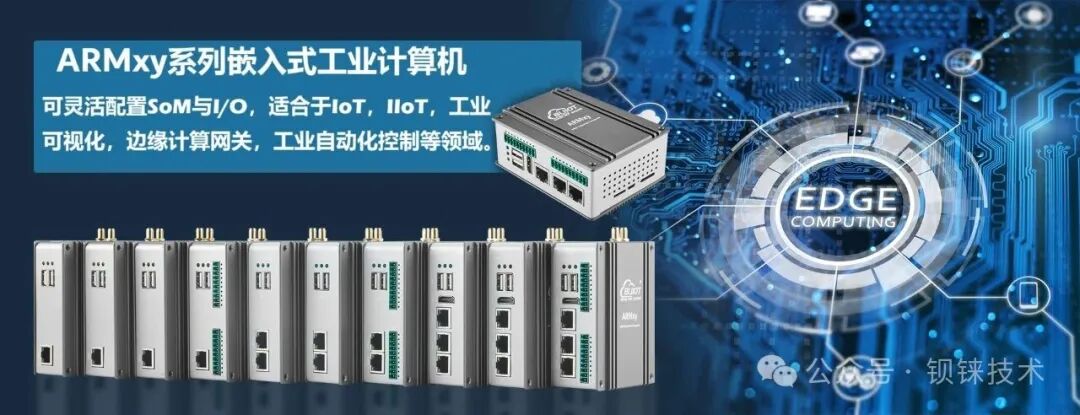
One ARMxy = Master controller + Edge control center + Multi-bus converter + Cloud terminal making project architecture lighter.
2. Significantly Reduced Development Costs and Cycles
No need for dedicated PLCs, no need for expensive motion controllers, and Node-RED logic development is much faster than traditional methods.
3. Flexible Adaptation, Faster On-Site Problem Solving
Changing devices, modifying logic, and adding protocols can all be implemented quickly.
4. Rich Self-Developed Software
BLRAT remote configuration tool, QuickConfig rapid configuration tool, BLIoTLink IoT soft gateway, AI-assisted programming tools, achieving more with less effort!
In today’s world where project delivery cycles are getting shorter, “flexibility” often outweighs “strength.”
7
In Conclusion
The ARMxy supporting EtherCAT is not just following a trend; it is genuinely advancing edge computing from “data collection” to the dimension of “business control.”
It can replace some PLC control tasks, serve as the upper-level coordinator of EtherCAT systems, and facilitate the data link between devices and cloud platforms.
In an era that emphasizes real-time performance, flexibility, and digitalization, this capability is becoming increasingly critical.
The future of industrial automation involves not only the evolution of controllers but also the evolution of edge devices. The ARMxy supporting EtherCAT is quietly transforming the landscape of industrial control.