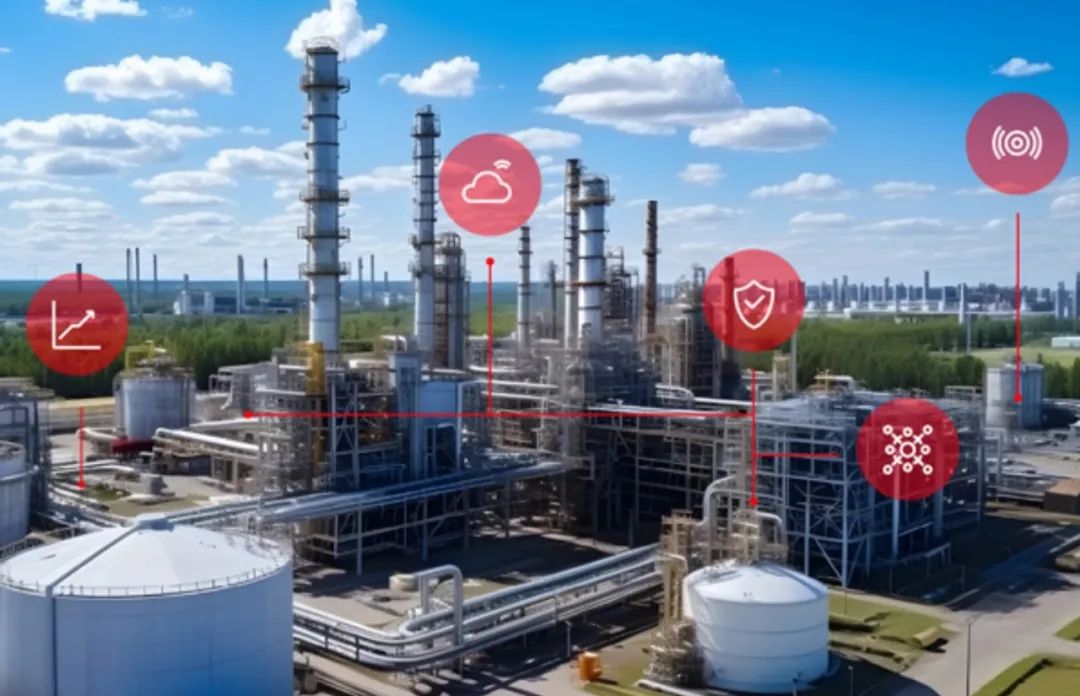
Image source: ABB
Author | Vikas Maurya
Manufacturing companies are increasingly focusing on the value of AI hosted at the edge for improving process control and operational efficiency and resilience, especially in remote sites where cloud connectivity cannot be utilized.
Today, AI and machine learning algorithms trained on cloud-hosted datasets can be executed on local computing devices at the network edge, enabling factories to process and analyze data securely and in real-time at the point of production and use.
As a core element of digital strategy, few industries remain untouched by the transformative power of AI. Moreover, from the perspective of process control and automation, AI holds immense potential to analyze and manage the vast datasets generated by thousands of interconnected devices, systems, and processes in modern industrial facilities.
In a typical industrial environment, AI can help optimize the efficiency, reliability, and safety of control processes. It can also assist in reducing the need for heavy human intervention in tedious or routine tasks, ultimately contributing to increased uptime for factories while lowering operational costs. In achieving these goals, AI also paves the way for the long-term objective of fully automated factory operations.
AI algorithms are supported by years of accumulated operational data, which can be trained using machine learning to discover trends and anomalies that human engineers typically overlook. These insights can provide early warnings of impending sensor failures or suggest how to fine-tune specific processes for greater energy efficiency.
Effective decision-making relies on ensuring timely access to accurate, relevant data, as well as the ability to quickly analyze and interpret that information. In process control environments, it is this necessity of “doing more with data” that has led to a focus on the most valuable applications of AI—namely, in the production and utilization of operational data.
01
Edge Artificial Intelligence
“Edge artificial intelligence” refers to the application of AI on connected devices to perform tasks in real-time or near real-time. The data that provides information for the decision-making process of AI engines can be hosted remotely in the cloud. Similarly, it may also reside at the network edge, very close to the devices themselves.
While the origins of edge computing can be traced back to around 2000, deploying AI models at the network edge is a relatively new phenomenon. Advances in CPU power and miniaturization of circuits have provided digital processing capabilities for compact hardware devices that were once thought to be only available to supercomputers a decade ago. Likewise, high-speed 5G connections allow data to be collected from thousands or millions of Internet of Things (IoT) devices, providing data for increasingly complex AI/ML models hosted in the cloud. By training these models with more devices and more data, they become smarter, more accurate, and more reliable.
There are several benefits to shifting AI computational power to the network edge. First, it can significantly reduce the bandwidth requirements and associated costs of transmitting large amounts of data from on-site devices to the cloud. Executing applications locally rather than remotely can also shorten system latency—the round-trip time between the data source and processing location. Whether you are sitting in a self-driving car or performing robotic surgery on a patient across a continent, even a 100-millisecond delay between system inputs and outputs can have catastrophic consequences.
Concentrating computing resources at the point of data generation and consumption can mitigate potential cybersecurity risks associated with connecting sites to remote data centers over the internet. While private and public clouds offer high levels of inherent security, being able to consistently keep commercially sensitive data locally ensures it is protected from unauthorized exposure and scrutiny, thus ensuring ultimate ownership and control of the data.
02
The Role of Edge Computing in Mission-Critical Applications
Similarly, edge computing is appealing in mission-critical applications because it does not rely on a continuous internet connection to process data. This ensures high availability of applications, which might otherwise be affected by network interruptions or poorly connected remote sites.
Given these advantages, it is not surprising that edge computing is playing a transformative role in many industrial process control and automation environments. As an intelligent bridge between on-site devices and the cloud, it allows asset owners to fully leverage the increasingly large amounts of data collected from industrial IoT devices and control systems.
Every factory operator faces the challenge of optimizing uptime, efficiency, safety, sustainability, and profitability. The key is to extract actionable insights in a timely manner from the vast amounts of operational, IT, and engineering technical data generated by thousands of sensors, subsystems, and other sources. This is particularly challenging in remote or hard-to-reach environments, such as mines, chemical processing plants, offshore wind farms, or oil platforms, where mobile broadband coverage is sparse. From a business perspective, AI analytics supported by edge and cloud computing can help unlock real value from the approximately 80% of production data that factories are currently not utilizing.
By definition, edge and cloud computing paradigms are fundamentally different. However, they are widely seen as complementary technologies that combine the immediacy, security, and resilience of edge computing with the unlimited scale and storage capacity of cloud computing.
A typical example is a process optimization model in a chemical plant. This model is supported by large-scale production data collected by on-site industrial IoT devices and can be executed in real-time on-site using edge AI. The model’s outputs ensure that devices and systems can respond to their environmental demands more quickly and accurately.
03
Powerful Edge Intelligence Tools
Edge AI can also serve as a powerful tool to support other use cases for industrial equipment owners, such as condition-based asset health and performance monitoring. Instrumentation data collected from sensors, actuators, and other devices at the network edge can serve as the basis for condition-based monitoring. Well-trained AI algorithms can detect potential anomalies in the data characteristics of connected devices or subsystems and cross-reference their behavior with historical data from thousands of similar devices. By sending automated alerts to factory personnel, it can provide early warnings of potential system failures that could otherwise impact factory or process performance, leading to costly unplanned downtime.
In the future, edge computing will have a transformative impact on numerous industrial automation applications. By combining industrial IoT technology with AI-driven analytics, edge computing can complement cloud-hosted storage and applications to unlock more value from production data in the process industries.
Key Concepts:
■ Understand the benefits of shifting AI computational power to the network edge.
■ Edge AI can serve as a powerful tool to support other use cases for industrial equipment owners.
Consider:
What transformative impacts will edge AI bring to industrial automation applications?
– END –

▲ This article is from CONTROL ENGINEERING China magazine, September 2024 issue, “Technical Articles” section: Deploying AI Models at the Network Edge

✦
Recommended Reading
✦