2025
High-Temperature and Low-Drift MEMS Piezoelectric Vibration Sensor
Shanghai Institute of Microsystem and Information Technology, Chinese Academy of Sciences
National Key Laboratory of Sensor Technology
MEMS Process and Advanced Sensor Research Group

Recently, the National Key Laboratory of Sensor Technology at the Shanghai Institute of Microsystem and Information Technology, Chinese Academy of Sciences, has made significant progress in high-temperature MEMS piezoelectric vibration sensors. The developed vibration sensor features a large measurement range, wide bandwidth, and high linearity, and has reduced temperature drift by 16 times through thermal stress isolation design, achieving a temperature coefficient of sensitivity as low as 0.015%/℃, enabling stable vibration monitoring in extreme environments up to 200℃ without additional compensation circuits. The related results were published in the well-known SCI journal “Measurement” under the title “Calibration-free Low-Drift MEMS Piezoelectric Accelerometer for High-Temperature Vibration Monitoring,” with doctoral student Zhang Cheng as the first author, and Associate Researcher Wang Yang and Researcher Wu Zhenyu as corresponding authors.
01
Research Background
With the advancement of science and technology, measurement and control technology increasingly impacts modern information society. Reliable and stable sensing of physical and mechanical parameters such as vibration and shock is a key component of intelligent control systems and automated industries. MEMS piezoelectric vibration sensors have advantages such as wide operating frequency range, fast response speed, large measurement range, and high batch consistency. However, in industrial, deep-earth, and aerospace environments, sensors often need to operate under extreme high-temperature conditions while maintaining stable performance. To address this issue, the research team focused on thermally stable sensing materials and thermal stress isolation design to develop low-drift MEMS piezoelectric vibration sensors suitable for high-temperature vibration monitoring.
02
Research Highlights
This work fabricated AlScN test structures using MEMS piezoelectric technology (Figure 1). Based on this structure, the lattice orientation and crystallinity of the piezoelectric thin film were characterized from room temperature to 600℃, as well as the temperature characteristics of the piezoelectric coefficient and electromechanical coupling coefficient, as shown in Figure 2. From room temperature to 600℃, the piezoelectric crystal orientation in the (002) direction remained very stable, with a change in half-width of less than 0.03°, and no phase transitions occurred. The piezoelectric coefficient d33 of the piezoelectric material from room temperature to 200℃ was approximately 8.5±0.5pC/N, indicating good temperature stability of its piezoelectric effect. Additionally, long-term stability tests of the electromechanical coupling coefficient at 200℃ in an air environment further confirmed its excellent temperature stability.
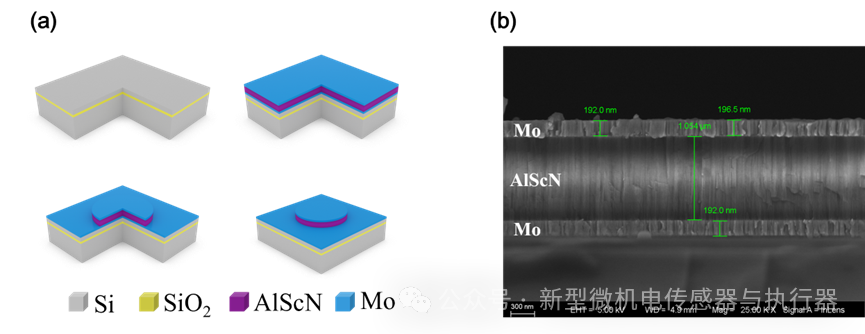
Figure 1 Piezoelectric material test structure
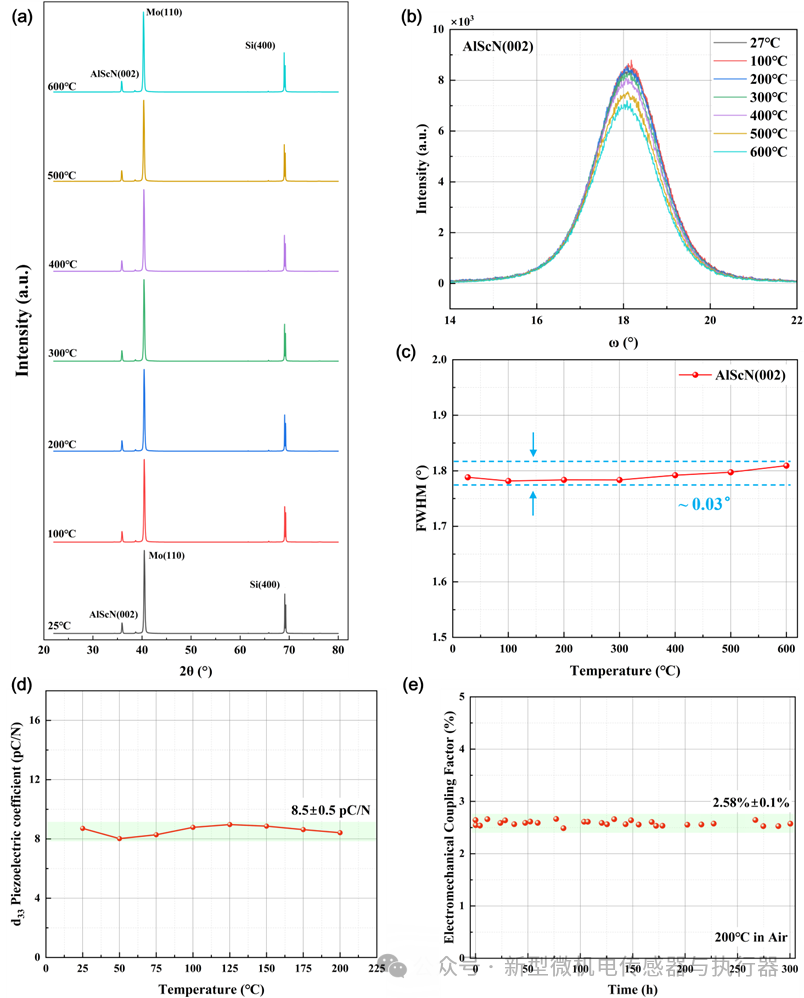
Figure 2. High-temperature characteristics of piezoelectric materials. (a) In-situ variable temperature XRD; (b) In-situ variable temperature rocking curve; (c) Change of half-width with temperature; (d) Change of piezoelectric coefficient d33 with temperature; (e) Long-term thermal stability of electromechanical coupling coefficient.
We designed a MEMS piezoelectric vibration sensor, with the structure shown in Figure 3. When external vibrational excitation is applied to the mass block, the cantilever beam undergoes forced stretching and contraction, generating strain within the piezoelectric layer, which triggers a polarization response, thereby inducing positive and negative charges on the upper and lower surfaces of the piezoelectric layer, converting mechanical energy into electrical energy to achieve vibration sensing.
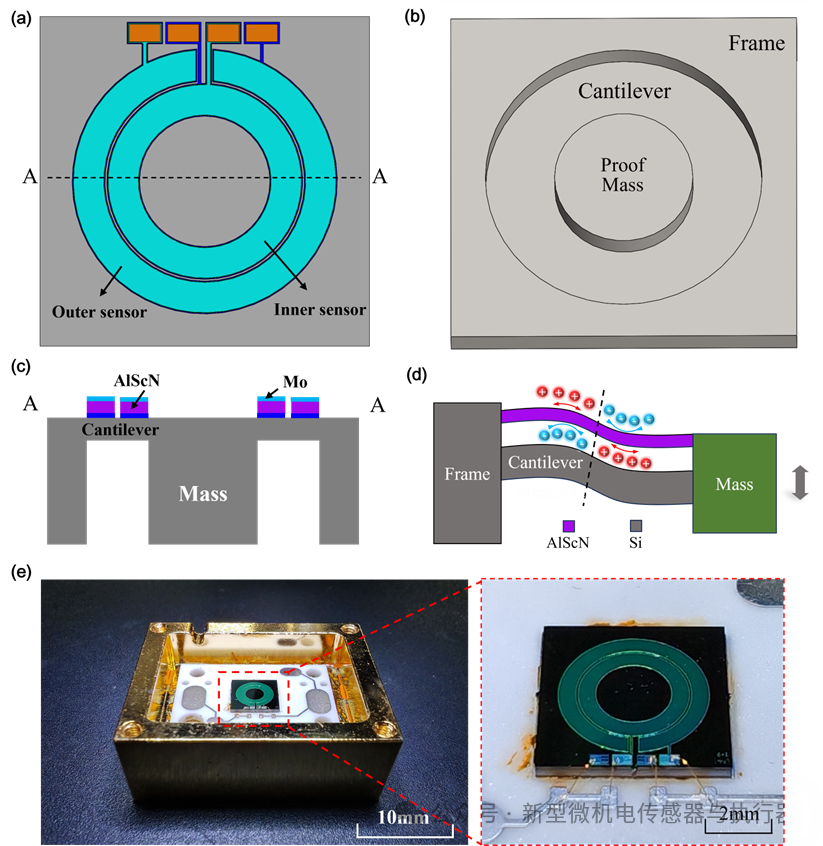
Figure 3. (a) Top view; (b) Bottom view; (c) Cross-section; (d) Sensing principle; (e) Physical image of the MEMS piezoelectric vibration sensor.
In terms of performance characterization, Figure 4(a) shows the frequency response of the vibration sensor under an external acceleration of 1 g in the frequency range of 3 Hz to 20 kHz. It can be observed that the vibration sensor exhibits a relatively flat response up to approximately 8000 Hz. Figure 4(b) shows the range and linearity of the vibration sensor, which still maintains very good linearity under a large range of 500 g, with a nonlinearity error of only 0.14%. The slope of the fitted curve indicates that the sensitivity of this sensor is approximately 0.59pC/g. Figure 4(c) shows that the maximum transverse sensitivity of the vibration sensor in a 360° plane perpendicular to the sensitive axis is only 1.08%, making it particularly suitable for vibration monitoring in harsh environments.
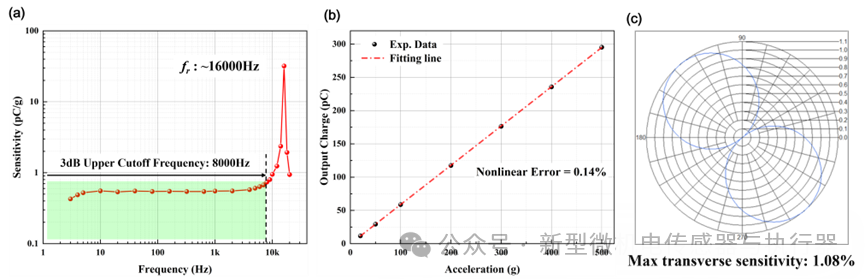
Figure 4. Performance testing of MEMS piezoelectric vibration sensor. (a) Frequency response; (b) Linearity and range; (c) Transverse sensitivity.
Typically, MEMS sensors are affected by packaging thermal stress in wide temperature environments, leading to changes in device stiffness with temperature, which causes temperature drift in device performance. To solve this problem, the research team designed and fabricated a stress isolation structure (Figure 5) to reduce the temperature drift of the sensor.
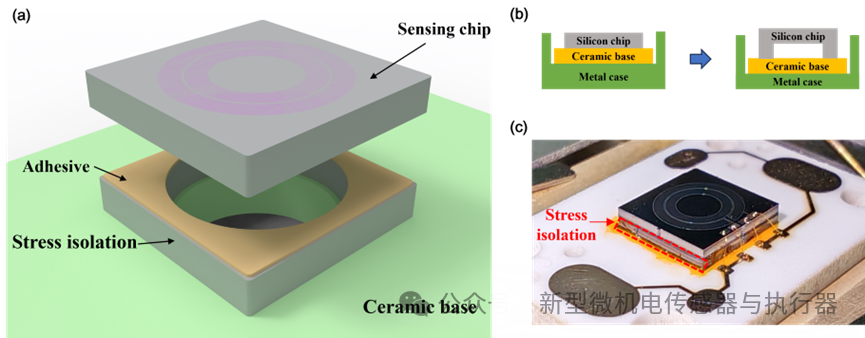
Figure 5. (a) 3D model of stress isolation structure; (b) Schematic diagram of cross-section before and after optimization; (c) Physical image of MEMS vibration sensor with stress isolation structure.
The temperature drift of the sensor was characterized using a high-temperature vibration testing system (Figure 6). Since the curing temperature of the adhesive is 200℃, the sensor without isolation structure performs similarly near 200℃. After stress isolation, the temperature drift of the sensor’s resonant frequency was reduced from 25% to 1%, and the sensitivity drift was reduced from -40.4% to 2.6%, decreasing by approximately 16 times. The sensitivity temperature drift coefficient of the sensor with stress isolation is only 0.015%/℃. The time-domain signals measured at room temperature and 200℃ for sensors with and without isolation structure under a constant 1 g vibration load in a heating furnace are shown in Figures 6(c) and (d). The results indicate that the sensor with the stress isolation structure maintains stable performance over a wide temperature range, achieving stable vibration monitoring without additional calibration circuits.
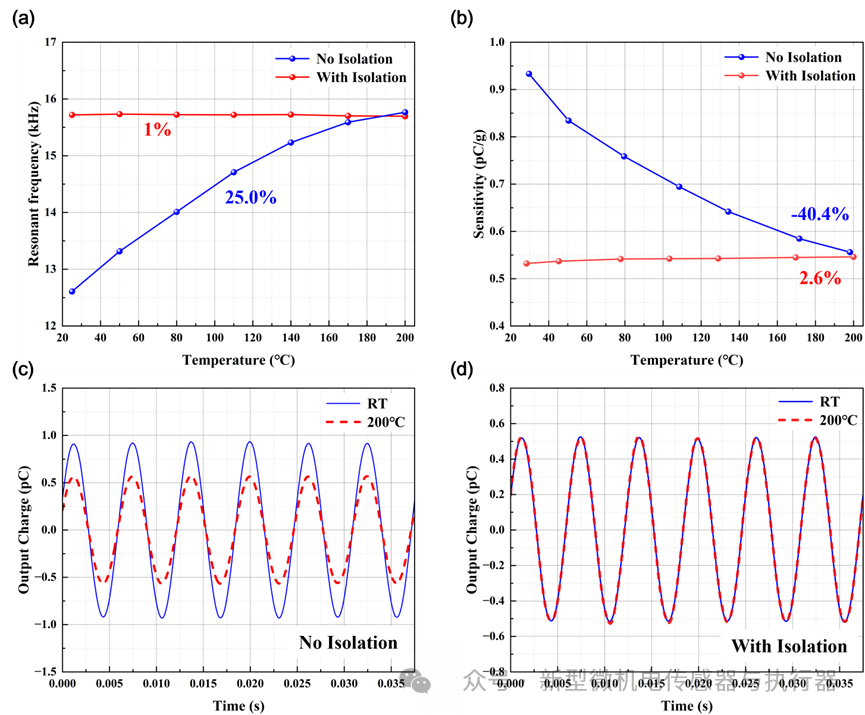
Figure 6. MEMS vibration sensor: (a) Resonant frequency (b) Sensitivity drift with temperature. (c)(d) Time-domain vibration signals measured at room temperature and 200℃ for MEMS vibration sensors with and without isolation structure.
03
Conclusion and Outlook
This work utilized thermally stable piezoelectric materials and designed and manufactured a wide bandwidth, large range, low-drift MEMS piezoelectric vibration sensor, which has significant application prospects in the field of vibration monitoring in extreme industrial environments. In the future, the research team will further improve the packaging preparation process of the sensor. Additionally, they will integrate signal conditioning circuits into the sensor to form a universal IEPE interface, enhancing the robustness of signal transmission over long distances in extreme environments.
Original link:
https://doi.org/10.1016/j.measurement.2025.118694
(Click the “Read Original” button below to view the original paper)