I. Research Background
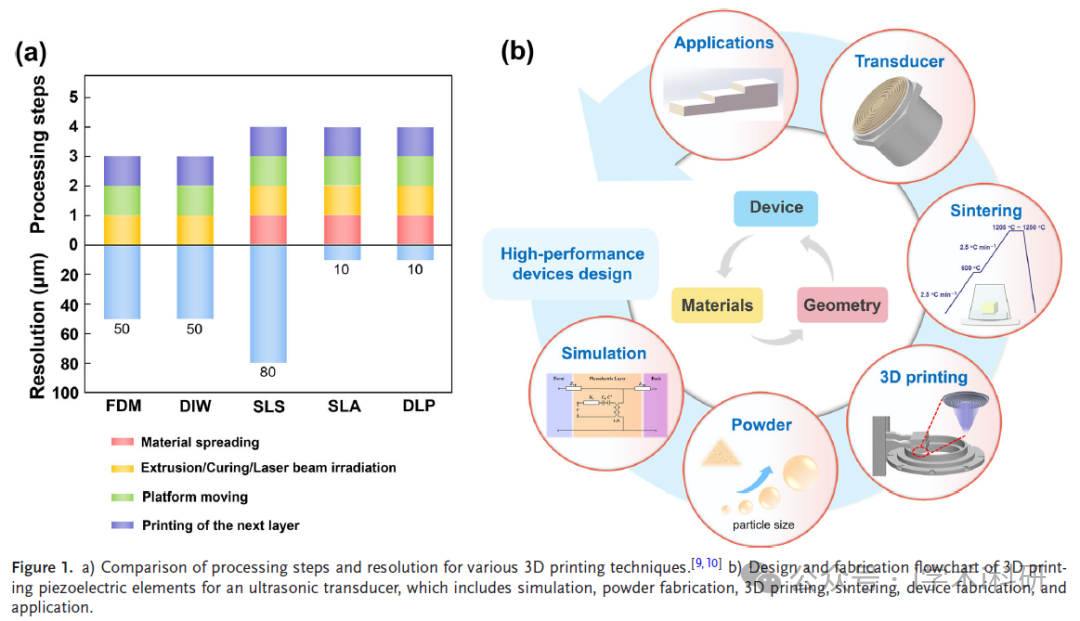
Piezoelectric devices are widely used in medical diagnostics, industrial testing, and intelligent systems. However, their core requirement—balancing complex structural formation with high-performance output—has long been constrained by traditional manufacturing technologies. Conventional material manufacturing (molding, casting) and subtractive manufacturing (laser cutting, milling) face issues such as insufficient precision, limited shapes, and long production cycles, making it difficult to achieve efficient preparation of complex structure piezoelectric ceramics. Although 3D printing technology offers advantages in rapid prototyping and flexible design, it faces multiple challenges in the manufacturing of piezoelectric ceramics: high refractive index piezoelectric powders lead to poor curing effects, delamination cracks are prone to occur after pyrolysis sintering, and the electrical performance of printed ceramics is significantly lower than that of products made by traditional processes. These issues severely restrict the practical application of 3D printed piezoelectric devices. Therefore, developing 3D printing technology for piezoelectric ceramics that balances complex structural formation and high performance has become key to breaking through industry bottlenecks.
Professor Ren Wei from Xi’an Jiaotong University and Associate Professor Zhuang Jian, along with Professor Fei Chunlong from Xi’an University of Electronic Science and Technology, have achieved a method for manufacturing high-performance piezoelectric Sm-PMN-PT ceramics using digital light processing technology. This ceramic features complex geometries suitable for device applications. They achieved a piezoelectric coefficient d33 of 1285 pC/N-1, the highest reported value among all 3D printed piezoelectric ceramics. Additionally, they designed and manufactured an ultrasonic transducer annular array through 3D printing, which is difficult to achieve with traditional manufacturing techniques. This transducer exhibits outstanding performance, with a large bandwidth of 60%, a peak-to-peak voltage of 952 mV, and improved imaging resolution. Notably, this exceptional performance establishes a new benchmark for 3D printed ultrasonic transducers at achievable device levels. These results highlight the tremendous potential of 3D printed piezoelectric ceramics and complex structures in devices, demonstrating their ability to meet specific needs and requirements.
II. Research Highlights
1. Through process optimization, the piezoelectric coefficient of 3D printed Sm-PMN-PT ceramics reached 1285 pC/N, the highest reported value for 3D printed piezoelectric ceramics, approaching 86% of the product made by traditional processes (1492 pC/N).
2. Utilizing digital light processing (DLP) technology, an 8-unit ultrasonic annular array was successfully fabricated, which is difficult to achieve with traditional processes. The kerf width is uniform (standard deviation 0.016-0.019 mm), and the edge perpendicularity is good (91.6°-93.5°), demonstrating excellent complex structure manufacturing capability.
3. An integrated process of “powder particle size optimization-curing control-stepwise pyrolysis sintering” was established. By combining finite element analysis (FEA) with the Jacob equation to optimize powder particle size, the curing difficulty of high refractive index powders was solved. The relative density of the sintered ceramics exceeded 95%, with no delamination cracks.
4. The ultrasonic annular array transducer based on 3D printed ceramics achieved a -6 dB bandwidth of 60%, a peak-to-peak voltage of 952 mV, and an imaging resolution improved by up to 55% compared to single-element transducers, outperforming existing 3D printed transducers and some commercial products.
III. Research Content
1. 3D Printing and Post-Processing Techniques
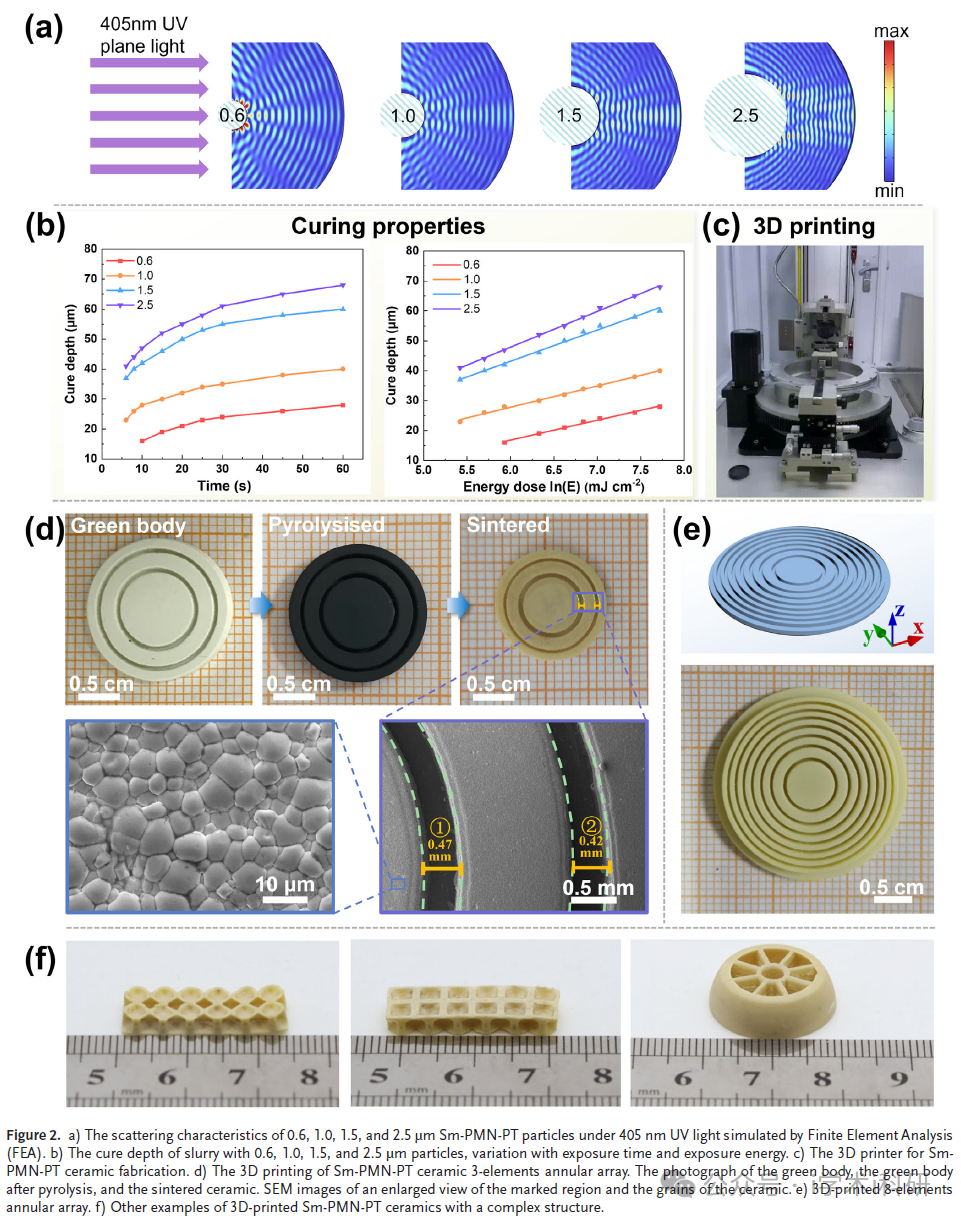
Sm-doped PMN-PT (Sm-PMN-PT) was selected as the piezoelectric material, and ceramic powders of different particle sizes (0.6, 1.0, 1.5, 2.5 μm) were prepared using a two-step magnesium niobate precursor method. Based on FEA simulations of the scattering characteristics under 405 nm UV light, it was found that increasing particle size can reduce light scattering and enhance the curing depth of the slurry. Combining the Jacob equation, 1.0 μm was determined to be the optimal particle size—ensuring low critical exposure energy (8.14 mJ/cm²) and good flowability while avoiding increased porosity caused by larger particle sizes. The solid content of the slurry was set at 40 vol%, with polypropyleneglycol (PPG) added as a diluent to further optimize curing performance.
DLP 3D printing technology was used to prepare ceramic green bodies, with the single-layer printing thickness set according to the slurry curing characteristics (12.5 μm for 0.6 μm powder and 25 μm for others). The post-processing adopted an “argon atmosphere pyrolysis-embedded sintering” process: 550 °C to remove resin, 600 °C to eliminate residual carbon, followed by sintering at 1190-1250 °C for 2 hours (heating rate 2.5 °C/min). After optimization, the ceramics sintered at 1235 °C with 1.0 μm powder achieved a relative density of over 95%, with no delamination cracks, uniform grain size, and clear boundaries.
2. Material Performance Characterization
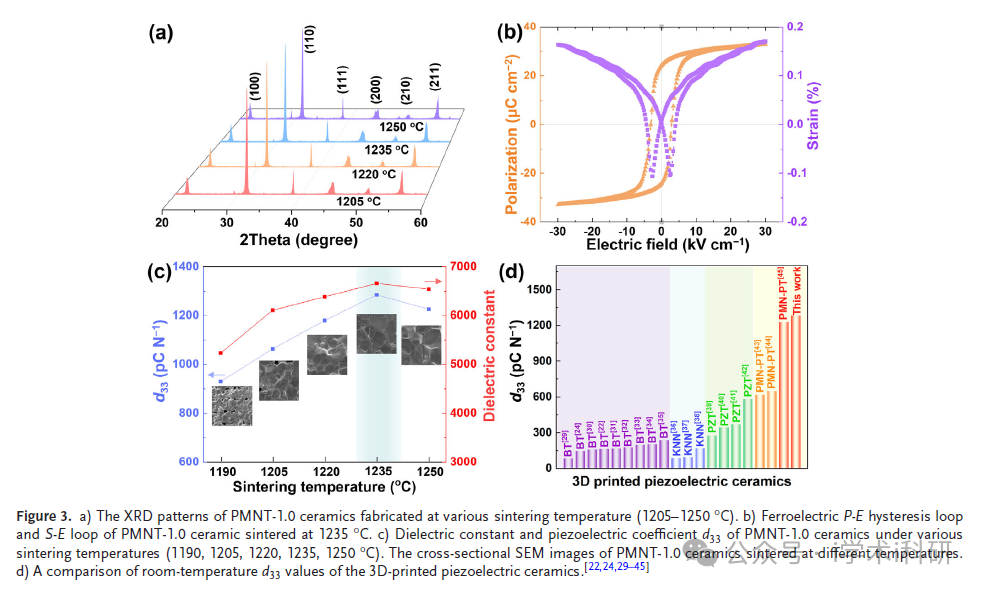
Crystal Structure: XRD tests showed that the ceramics were in the tetragonal perovskite phase, with distinct (002)/(200) peak splitting, and a small amount of secondary phase of焦绿石 appeared during sintering at 1250 °C;
Electrical Performance: The ceramics made from 1.0 μm powder achieved a dielectric constant of 6661 (1 kHz), with a dielectric loss as low as 0.042, a saturated ferroelectric hysteresis loop, and a remnant polarization strength of 24.0 μC/cm², with a strain value of 0.16%;
Stability: The dielectric loss of the ceramics fluctuated little under different particle sizes and sintering temperatures, and the piezoelectric performance showed good repeatability (the standard deviation of d33 was only 17).
3. Preparation and Testing of Ultrasonic Annular Array Transducer
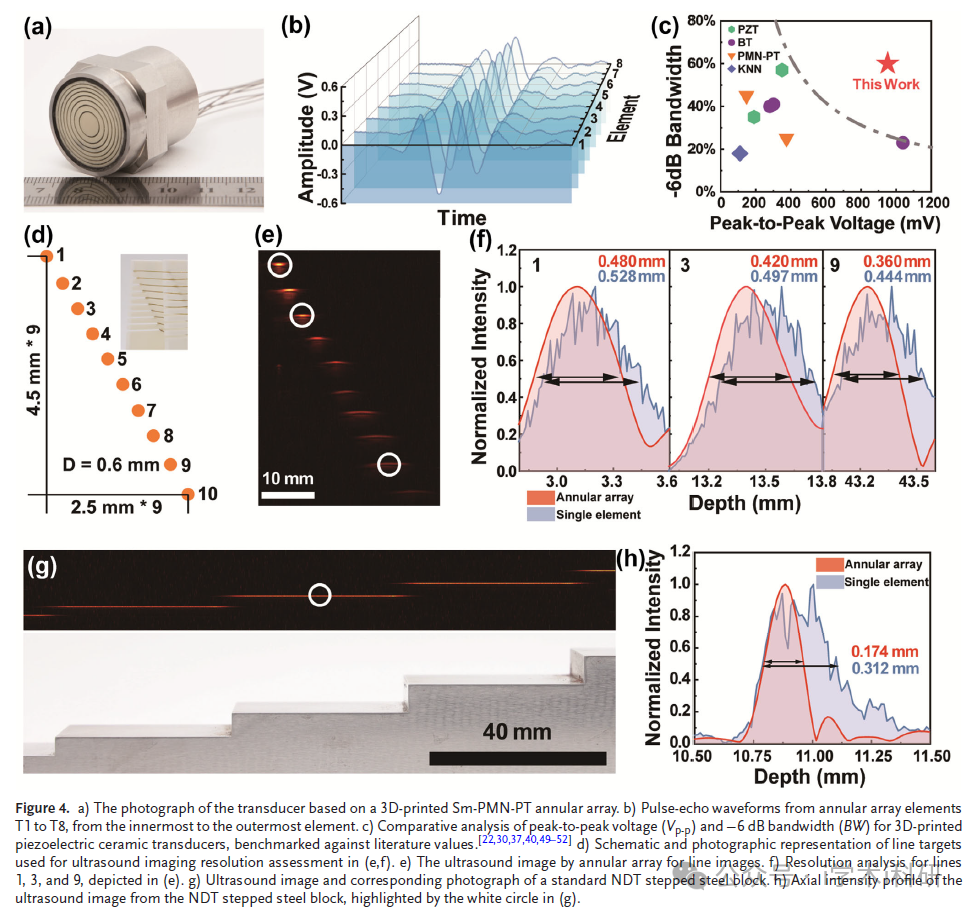
An 8-unit concentric annular array was designed and printed, followed by electrode preparation, epoxy filling, polarization (15 kV/cm for 10 min in silicone oil), and assembly with backing layers and acoustic lenses to form the ultrasonic transducer. Test results showed:
Electrical Performance: The pulse-echo waveforms of each unit were consistent, with peak-to-peak voltages ranging from 654 to 952 mV, and a -6 dB bandwidth of approximately 60%;
Imaging Performance: The imaging resolution for line targets improved by 10%-23.3% compared to single-element transducers, and the imaging resolution for NDT stepped steel blocks improved by 55%, allowing for precise identification of targets at different depths.
IV. Conclusion and Outlook
This study has broken through the dilemma of “complex structure and performance cannot coexist” in 3D printed piezoelectric ceramics by systematically optimizing powder particle size, slurry formulation, printing parameters, and post-processing techniques. Successfully fabricated Sm-PMN-PT ceramics with both complex structural formation capabilities and ultra-high piezoelectric performance (d33=1285 pC/N), and achieved integrated manufacturing of high-performance ultrasonic annular array transducers based on this material. This transducer exhibits excellent performance in bandwidth, output voltage, and imaging resolution, validating the feasibility of 3D printing technology in the industrial application of complex structure piezoelectric devices.
Reference Link:http://dx.doi.org/10.1002/adma.202514520
Previous RecommendationsLatest Nature on Smart Fabrics!Brain-like Devices: Artificial Synapse Clusters Achieve Neuromorphic Sensory ReasoningLatest Review on Ionic Hydrogels! A New Revolution in Flexible ElectronicsRecent Releases! Professor Li Zhuo from Fudan University on 3D Printing and Flexible Electronics Latest Review!Latest Nature from Professor Zhou Peng at Fudan University! Fully Functional 2D NOR Flash Memory ChipVideo Account:##Flexible Electronics Matters