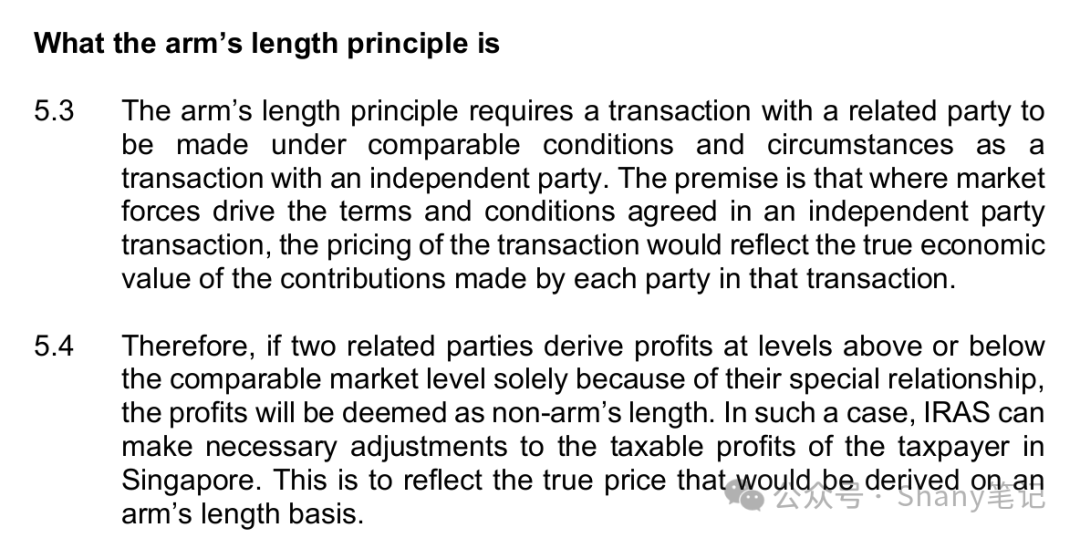
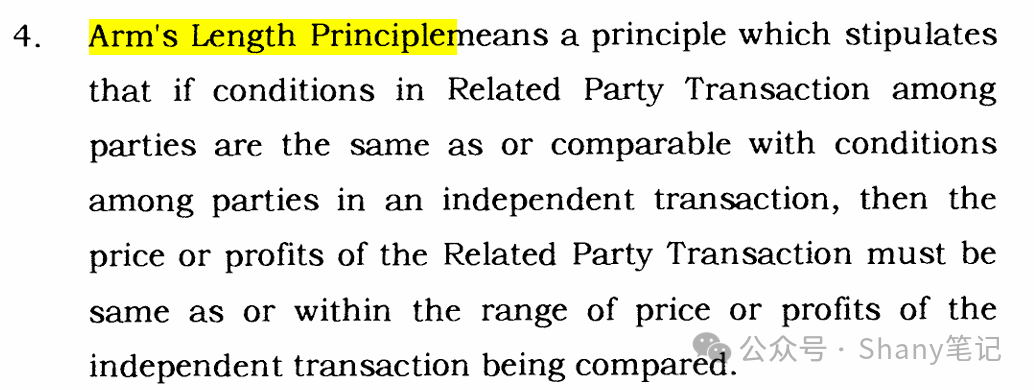
Recently, I reviewed transfer pricing documents from Singapore, which included a very important concept called Arm’s Length Principle. Deepseek translates it as “Independent Transaction Principle”. Huh? This is different from the translation provided in the Indonesian transfer pricing documents! When I looked at the Indonesian documents, it was translated as “Fair Transaction Principle”. Which translation is more appropriate?
First, let’s look at the original text:
Singapore
Indonesia
So I asked Deepseek which translation is more appropriate, and the response was as follows:
-
Literal Meaning and Core Imagery
Arm’s Length (一臂之长): The literal meaning of this English phrase is that both parties maintain a certain physical distance. In a business context, it metaphorically indicates that there is no special relationship between the parties, maintaining independence without undue influence or control.
Independent Transaction: The Chinese term “独立” perfectly corresponds to the core imagery of “maintaining distance and mutual non-control.” It emphasizes that the parties involved in the transaction are separate entities making independent decisions.
2. Legal and Economic Implications
The core of this principle is that transactions between related parties should have conditions and prices consistent with those agreed upon by unrelated, independent third parties under similar circumstances.
The term “independent” directly points to the benchmark for comparison—independent third parties. Translating it as “fair transaction” or “normal transaction” may sound pleasant, but it is not as accurate as “independent transaction,” because “fair” and “normal” are subjective judgments, while “independent” describes an objective, verifiable standard for comparison (i.e., comparing with transactions of independent parties).
3. Direct Correspondence with “Related Transactions”
In Chinese legal and accounting terminology, the concept that corresponds to “independent transaction” is precisely “related transaction.”
Related transaction: Refers to transactions occurring between parties with a related relationship.
Independent Transaction Principle: This is the criterion used to assess whether the pricing of these “related transactions” is reasonable, requiring that they be conducted as if they were “independent transactions.”
This opposing relationship makes the translation of “Independent Transaction Principle very logically clear in a professional context.
4. Consistency in Official and Professional Terminology
China’s Corporate Income Tax Law and its implementation regulations, as well as numerous official documents issued by the State Administration of Taxation, formally adopt the term “Independent Transaction Principle.” Using a unified term helps ensure consistency in law and practice.
Why not translate it into other possible forms?
Fair Transaction Principle??
“Fair” is a more subjective moral or legal concept.Independent Transaction Principle is a specific testing method, which does not directly ask “Is this price fair?” but rather “Is this price consistent with the price agreed upon by independent parties?” The latter is a more objective, verifiable standard.
Normal Transaction Principle??
“Normal” may refer to what is usual or common, but related transactions may not be “normal” at all. “Independent” precisely defines the benchmark for comparison—independent third parties.
Distance Maintenance Principle??
This is a literal translation, which, while conveying the core imagery, appears too informal and imprecise in legal and tax texts, failing to directly reflect its nature as a specific “principle” and “pricing method.”
Conclusion
The translation “Independent Transaction Principle” is widely accepted because it:
-
Accurately reflects the core methodology of “comparing with transactions of independent third parties.”
-
Professionally corresponds directly with the term “related transaction.”
-
Is officially adopted by tax authorities and legal texts in various countries, ensuring consistency in terminology.
Therefore, it is amodel of professional legal translation that is “faithful, expressive, and elegant.”
END