Seeing this title, are you scared?!
In mid-November, domestic FPGA company Anlu Technology held its annual technical seminar in Beijing. The one-day conference covered the industry, technology, and solutions extensively. At the entrance of the conference, many products were displayed by their partner solution providers.
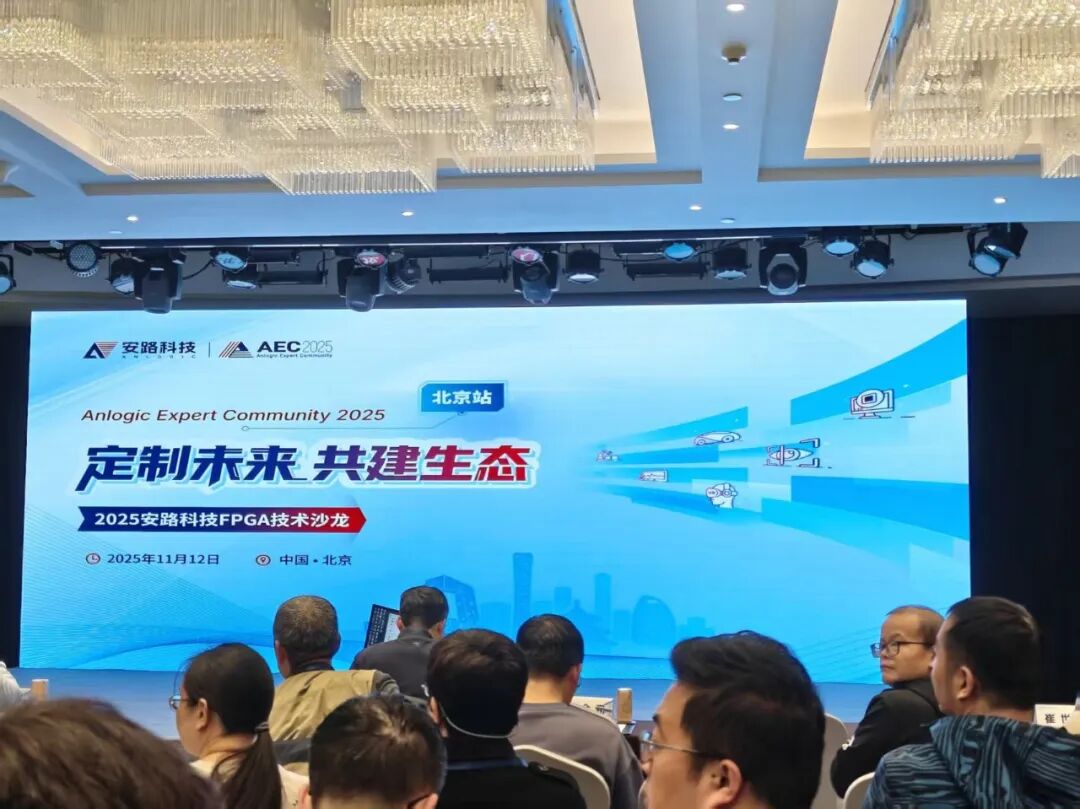
As a typical domestic FPGA company, Anlu Technology’s seminar was substantial enough to analyze the current state of domestic FPGAs and even the survival status of international giants.
After being bombarded with FPGA knowledge for a day, I felt the ambition of domestic FPGA companies.

Achievements of Domestic FPGAs
The first achievement is market share.
As Anlu Technology stated, for a long time, the global FPGA market has been dominated by international industry giants. However, the pace of domestic substitution is accelerating. According to relevant estimates, the market share of domestic FPGAs in the local market has exceeded 30%. This data indicates that domestic FPGAs have established a relatively stable position in the mid-to-low-end market.

Clearly, in the mid-to-low-end layout, domestic FPGAs have firmly established their foothold at a rapid pace. This is the achievement of domestic FPGA companies over the past few years, resembling the first steps in all semiconductor subfields.
The second achievement is the ecosystem.
I used to not understand why many international chip companies like to engage in student programs, but now I get it; this is a long-term and stable ecosystem, brainwashing from the source.
Domestic chip companies, especially FPGA companies, heavily rely on ecosystems. FPGAs are like the Infinity Stones in the Marvel Universe, fully armed by solution providers. When the Infinity Stone is in Iron Man’s hands, it becomes armor fuel; in Loki’s hands, it becomes a scepter; in Thanos’s hands, it becomes the Infinity Gauntlet. When FPGAs are in the hands of solution providers, they can deeply utilize the programmable and scalable flexibility of FPGAs for development.
Currently, solution providers consider Xilinx, Altera, and domestic manufacturers simultaneously when choosing FPGAs. The answer to “Why choose Anlu for domestic FPGAs” is very straightforward—”The underlying technology of Anlu is all self-developed, from hardware to software and IP.”
Clearly, political factors are disrupting the global semiconductor market while also affecting each company’s procurement of domestic chips.
Companies like Milink, Mir Electronics, Xinlongpeng Technology, and Chuanglong Technology showcased solutions using Anlu FPGA products, including solutions in fields such as fiber optic cameras, laser cutting machines, inkjet printers, and video displays.
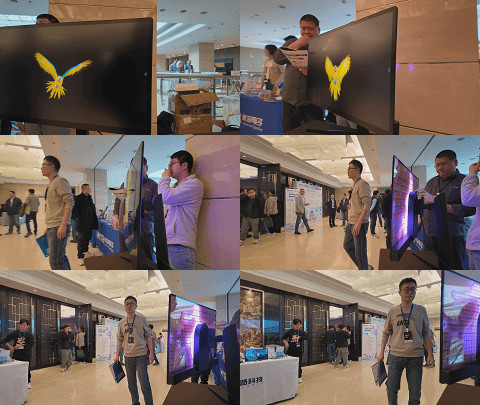
miniLED Solutions
The miniLED driving solution displayed on-site utilizes FPGA’s flexibility to manage various sizes of displays with a single solution. The non-illuminated areas of the miniLED display maintain their original deep black color, achieving energy-saving effects. As the screen size increases, the energy-saving effect becomes more apparent.
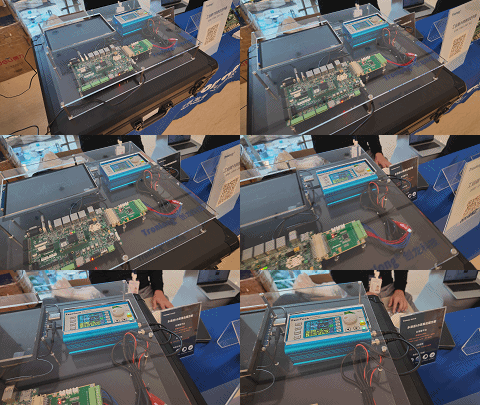
The above image shows a solution from Chuanglong, primarily applied in the power sector, showcasing the rich interfaces of FPGAs.
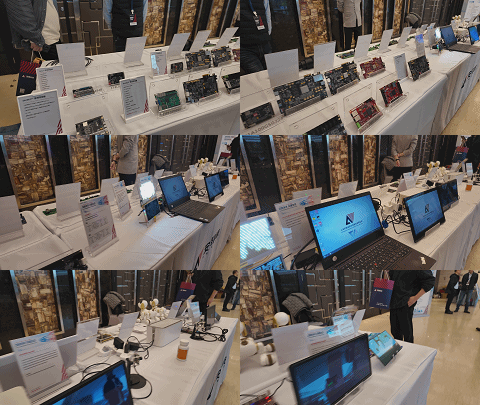

The core exhibition area of Anlu showcases a collection of solutions for automotive electronics, machine vision, robotic dogs, intelligent computing servers, industrial automation, etc.
In the camera solution, compared to traditional industrial cameras, adding FPGA as this energy stone can transform the traditional into AI intelligence. The FPGA directly completes positioning and coordinate calculations within the camera and can send coordinates to the robot with extremely low latency to complete the grasping action.According to on-site explanations, compared to traditional embedded CPUs, FPGAs have a significant advantage in processing image preprocessing tasks due to their parallel architecture. The most significant low-latency feature is crucial for the robot from seeing an object to grasping it. Additionally, with the flexibility and customizability of FPGAs, customers can “mold” an industrial camera themselves. At the same time, one FPGA is equivalent to a collection of multiple chips, optimizing design responsibility and efficiency.The robotic dog displayed on-site utilizes FPGA for front-end perception and back-end motion control, where dozens of sensors can be directly handed over to the parallel computing FPGA.The advantages of FPGAs in automotive applications lie in their ability to handle real-time data processing amidst the onslaught of sensors like cameras, LiDAR, and millimeter-wave radar, delivering high-quality data to the main SoC for fusion and decision-making.Similarly, FPGAs can handle multiple displays;similarly, FPGAs can achieve conversions between different network protocols;and similarly, FPGAs can adapt to various lighting systems.On-site, Anlu Technology’s marketing team shared the progress of their products in cutting-edge fields: Anlu FPGA devices have already gained customer recognition in areas such as robotic dexterous hands; several AEC-Q100 certified devices have been mass-produced in mainstream automotive manufacturers; and products have successfully entered high-growth fields such as power energy and intelligent computing servers.Of course, these solution providers are tools for domestic FPGA companies to explore ecosystems. After all, international giants like Xilinx have a very complete ecosystem with a large user base. For Anlu, building an ecosystem requires as much effort as technological research and development.
For example, in April of this year, Anlu and solution provider Mir Electronics jointly developed the high-performance FPSoC of the Feilong SALDRAGON series, including core boards, development boards, and industry solutions. In June, Anlu supported the first “Domestic FPGA Education Conference,” allowing future developers to use domestic FPGAs to set up courses and participate in competitions.
Can We Compete with Xilinx?
In the current rapid development of domestic FPGAs, everyone has the ultimate dream of directly competing with Xilinx. Of course, Xilinx is also a mortal being and has been experiencing a downturn in recent years.
Xilinx’s revenue for 2023 is $5.321 billion, while the revenue for 2024 is projected to be $3.557 billion.
Besides Xilinx, the other two giants, Altera and Lattice, are also facing similar downturns. Altera’s revenue for 2023 is $2.8 billion, with a projected revenue of $1.54 billion for 2024. Lattice’s revenue for 2023 is $737 million, with a projected revenue of $509 million for 2024.
Everyone is experiencing a sharp decline in 2024. The reason is that the communication industry is facing a gap period, needing to endure the transition from 5G to 6G.
During the industry’s downturn, it requires endurance in research and development and strategic vision.
The heterogeneous strategy is a breakthrough point that FPGA manufacturers are collectively aiming for. One-third of Xilinx’s revenue comes from SoC. Anlu is also considering this; Anlu Technology’s heterogeneous technology is concentrated in FPSoC, especially in the SALDRAGON (Feilong) DR1 series released in 2023, which adopts a heterogeneous architecture of “high real-time RISC-V/high-performance ARM CPU + high flexibility FPGA + high-performance JPU + high-efficiency NPU.”
At the same time, the challenge of high-end FPGAs is significant. Anlu Technology emphasizes the “full-link independent innovation route from hardware, software to IP” and “joint development breakthroughs with partners.”
According to data, Anlu Technology’s latest PH2A series devices have a logic scale of 540K, with up to 20 pairs of 26.6G high-speed serial transceivers, integrating two PCIe Gen4 hard cores, two 100G Ethernet MACs, and supporting 64-bit dual-rank DDR4. The performance fully matches foreign high-end products, successfully filling the market gap for domestic high-end FPGAs.
On-site, Anlu Technology’s leadership focused on the data center track, believing that the prospects for data centers are enormous: “The market for AI inference is much larger than that for AI training, at least 100,000 times larger. If FPGAs can be linked to AI inference, there will be limitless prospects.”
Of course, all of this is in the arena of competing with Xilinx.
“Foreign FPGA companies are very advanced in process technology, with absolute advantages in the logic resource capacity and density of high-end FPGAs. Additionally, there are significant gaps in high-speed interfaces and IP,” a FPGA practitioner stated during discussions, throwing out all the challenges in one breath, “This is a problem that requires the entire industry chain to develop together, not just the design companies, but also the upstream manufacturers need to accumulate.”
“Quality will not make a company soar, but quality will certainly lead to a company’s rapid demise.” This statement made at the Anlu Technology forum is very suitable for a conclusion; it is not only the secret to the ambition of FPGA companies but also the survival line that all domestic chip companies need to adhere to.