 This article2953words Reading time approximately 7minutes
Imagine this scenario: Late at night, a modern digital city (your company network) is quietly operating. Traditional security systems are like security guards standing in fixed booths, checking vehicles entering and exiting according to a manual. Suddenly, a group of “digital agents” wearing cloaks of invisibility and constantly changing forms breach the walls. The security guard’s manual has no corresponding clause; he can only sound the alarm, but it is too late—the attack has succeeded, and data has been stolen.
This is the dilemma faced by traditional cybersecurity: rules can never keep up with evolving threats.
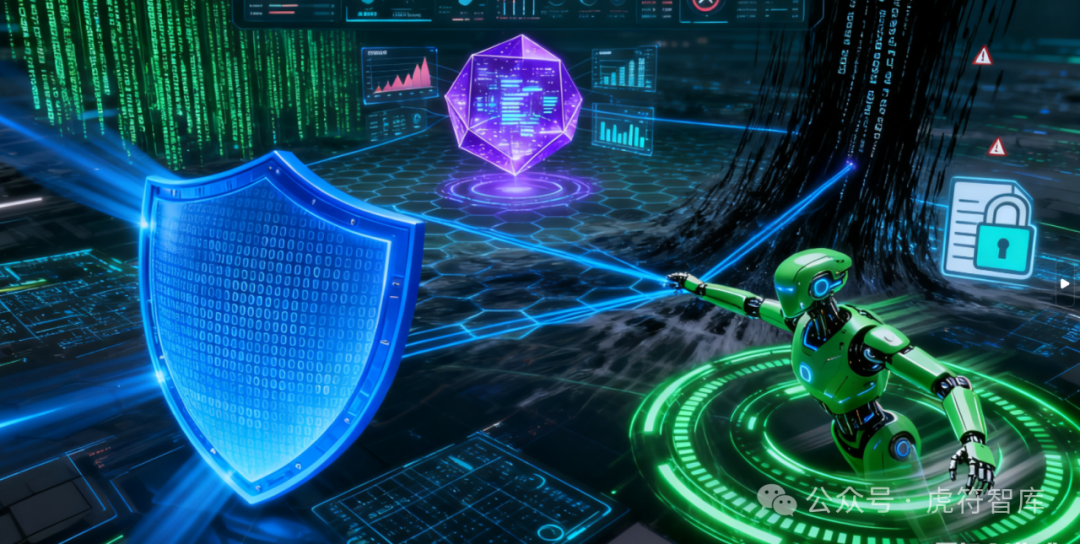
But there is no need to be pessimistic, as a revolution is underway. The future guardians will no longer be those rigid “security guards,” but a group of AI Agents (AI intelligent agents).
AI agents possess cross-task memory retention capabilities, can integrate multiple AI models to perform complex tasks, and autonomously determine when to call upon internal and external systems. They are evolving from tools that execute commands to entities with survival instincts, social collaboration, and empathy.
This leap from “tools” to “living entities” is fundamentally rewriting the rules of the cybersecurity game. The future security perimeter will be composed of countless AI Agents with survival instincts, social intelligence, and empathy, forming a resilient, evolving, and thinking “organic life form”.
The First Leap: From “Waiting for the Rabbit” to “Fighting for Survival”—Awakening of Survival Instincts
Past firewalls and antivirus software are what we call “passive defenses.” They try hard, but essentially they are “waiting for the rabbit”: they react only when an attack occurs. This is like only getting fixed vaccinations for the body, unable to cope with constantly mutating new viruses.
The “survival-driven” AI Agent is like having a powerful “life brain” implanted. Its core driving force is no longer “following rules,” but “ensuring the survival and health of the network ecosystem I protect.”
Authoritative analysis institutions have also foreseen this shift: the international research organization Gartner clearly predicts in its trend report that by 2026, 30% of enterprises will deploy AI-driven security systems with self-learning and adaptive capabilities to address unknown threats【1】. To survive, it exhibits three astonishing instincts:
1. Dynamic Adaptation: Possessing a “Digital Immune System”
When encountering an unprecedented attack (zero-day vulnerability), traditional systems may become “dumbfounded.” But AI Agents will quickly identify this “foreign pathogen” like our immune system and immediately begin to “produce antibodies”—that is, self-learn and iterate new defense strategies. They no longer need to wait for human engineers to release patches; they evolve in combat, becoming stronger with each battle.
2. Proactive Reconnaissance: Tireless “Internal Penetration Testers”
They do not wait for attacks. Instead, they transform into “white hat hackers,” patrolling the network 24/7, constantly “attacking themselves,” simulating various intrusion paths, and actively seeking vulnerabilities. This “self-immunity” practice allows them to complete repairs and fortifications before real hackers discover vulnerabilities. It is like conducting regular fire drills rather than waiting for a fire to occur to read the manual.
3. Resource Balancing: Intelligent “Ecosystem Managers”
They understand “good steel should be used on the blade.” In calm times, they proactively lower defense levels, releasing computing resources to business systems to ensure the network’s “physical fitness” is robust. Once they sense a threat approaching, they can instantly mobilize all resources, entering a “wartime state” to form an impenetrable barrier. This dynamic balancing capability transforms security from a “cost burden” into an intelligent “resource scheduling art.”
The Second Leap: From “Lone Heroes” to “Superhero Alliances”—The Rise of Social Intelligence
No matter how powerful an AI is, it can easily be overwhelmed by organized, multi-stage “saturation attacks.” The future of cyber warfare will essentially be a “social war” of multi-agent (Multi-Agent) systems. Both offense and defense will appear in the form of AI Agent societies organized as “legions.”
The MIT Technology Review has pointed out that the “agent society” where multiple AI agents work together will be an important form of future AI applications, and cybersecurity is a key battlefield【2】. This trend is gradually being recognized by academia and industry.
Google DeepMind’s findings in multi-agent system research show that AI can develop complex cooperative behaviors, achieving collective intelligence that surpasses individual capabilities【3】.
1. Defense Side: “Digital Avengers” Working Together
The future security perimeter will be guarded by a well-defined, coordinated AI agent team
-
“Scout” Agent: Like an eagle eye, responsible for regular patrols at the borders (network boundaries) and internally (data flows), reporting any anomalies immediately.
-
“Intelligence Officer” Agent: Like Nick Fury from S.H.I.E.L.D., specializing in analyzing vast amounts of threat intelligence, identifying attack patterns, and sharing insights in real-time with the entire alliance.
-
“Emergency Response Officer” Agent: Like Thor or Iron Man, quickly isolating infected devices and blocking malicious traffic upon receiving intelligence.
The trust and collaboration mechanisms established among them are the true core of the defense system, giving the entire system strong “robustness” (the ability to withstand attacks).
2. Attack Side: Organized “Digital Terrorist Legion”
Similarly, the AI on the hacker side is no longer operating solo. They will form efficient “criminal gangs”: one Agent responsible for social engineering phishing (door prying), another for lateral movement (expanding control internally), and another specifically for encrypted communication and log clearing (destroying evidence). This tactical coordination renders single-point defenses ineffective.
Thus, the future confrontation will be a game between one AI Agent society and another AI Agent society. Human security experts will be elevated to the role of “strategic commanders” in this war, responsible for setting macro goals, formulating engagement rules, and making top-level decisions.
The Third Leap: From “Cold Alerts” to “Understanding Allies”—The Birth of Empathetic Collaboration
Current security systems interact with humans in a very “mechanical” way: throwing a pile of codes and log alerts at you (Alert Fatigue), leaving the already understaffed security teams overwhelmed.
The goal of “empathetic” AI Agents is to become the “intelligent co-pilot” of human analysts or the “force beside the Jedi Master.” They not only empower technically but also provide cognitive and emotional support. The core of this leap is value alignment, as emphasized by OpenAI in its discussions on building safe AGI (Artificial General Intelligence), where cutting-edge AI systems must align with human intentions and values【4】.
“Empathetic” AI Agents need to:
-
Understand Intent and Emotion: They can determine whether you are “anxious” or “confused” based on your typing tone and commonly used keywords. When you are anxious, they will automatically simplify information and provide the highest priority action suggestions; when you are confused, they will slow down and explain the attack chain in a more intuitive way (e.g., visual graphs).
-
Emotional Communication: They will say to novice analysts: “Don’t worry, we’ll take it step by step. This alert may be a false positive; let’s first verify these three simple steps…”; to experienced experts, they will be concise: “Advanced Persistent Threat (APT), attack source located, key data not compromised, recommend executing containment strategy number three immediately.”
-
Value Alignment: This is the highest level of achievement. Such AI Agents will internalize human societal ethics and values as part of their decision-making. For example, when discovering suspicious behavior from an internal employee, they will not simply expose their private data across the network but will prioritize privacy protection principles while controlling risks, perhaps only providing necessary, anonymized behavioral evidence to supervisors. What they do is not only the “right” thing but also the “right” thing to do.
Conclusion: Embracing the Era of “Life Forms” and Redefining Security Frontiers
The trajectory of cybersecurity development is clear: it is evolving from a contest of tools to an ecological competition of life forms. As forward-looking research from institutions like Gartner, DeepMind, MIT, and OpenAI indicates, this transformation is not just a technological upgrade but a cognitive revolution.
The future cybersecurity perimeter will be composed of countless AI Agents with survival instincts, social intelligence, and empathy, forming a resilient, evolving, and thinking “organic life form”.
This means our understanding of cybersecurity must elevate. It is no longer just about firewall rules and antivirus virus databases, but about how to design, cultivate, and manage a healthy digital ecosystem.
Whoever can first understand and master these profound insights that transcend technology, biology, and sociology will fundamentally build a truly intelligent security system for the future.
About the Author
Zhang Zhuo, Partner and Vice President of Qi An Xin Group, Head of Security Operations PBG, with over ten years of experience in technical research and development, architecture, product, and project management in well-known domestic cybersecurity companies.
References
【1】Gartner, “Predicts 2023: Cybersecurity Industry Focuses on Human-Centric, Platform Consolidation and Talent Management”, 2022.
【2】MIT Technology Review, “AI agents that do real work are the next frontier of AI”, 2023.
【3】DeepMind, “The Emergence of Cooperative Behaviors in Multi-Agent Systems”, 2023.
【4】OpenAI, “Our approach to alignment research”, 2022.
END