Have you ever fantasized about having an intelligent assistant like “Jarvis” from “Iron Man”? You just need to speak, and it can help you manage emails, book flights, analyze data, and even complete more complex tasks. This scene, once belonging to science fiction, is rapidly becoming a reality with the rise of a technology called “AI Agent” (Artificial Intelligence Agent).
In the past year or two, we have marveled at the “conversation revolution” brought by large language models (LLMs). From ChatGPT to Gemini, AI can now converse with us fluently, write poetry, and create art. But if you think the endpoint of AI is merely “chatting,” you may be underestimating the true potential of this technological transformation. The emergence of AI Agents marks the evolution of AI from a “knowledgeable conversationalist” to a “capable doer.” It no longer just tells you “how to do it”; it directly “does it for you.”
This article will take you through a comprehensive understanding of what AI Agents are, the “magic” behind them, how they will disrupt our work and lives, and what challenges we still face on the road to an intelligent future.
1. From “Conversation” to “Action”: What Exactly is an AI Agent?
Let’s start with a simple example.
Suppose you want to plan a trip to Beijing next weekend.
Traditional AI assistants (like chatbots) operate as follows: You ask, “Help me plan a weekend trip to Beijing.” It replies, “Sure. On the first day, you can visit attraction A in the morning, and attraction B in the afternoon, and on the second day you can…” — It provides a detailed itinerary, but you remain the executor.

Using a Chatbot to create a plan
In contrast, the AI Agent operates as follows: You make the same request. It says, “Okay, please wait a moment.” Then, it begins to operate autonomously in the background:
-
Thinking and Planning: “The user wants to go to Beijing next weekend. The tasks are to book flights, hotels, and recommend an itinerary. I need to confirm the user’s budget and preferences first.”
-
Interacting with you: “What is your approximate budget? Do you have any specific requirements for accommodation, such as being close to the city center?”
-
Gathering information and acting: After you respond, it automatically connects to the corresponding application API, queries the lowest price flights that fit the schedule, and filters several options. At the same time, it accesses the hotel booking platform’s API to find highly rated hotels in good locations based on your requirements.
-
Integrating and presenting: “I have filtered three ‘flight + hotel’ options for you. Option A has the best cost-performance ratio, and Option B is the most flexible in terms of timing… Which one would you like to choose? Once confirmed, I will book it for you directly.”
-
Completing the task: After you confirm, it calls the payment interface (with your authorization), completes the booking, and sends the electronic ticket, hotel confirmation, and a suggested itinerary to your email.
Notice the difference? The core distinction of the AI Agent lies in its ability to “act autonomously” and “use tools.” It is like an intelligent agent with a super brain (LLM) that has been granted access to and the ability to operate other software tools.
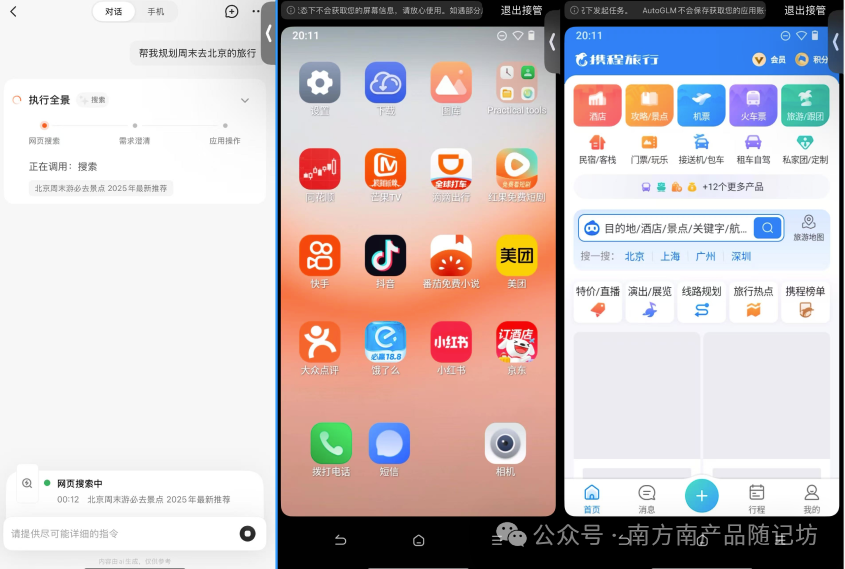
Using a mobile Agent to automatically invoke applications for queries
An AI Agent typically consists of four core components:
-
Brain: This is the core of the Agent, usually a powerful large language model (LLM). It is responsible for understanding your intentions, performing complex logical reasoning, and breaking down a grand goal (like “planning a trip”) into a series of executable steps.
-
Perception: The Agent needs to understand its environment and the information it receives. This includes the text and images you input, as well as data and error messages returned from various apps (tools).
-
Action: This is the key to the Agent’s interaction with the digital world. It executes tasks by calling various APIs (Application Programming Interfaces), such as sending emails, querying databases, and placing orders online. Each API acts like an “organ” or “tool” for it, greatly expanding its capability boundaries.
-
Memory: An excellent Agent possesses memory capabilities. Short-term memory allows it to remember the context of the current task, ensuring task coherence. Long-term memory enables it to learn from past experiences, understand your preferences, and perform better in future tasks (like remembering that you prefer window seats).
In simple terms, an AI Agent = a thinking “brain” + a set of usable “toolboxes.” It is not an isolated program but a “commander” capable of connecting and orchestrating other programs to complete complex tasks.
2. Unveiling the “Magic” Behind: How the ReAct Framework Drives Agent Thinking and Action?
At this point, you may wonder how AI Agents achieve such intelligent thinking and action. One of the key technologies behind this is a conceptual framework called “ReAct.”
ReAct stands for “Reasoning” and “Acting,” and it constructs a powerful “thinking-action” loop for AI Agents. This process closely resembles how humans solve problems:
-
Thinking: The Agent first analyzes the current goal and existing information, then reasons, “What do I need to do now? What is the most reasonable next step to achieve the goal?”
-
Action: Based on the results of the thinking, the Agent decides to call a specific tool to perform the operation. For example, it decides to use the “search engine” tool to check the “weather in Beijing next week.”
-
Observation: After executing the action, the Agent “observes” the results returned by the tool. For instance, it receives the weather forecast data.
-
Re-thinking: The Agent updates its understanding of the task based on the new observations and plans the next action. “The weather forecast shows rain this weekend; I should include indoor activities in the itinerary and remind the user to bring an umbrella.”
Through this “thinking -> action -> observation” loop, the AI Agent can gradually approach the final goal. Even if it encounters problems along the way (such as a failure in calling an API of a certain app), it can “observe” the error, re-think, and attempt other solutions, demonstrating remarkable flexibility and robustness.
This framework transforms LLMs from mere models that “fantasize” within their knowledge base into intelligent agents that can interact with real-world data and tools, continuously learning through trial and error in practice.
3. From Science Fiction to Reality: In Which Fields are AI Agents Making a Big Impact?
Although AI Agent technology is still rapidly developing, it has already begun to show tremendous potential in many fields.
-
Personal Assistants and Office Automation: This is the most intuitive application. Your Agent can become a “super secretary,” helping you manage schedules, automatically reply to specific emails, organize meeting minutes, extract key to-do items, and even submit expense reimbursement requests automatically while you are on business trips. It can free you from tedious administrative tasks.
-
Software Development and Testing: Programming Agents like Devin AI have garnered widespread attention in the industry. They can autonomously write code based on requirement documents, find and fix bugs, configure server environments, and even complete entire software projects. This will significantly change the working patterns of software engineers, allowing them to focus more on creative system design.
-
Business Intelligence and Data Analysis: Corporate executives no longer need to wait for data analysts to schedule reports. They can directly ask the Agent in natural language, “Analyze the main reasons for the decline in sales in East China last quarter and compare it with the same period last year.” The Agent will automatically connect to the company database, run complex SQL queries, integrate data, and generate a visually rich analysis report.
-
E-commerce and Customer Service: Traditional customer service chatbots can only answer preset questions, while Agent-driven customer service can handle more complex scenarios. It can not only answer questions but also directly access the order system to help customers complete returns, modify addresses, and check logistics, providing a one-stop solution.
-
Scientific Research: Researchers can use Agents to automatically read and summarize vast amounts of literature, discovering new research directions or potential drug targets. Agents can even assist in designing experimental plans and analyzing experimental data, accelerating the pace of scientific discovery.
4. Opportunities and Challenges Coexist
The future depicted by AI Agents is undoubtedly exciting. It heralds an “agent-first” era, where future software interactions may no longer require us to manually switch between countless apps, but rather through a unified natural language interface, with a cluster of Agents behind the scenes orchestrating everything for us.
However, as of now, the large-scale application of AI Agents still faces the following challenges:
-
Reliability and Fault Tolerance: LLMs occasionally “make mistakes” (i.e., “hallucinations”). While this may be harmless in conversations, if an Agent makes an error while executing critical tasks (such as financial transactions or deleting files), the consequences could be severe. Ensuring the accuracy of each action taken by the Agent is currently the biggest technical challenge.
-
Security and Permission Management: The more powerful the Agent’s capabilities, the greater the permissions it is granted. Designing a permission system that allows the Agent to work effectively while preventing misuse or hacking is a crucial issue. No one wants their Agent to “betray” them, leaking personal privacy or causing financial losses.
-
Cost and Efficiency: Each “thinking-action” cycle of the Agent requires calling a powerful LLM, which incurs high computational costs. Before achieving large-scale application, methods must be found to improve efficiency and reduce costs.
-
Human-Machine Interaction and Trust: How should we collaborate with these powerful Agents? How can we design a clear interface that allows us to supervise, intervene, or even “stop” the Agent’s actions at any time? Establishing a trust relationship between humans and Agents is a prerequisite for their widespread acceptance.
We welcome everyone to follow, like, and share, to exchange ideas and grow stronger together!