Multi-Agent Collaboration

Multi-Agent Collaboration

Hello everyone, today I continue to share Google expert Antonio Gulli’s “Agentic Design Patterns”. Today is Chapter 7: “Multi-Agent Collaboration”. When a single AI cannot solve complex problems (such as needing market analysis, copywriting, and design layout simultaneously), a multi-agent system can decompose tasks and have multiple specialized agents collaborate to complete them. There are … Read more

A New Paradigm for Multi-Agent Routing: Directing Large Models

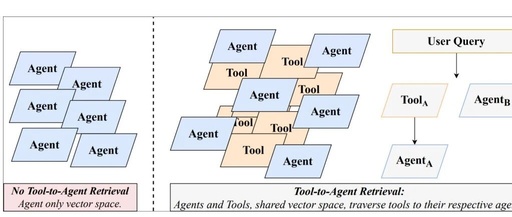
A New Paradigm for Multi-Agent Routing: Directing Large Models

With the rise of the Model Context Protocol (MCP) ecosystem, an Assistant may be supported by hundreds of tools/sub-Agents. Stuffing all tool descriptions into the Prompt? → Starting at 4,600+ tokens, which is painfully expensive. Selecting an Agent before choosing tools? → Coarse-grained descriptions often bury “hidden treasure tools”. Using only a single tool? → … Read more

Selected Robotics Papers from arXiv – November 8, 2025

Selected robotics papers from arXiv! 👏👏👏 #Robotics ForeRobo: Unlocking Infinite Simulation Data for 3D Goal-Driven Robotic Manipulation Date: November 6, 2025 Authors: Dexin Wang, Faliang Chang, Chunsheng Liu Link: http://arxiv.org/abs/2511.04381v1Efficiently utilizing simulation to acquire advanced manipulation skills is both challenging and highly important. We introduce ForeRobo, a generative robotic agent that autonomously acquires manipulation skills … Read more

Thoughts on the AI Multi-Agent Collaboration Paradigm

Currently, AI is extremely popular, and for us engineers, the main focus is on multi-agent collaboration to complete vertical business tasks. Through exploration, it seems that the paradigm of AI does not deviate significantly from computational paradigms; its core collaboration logic still follows the classic control flow patterns in computer science. It represents a natural … Read more

AI Agents: The Core Engine Reshaping the Intelligent Future

1. Technological Breakthroughs and Architectural Evolution of AI Agents1. Technological Leap: An Efficiency Revolution from “Teaching Mode” to “Practical Training”The “learning method” of AI Agents has undergone a critical upgrade: early supervised fine-tuning (SFT) was like a teacher guiding students through problems, relying on manually labeled data for learning.Now, reinforcement feedback tuning (RFT) resembles athletes … Read more

The AI Agent Revolution in Cybersecurity: From Tool Wars to Life-Level Ecological Games

The AI Agent Revolution in Cybersecurity: From Tool Wars to Life-Level Ecological Games

This article2953words Reading time approximately 7minutes Imagine this scenario: Late at night, a modern digital city (your company network) is quietly operating. Traditional security systems are like security guards standing in fixed booths, checking vehicles entering and exiting according to a manual. Suddenly, a group of “digital agents” wearing cloaks of invisibility and constantly changing … Read more

AI Agents: Until the Illusions Completely Disappear

AI Agents: Until the Illusions Completely Disappear

AI Agent After the Dartmouth Conference in 1956, the spark of artificial intelligence was ignited. However, for pioneers like John McCarthy, Allen Newell, and Herbert Simon, how machines could truly simulate “human learning and intelligence” remained a grand mystery. At that time, the academic focus was on model algorithms, program logic, and system strategies—these were … Read more

Optimizing Intelligent Agents: Practical Application of AI Multi-Agent Collaborative Architecture in 5G Slicing Optimization

Optimizing Intelligent Agents: Practical Application of AI Multi-Agent Collaborative Architecture in 5G Slicing Optimization

Background This article is the fourth in the series on telecom AIOps intelligent agents. Building on the previous articles on Monitoring and Diagnostics agents, it focuses on the most critical link in the operational closed loop: Optimization and Repair. Based on the agent workflow orchestration capabilities and the RAG knowledge base, this article constructs a … Read more

Chapter 6: Multi-Agent Systems

Chapter 6: Multi-Agent Systems

1. Why Do We Need Multiple Agents? Division of Labor, Fault Tolerance, and Coverage of Specialized Fields A single agent can accomplish a “task,” but when faced with complex projects, multi-role collaboration, and high fault tolerance requirements, it becomes inadequate. Multi-Agent Systems (MAS) provide core value by enabling multiple specialized agents to collaborate, working in … Read more

AI Agents: From ‘Tools’ to ‘Brains’

AI Agents: From 'Tools' to 'Brains'

In the past, we were accustomed to viewing AI as a passive tool, such as chatbots or image generators, where we provided explicit instructions, and it executed corresponding tasks. Once the task was completed, the conversation would end. This model is essentially a “question-and-answer” mechanism. However, AI Agents are fundamentally different. Their core lies in … Read more