In recent years, with the evolution, combination, and iteration of emerging digital technologies such as big data, cloud computing, and artificial intelligence, trade, as a key link in the allocation of economic and social resources, is undergoing a digital transformation, gradually giving rise to a new trade model known as digital trade (Ma Shuzhong and Shen Yuting, 2023).
Since the beginning of the 21st century, there has been a significant divergence in the growth rates of digital trade and traditional trade, with digital trade becoming a new trend in international trade development and a new growth point for the economy. In this process, China has gradually recognized the importance of digital trade development and has elevated it to a national strategy.
In 2021, the “14th Five-Year Plan for the Development of Service Trade” first included digital trade in China’s service trade development plan, greatly enhancing the status of digital trade in China’s international trade. The report of the 20th National Congress of the Communist Party of China proposed to “develop digital trade and build a strong trading nation,” and the third plenary session of the 20th Central Committee further clarified the need to “innovate and develop digital trade.” Under a series of policy initiatives, digital trade has shown vigorous development, becoming a “new engine” for China to build a strong trading nation. At the same time, China actively participates in the formulation of digital trade rules, expanding its “circle of friends” in digital trade, gradually transforming from a “follower” of existing rules to an active “participant” in digital trade negotiations.
With the rapid rise of digital trade, related discussions have gradually increased. Early research suggested that digital trade mainly includes digital products and services, without covering tangible goods (USITC, 2013), viewing cross-border e-commerce as a primary form of digital trade development.
Currently, research generally holds that digital trade is a new trade model significantly different from traditional trade, with discussions mainly focusing on two aspects:
First, the microeconomic effects of digital trade. For example, digital trade significantly promotes the innovation level of enterprises and their international competitiveness. The broader and deeper the digital trade rules, the more effectively they can promote the digital transformation of enterprises and enhance their position in the global value chain (Hou Junjun et al., 2023).
Second, the macroeconomic effects of digital trade. For instance, digital trade can reduce bilateral trade costs and promote the cross-border flow of R&D factors, thereby driving the digital transformation of the global value chain. The signing of digital trade rules can significantly increase the proportion of technology-intensive and high-value-added products, represented by computer and communication technologies, exported to contracting countries, thus promoting the industrial transformation and upgrading of a country (Wu Na et al., 2024). Unfortunately, there is little research on the impact of digital trade on the internationalization of currencies. Even though some studies have found that digital trade can provide new application scenarios for the internationalization of the renminbi (Shi Lei and Zhang Jing, 2024), they have not analyzed the underlying logic and mechanisms behind it.
In fact, in-depth exploration of the determinants of currency internationalization and promoting the internationalization of the renminbi has always been a topic of common concern in both theoretical and practical circles. Among them, trade development significantly affects the process of a country’s currency internationalization (Krugman, 1980). Trade is not only a fundamental condition for currency internationalization but also a core driving force (Li Chao, 2010).
Generally, the higher the degree of differentiation of a country’s export goods, the stronger its international trade competitiveness, and the larger its market share, the greater the power of discourse for pricing and settling export trade in its own currency, thus promoting the use of its currency in export trade (Goldberg & Tille, 2008). However, despite being a major trading nation, China has long faced the issue of being large but not strong in trade. Since the reform and opening up, China has achieved extensive development of export trade through processing trade, with rapid growth in export volume, but most export products are of medium to low added value and highly substitutable, resulting in China’s manufacturing industry being positioned at the low end of the global value chain for a long time. Additionally, the insufficient competitiveness of trading enterprises and products, limited bargaining power, and weak choice of pricing currency have also affected their role in promoting the internationalization of the renminbi (Chen Weidong et al., 2023).
Unlike traditional trade and value chain trade, digital trade, as a product of the digital economy era and economic globalization, has undergone significant changes in terms of trade methods, trade objects, timeliness of trade, payment methods, and trade regulatory policies, making its impact on the internationalization of the renminbi more complex, with channels of action significantly different from traditional trade and value chain trade.
In light of this, this article attempts to explore the basic logic of prudently and steadily promoting the internationalization of the renminbi under the development of digital trade, and from the channels of trade transformation and upgrading, currency choice discourse power, and cross-border digital ecology, elucidate the theoretical logic and mechanisms of digital trade promoting the internationalization of the renminbi. On this basis, based on China’s actual situation, it further explores the feasible paths for digital trade to promote the internationalization of the renminbi.
The Rise of Digital Trade and Consensus
(1) Definition and Connotation of Digital Trade
As a new trade model distinct from traditional trade, the Organization for Economic Cooperation and Development (OECD), the International Monetary Fund (IMF), the United Nations Conference on Trade and Development (UNCTAD), and the World Trade Organization (WTO) jointly released the second edition of the “Digital Trade Measurement Handbook” in 2023, defining digital trade as “all international trade ordered and/or delivered digitally.”
China’s Ministry of Commerce adopts this definition, considering digital trade as trade characterized by data resources as key production factors, digital services as the core, and digital ordering and delivery as the main features. Among them, digital delivery trade refers to all international trade transactions delivered remotely through computer networks, including digital technology trade, digital service trade, digital product trade, and data trade. Digital ordering trade refers to international trade transactions conducted by receiving or placing orders through computer networks, primarily represented by e-commerce and cross-border e-commerce. It is evident that digital trade is a new international trade model that uses products or services as carriers, conducts cross-border transmission through digital transactions, and is carried out in a digital manner (Shen Yuliang et al., 2022).
Compared with traditional trade, digital trade exhibits new characteristics in terms of trade methods, trade objects, timeliness of trade, payment methods, and trade regulatory policies (Table 1).
Digital trade is a product of traditional trade adapting to digitalization and globalization, characterized by both trade methods and trade objects being digital (Hou Junjun et al., 2023). Specifically, the digitization of trade methods is the deep integration of information technology with traditional trade at all stages, promoting the digitization of the entire trade chain and process.
In traditional trade, transactions typically rely on the cross-border transportation of physical goods, face-to-face business negotiations, the signing of paper contracts, and bank wire transfers for payment. These transaction methods are often limited by geographical location, transportation costs, and time, usually resulting in longer transaction cycles and higher transaction costs (Ma Shuzhong et al., 2018).
In contrast, digital trade utilizes tools such as e-commerce platforms, online payments, electronic contracts, and digital logistics systems to automate, instantaneously, and globally realize the transaction process. Digital transformation not only enhances the efficiency of order acquisition, payment settlement, and product delivery but also eliminates the time and space limitations of traditional trade through internet technology, significantly reducing transaction costs and enhancing market transparency and liquidity.
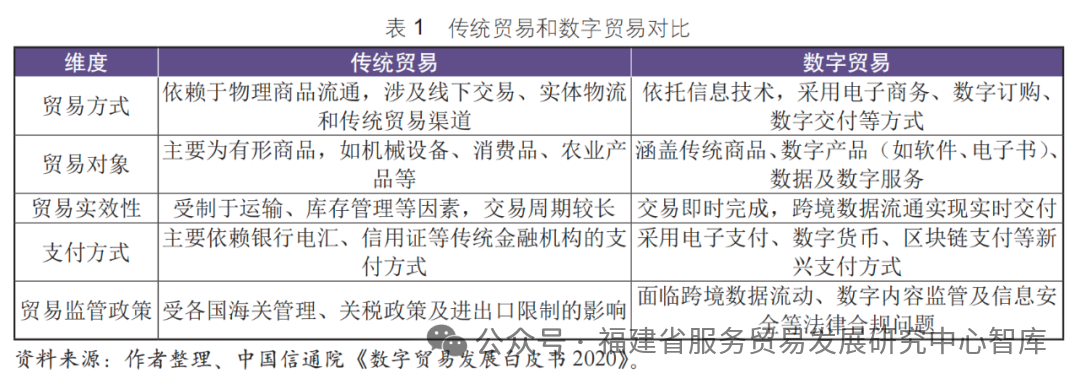
The digitization of trade objects means that, under the development of information technology, elements, products, and services that exist in data form have become important trading objects in international trade, making trade objects more diverse.
Specifically, in traditional trade, goods and services are usually concrete and physical, requiring logistics and cross-border transportation for delivery. However, with advancements in information technology, digital goods (such as software, digital content, online services, etc.) and virtual goods (such as cloud computing services, digital currencies, etc.) have become important components of global trade.
Digital trade not only promotes the flow of intangible assets in the global market but also breaks geographical and political boundaries through cloud platforms, online transactions, and data exchanges, making international trade exchanges no longer limited to physical goods. It is worth mentioning that data, as a core production factor, is also gradually becoming a new trading object.
(2) Development of Digital Trade in China
Since 2021, when China included digital trade in the “14th Five-Year Plan for the Development of Service Trade,” the status of digital trade in China’s international trade system has significantly improved, becoming an important engine for economic growth. Subsequently, digital trade in China has rapidly developed, demonstrating strong support for high-quality trade development.
In terms of trade methods characterized by digital delivery, in 2023, China’s total import and export volume of services based on digital delivery has approached $386 billion, with a year-on-year growth of about 3.5%, accounting for more than 40% of the total service trade volume. Among them, exports exceeded $219 billion, with a year-on-year growth of about 4%, ranking sixth globally; imports were about $166.9 billion, with a year-on-year growth of about 2.9%, ranking seventh in the world. The continuous rise in the scale and proportion of digital delivery service trade is mainly attributed to the rapid development of technology-intensive and knowledge-intensive industries. For example, in the telecommunications, computer, and information services sector, the trade volume in 2023 reached about $129 billion, growing nearly 4% compared to the previous year, providing strong support for digital trade.
The “Opinions on the Reform and Innovation Development of Digital Trade” released in November 2024 further clarifies that by 2029, the scale of digital delivery service trade should steadily increase, striving to raise its proportion in China’s total service trade to over 45%, indicating the direction for digital trade development in the next five years.
In terms of trade methods characterized by digital ordering, since 2015, the proportion of cross-border e-commerce import and export volume in China’s total goods trade has increased from 1% in 2015 to 5.7% in 2023, with cross-border e-commerce gradually becoming a new engine driving the growth of China’s foreign trade.
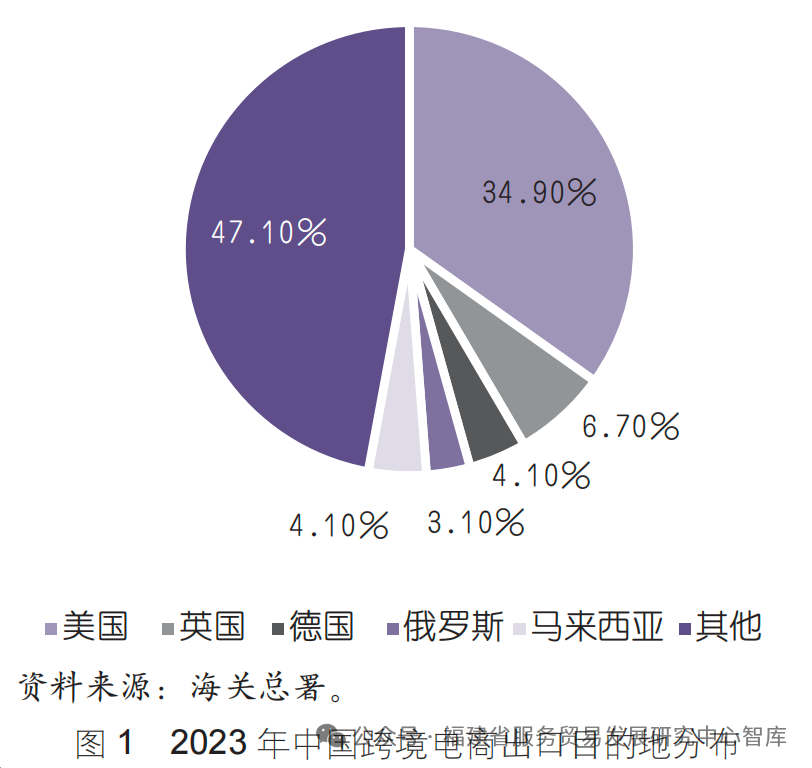
According to statistics from the General Administration of Customs, in 2023, China’s total import and export volume of cross-border e-commerce reached 2.38 trillion yuan, a year-on-year increase of 15.6%, with exports reaching 1.83 trillion yuan and imports approximately 548.3 billion yuan. Compared to 1.06 trillion yuan in 2018, the total import and export volume of cross-border e-commerce has increased by 1.2 times over five years, showing a continuous growth trend. In terms of export destinations, due to the well-established e-commerce infrastructure in developed countries in Europe and America, over 60% of China’s cross-border e-commerce exports in 2023 were directed to the US and European markets: among them, the US market accounted for 34.9%, the UK 6.7%, and Germany 4.1% (Figure 1).
This trend also reflects that China’s cross-border e-commerce trading partners have covered the globe, with cross-border e-commerce increasingly enhancing its competitiveness in global network channels.
Digital Trade, Trade Transformation and Upgrading, and Renminbi Internationalization
A country’s trade strength is a key driving factor for its currency to become an international currency (Flandreau & Jobst, 2009). The internationalization of the renminbi is inseparable from high-level foreign trade (Zhang Ming et al., 2022).
As early as the 18th century, Britain relied on its strong trade and financial strength to gradually make the pound a major international currency. In the first half of the 20th century, the United States established a strong industrial system through two world wars, dominating industrial production, trade, and financial transactions, leading to the dollar gradually replacing the pound as the main international currency. In comparison, China is the world’s second-largest economy and the largest trading nation, possessing a strong manufacturing industry and a complete industrial chain.
However, from the reform and opening up to the early 21st century, due to a lack of advanced technology and raw materials, relying on the advantages of low-cost labor and land, China achieved rapid development of export trade through processing trade. Although the growth rate of export volume is astonishing, most export products are of medium to low added value and highly substitutable, resulting in China’s manufacturing industry being positioned at the low end of the global value chain, unable to obtain corresponding currency pricing choices, and having a relatively limited role in promoting the internationalization of the renminbi.
(1) Digital Trade and Trade Transformation and Upgrading
Optimizing the trade structure is one of the core goals of trade transformation and upgrading.
In recent years, with the continuous development of digital trade, the digitalization of the entire industrial chain, supply chain, and value chain of foreign trade has been upgraded and reconstructed, promoting the upgrading of industrial structure. Traditional foreign trade mainly relies on processing trade dominated by labor-intensive products, which have low added value and find it difficult to occupy a favorable position in the global industrial chain.
With the widespread application of information technology, especially the development of digital products, digital technologies, and digital service trade, China’s industrial chain is gradually transforming from low to medium added value production links to higher value-added links with more technological content and innovation, thus continuously optimizing the trade structure and enhancing trade competitiveness (Hou Huifang et al., 2024).
With the optimization of the industrial structure, the proportion of high-tech products represented by computer and communication technologies in exports continues to expand. Digital trade has gradually become a new trend and new growth point for China’s foreign trade development, giving rise to new business formats such as cross-border e-commerce, virtual exhibitions, and smart logistics, accelerating the deep reconstruction of global industrial chains, supply chains, and value chains, further highlighting the international competitiveness of Chinese manufacturing and services.
Trade transformation and upgrading are not only reflected in the optimization of trade structure but also require the improvement of cross-border trade infrastructure.
Digital trade, through the construction of digital trade platforms, further releases the supply and demand potential of international markets, where highly interconnected virtual networks intersect with trade networks that have significant economic impacts, generating strong positive externalities, promoting China’s transition from traditional manufacturing exports to a more diversified and innovation-driven trade model (Shen Yuliang et al., 2022).
For example, Alibaba’s Electronic World Trade Platform (EWTP) serves as an important practice in China’s digital trade field, establishing global digital trade infrastructure, simplifying customs clearance processes, and improving trade efficiency. It has established cooperative networks in 11 countries and regions, providing digital trade services for over 140,000 small and medium-sized enterprises, promoting the digital and intelligent transformation of foreign trade. These platforms not only enhance China’s position in the global value chain but also promote the optimization and upgrading of domestic industrial structures.
Digital trade platforms break the time and space limitations of traditional trade, reducing the costs of cross-border transactions and improving resource allocation efficiency. With the support of technologies such as cross-border e-commerce, digital payments, cloud computing, and big data, Chinese enterprises can more easily access global markets, pushing enterprises to gradually shift from exporting medium to low value-added manufacturing products to high value-added technology and services.
Trade transformation and upgrading involve not only the optimization of trade structure and trade infrastructure but also the upgrading of trade rules.
As the global trade environment changes, traditional trade rules can no longer meet the needs of new trade models. The formulation of digital trade rules not only helps China occupy a favorable position in the global digital economy but also provides important institutional guarantees for China’s transformation from traditional manufacturing to high value-added and high-tech trade structures (Wu Na et al., 2024).
China actively participates in the formulation of digital trade rules, gradually forming a “China model” for digital trade rules, and promoting the experience of China’s rule-making internationally, expanding the institutional openness of digital trade (Liu Bin and Zhen Yang, 2022).
Since signing the Comprehensive Economic Cooperation Framework Agreement with ASEAN in 2002, which first proposed “strengthening cooperation in the field of e-commerce,” China has gradually included and enriched digital trade rules in regional trade agreements (RTA) with other countries and regions. As of 2023, China has signed 19 RTAs containing digital trade rules with 29 countries or regions.
In May 2024, the fifth round of negotiations for the Digital Economy Partnership Agreement (DEPA) that China participated in was held in New Zealand, focusing on clauses related to digital payments, digital identity, data flow, and paperless trade, demonstrating China’s determination to actively participate in the formulation of global digital trade rules and the transformation of trade structures.
Overall, China is occupying an increasingly important position in the global formulation of digital trade rules. The evolution of China’s digital trade rules shows a trend from singularity to richness, from recipient to rule-maker, and from learning to innovation, making positive contributions to the formulation and improvement of global digital trade rules, while providing a solid institutional guarantee for the transformation and development of China’s trade structure.
(2) Trade Transformation and Upgrading and Renminbi Internationalization
Digital trade provides important impetus for the internationalization of the renminbi in the process of promoting China’s trade transformation and upgrading.
First, the widespread application of digital technology in the trade field promotes China’s transformation from low to medium value-added manufacturing to high value-added, technology-driven industries. This transformation not only enhances China’s position in the global value chain but also increases the stickiness of the use of the renminbi in international trade. As the proportion of China’s high value-added products in the global market continues to rise, the use of the renminbi as a settlement currency gradually increases, promoting the internationalization of the renminbi. Second, the construction of digital trade platforms reconstructs the global payment network and innovates currency circulation channels.
The global layout of cross-border e-commerce and digital payment platforms, such as Alipay and WeChat Pay, breaks the time and space limitations of traditional trade, effectively reducing the transaction costs of renminbi and improving the efficiency of renminbi payments. These platforms enable the widespread use of the renminbi in cross-border transactions, promoting its integration into the global payment system and enhancing the international circulation of the renminbi.
Finally, the formulation of digital trade rules reconstructs the international monetary order and builds institutional guarantees. By actively participating in the formulation of global digital trade rules, China not only ensures its discourse power in digital trade but also provides legal and policy support for renminbi settlement. For example, clauses related to digital payments and data flow in regional trade agreements such as RCEP create conditions for the use of the renminbi within the region, promoting its application in international trade. In summary, digital trade provides strong support for the internationalization of the renminbi by optimizing trade structure, promoting the construction of trade infrastructure, and improving the trade rule system.
Digital Trade, Currency Choice Discourse Power, and Renminbi Internationalization
The choice of pricing and settlement currency in bilateral trade is often influenced by the strength or bargaining power of the enterprises on both sides (Friberg & Wilander, 2008). In recent years, with the advancement of high-level opening up, the number of foreign trade enterprises in China has continuously increased, but the overall scale remains small, and the risk management capabilities and overall operational mechanisms are not sound. The foreign trade development model that relies on quantity and price leads to weak discourse power in the choice of settlement currency, making it difficult to maximize the use of the renminbi for pricing and settlement, which is not conducive to avoiding exchange rate risks and promoting enterprise innovation (Li Daokui and Yin Xingzhong, 2010).
(1) Digital Trade and Enterprise International Competitiveness
Digital trade provides a rare opportunity to enhance the core competitiveness of China’s foreign trade enterprises and thereby promote the internationalization of the renminbi.
First, trade digitization helps reduce various transaction frictions such as settlement costs and time costs for enterprises.
Trade digitization can improve the speed of bilateral trade settlement and save payment settlement costs. For example, in export trade, the implementation of new rules such as paperless trade, online consumer protection, electronic signatures, and certifications can effectively improve the efficiency of export customs clearance and tax refunds, reducing the time costs and menu costs for enterprises (Wilson et al., 2005).
At the same time, the application of big data, artificial intelligence, and blockchain technology in trade provides enterprises with more precise market analysis and forecasting tools, optimizing supply chain management and improving resource allocation efficiency and market response speed. These technological applications enable enterprises to manage supply chain risks more effectively, flexibly adjust production and supply networks, and optimize global layouts, thereby mitigating the impact of industrial chain relocation.
Second, digital trade promotes the digital transformation of enterprises.
In the digital economy era, the massive data generated by digital trade is crucial for promoting international trade activities, facilitating cross-border economic cooperation, and spreading digital content and services (Liu Hongkui, 2020).
Export-oriented enterprises, in order to collect, analyze, and apply data, promote the flow of products, technologies, and funds towards lower costs, higher efficiency, and closer to user directions by providing digital services, recruiting high-quality digital talent, and building new digital platforms, thus meeting the growing personalized demands of consumers and minimizing production and transaction costs (Lanzolla et al., 2021).
Finally, digital trade helps enterprises climb upstream in the value chain.
Digital trade enables enterprises to quickly obtain market demand and industry dynamics through data flow, allowing them to adjust production and marketing strategies more flexibly. This not only helps enterprises enhance their ability to respond to market changes but also facilitates the sharing of information and technology among upstream and downstream enterprises in the industrial chain, leading to collaborative development of the industrial chain. This, to some extent, breaks the monopoly of various value-creating links in the industrial chain, enhancing the breadth and depth of enterprises’ participation in the value chain. Enterprises’ deeper participation in the global value chain division of labor can increase the added value of their export products, drive the digital transformation of traditional industries, and extend to the high end of the global value chain (Ma Dan and Yang Yuhan, 2024).
(2) Currency Choice Discourse Power and Renminbi Internationalization
Digital trade enhances the currency choice discourse power of Chinese enterprises, providing important impetus for the internationalization of the renminbi.
First, digital trade reduces the transaction costs of the renminbi and improves the efficiency of renminbi settlement, creating favorable conditions for renminbi settlement.
The application of digital technology optimizes cross-border transaction processes, improving the convenience of payment settlement, allowing enterprises to choose settlement currencies more flexibly. In the past, foreign trade enterprises tended to choose currencies with high liquidity and international acceptance, such as the dollar or euro, due to significant transaction frictions (Devereux et al., 2017).
However, with the support of digital payments, blockchain smart contracts, and other technologies, the convenience of renminbi transactions has significantly improved, reducing exchange costs and time costs, making more enterprises willing to use the renminbi for settlement, thereby expanding the international use of the renminbi.
Second, digital trade enhances enterprises’ bargaining power in the international market, increasing the acceptance of the renminbi as a settlement currency.
The bargaining power of enterprises in international trade directly affects their choice of settlement currency. Traditionally, foreign trade enterprises often relied on low-cost competition, had weak discourse power, and found it difficult to promote the renminbi as the main settlement currency (Yuan Kaibin et al., 2023).
Digital trade promotes the digital transformation of enterprises, enabling them to enhance their competitiveness through precise market analysis, supply chain optimization, and brand premium, thereby gaining greater control over upstream and downstream information, which in turn provides them with greater initiative in trade negotiations. Enhanced bargaining power allows enterprises to choose settlement currencies more flexibly during negotiations, thereby more effectively promoting the application of renminbi settlement and expanding its use in the international market (Goldberg & Tille, 2013).
Finally, digital trade promotes enterprises’ ascent to the upstream of the global value chain, aiding the enhancement of the renminbi’s status in the international monetary system.
As enterprises optimize supply chain management and market layout through digital technologies, their embedding in the global industrial chain deepens, and the trade model upgrades from simple commodity exports to high value-added services and technology outputs. In this process, the demand for the renminbi extends beyond commodity trade to include digital services, intellectual property transactions, and cross-border investments, thereby broadening the application scenarios of the renminbi. Therefore, in summary, digital trade enhances the international competitiveness of enterprises by optimizing operational efficiency, promoting digital transformation, and facilitating the ascent of enterprises in the value chain, improving their bargaining power in the international market and their discourse power in the choice of trade settlement currency.
Digital Trade, Cross-Border Digital Ecology, and Renminbi Internationalization
As international trade gradually shifts towards the digitalization of the entire process, value chain, and industrial chain, a digital trade ecosystem characterized by intelligent interaction among various trade links and broad participation of trade entities will gradually take shape. In this context, traditional logistics freight, cross-border service platforms, customs business handling, and cross-border payments are gradually declining, while digital logistics, digital services, and digital payments are emerging, providing more diverse cross-border usage scenarios for the renminbi in the international market and significantly supporting its internationalization.
(1) Digital Trade and Cross-Border Digital Ecology
Digital trade promotes the construction of cross-border digital ecology in the following aspects.
First, the development of digital trade helps to digitize cross-border payments.
Efficient and convenient cross-border payments are an important guarantee for the efficient and orderly operation of the digital economy and digital trade. However, current cross-border payments still face pain points such as inefficiency and high costs. Only by continuously exploring new cross-border payment methods represented by the Central Bank Digital Currency Bridge (M-bridge) can a new cross-border payment system be established to effectively improve the efficiency of cross-border payment clearing and thereby enhance the willingness of foreign entities to use the renminbi (Tu Yonghong et al., 2024). For example, SWIFT cross-border payments typically take 3 to 5 days to complete due to lengthy transaction chains and complex compliance processes. Although SWIFT continues to launch cross-border payment products such as SWIFT Global Payments Innovation (GPI), overall transaction efficiency remains inadequate. In contrast, using third-party cross-border payment platforms for cross-border payments can reduce transaction costs and streamline transaction processes, significantly shortening cross-border transaction times to 2 to 10 seconds.
Moreover, high-standard digital trade rules typically include regulations and support for cross-border payment services. These rules clarify the standards, compliance requirements, and regulatory frameworks for digital payments, helping to reduce technical barriers in payment systems among countries, promoting the standardization and digitization of payment processes, allowing China’s third-party cross-border payment platforms and cross-border payment clearing infrastructure (such as the Cross-Border Interbank Payment System, CIPS) to fully utilize digital technologies such as artificial intelligence, big data, and blockchain to collect and process data, thereby improving the efficiency of cross-border payment settlements and reducing transaction costs for the renminbi (Tan Xiaofen et al., 2024).
Second, the development of digital trade helps to digitize supply chains.
Logistics and supply chain digitization is a crucial aspect of achieving the digitalization of the entire trade process and value chain. With the application of digital technologies such as big data, cloud computing, blockchain, and artificial intelligence in trade, the demand for logistics services has become more complex, necessitating the establishment of efficient and sustainable cross-border logistics network operation platforms that align with digital trade through enhanced local legislation and tax incentives.
Precise analysis and matching of supply chain data can facilitate the efficient flow of information, physical goods, and funds within the supply chain, creating a highly efficient and convenient digital supply chain system. This digital supply chain management system enables enterprises to respond more flexibly to external market changes and supply chain disruptions, enhancing the resilience of the supply chain and resource allocation efficiency, helping enterprises maintain competitiveness in the global industrial chain reconstruction (Wu Qiang and Yao Yuxiu, 2023).
Third, the development of digital trade helps to digitize regulation.
Digital customs clearance and digital regulation are important guarantees for the development of digital trade. By promoting innovation in customs clearance platforms and regulatory models through new technologies and digital thinking, the introduction of innovative means such as electronic customs, intelligent inspection systems, and online declaration systems allows enterprises to complete all customs clearance procedures online, alleviating the pain points of traditional methods that are cumbersome, slow, and complex, reducing time and transaction costs for enterprises, accelerating capital turnover, improving customs clearance efficiency for enterprises and regulatory efficiency for governments, and enhancing the transparency and traceability of capital flows during trade, thereby optimizing cross-border trade service models and operational mechanisms.
Supported by a digital regulatory system, the use of the renminbi as a cross-border payment tool will become more compliant and transparent, thereby increasing global market trust in the renminbi. At the same time, the digital regulatory system can achieve real-time monitoring and compliance checks of cross-border payments, reducing regulatory risks and promoting the credibility and stability of the renminbi in the international market. As the international market gradually recognizes the transparency and regulatory compliance of the digital renminbi, the process of renminbi internationalization will gain more solid support.
(2) Cross-Border Digital Ecology and Renminbi Internationalization
Digital trade promotes the construction of cross-border digital ecology, providing important impetus for the internationalization of the renminbi.
In this process, the digital renminbi can play a key role as a payment and settlement tool, enhancing the efficiency of cross-border payments and reducing transaction costs (Eichengreen et al., 2019; Kuehnlenz et al., 2023), while seamlessly integrating with various services and payment platforms in the digital trade ecosystem. By ensuring the transparency and security of payments through decentralized technologies such as blockchain, it provides enterprises with more convenient cross-border payment solutions, thereby enhancing the competitiveness of Chinese enterprises in global trade (Song Ke et al., 2024).
Therefore, accelerating the formation of a digital trade ecosystem centered on digital trade platforms, integrating digital renminbi with digital trade, is a key step towards achieving the intelligent and digital transformation of foreign trade. China can promote the implementation of the digital renminbi project and its application in digital trade and digital payment platforms through a “digital trade platform – digital renminbi – cross-border digital ecology” integrated model (Deng Fuhua et al., 2024).
In this ecosystem, the digital renminbi can be closely connected with cross-border payments, digital supply chain management, and digital customs regulation, forming an interconnected cross-border digital network. By integrating functions such as smart contracts, data exchange, and transaction matching throughout the trade process, and actively exploring innovative applications of the digital renminbi in digital trade, it will fully leverage the settlement function of the renminbi.
At the same time, this digital trade ecosystem can also significantly promote the storage function of the renminbi. First, under this ecosystem, cross-border capital flows become more efficient, and the demand for real-time clearing and settlement of funds in the transaction chain significantly increases, leading market participants to prefer currencies that offer security and liquidity for value storage.
The digital renminbi, with its traceability and programmable payment features based on blockchain, can provide holders with higher transparency, thereby enhancing trust in it as a medium for value storage. Second, the deep integration of digital trade platforms with the digital asset market has given rise to diversified digital financial products and tools denominated in renminbi, allowing investors to achieve seamless transitions between “payment – storage – investment” functions through these online channels. For example, digital bonds and supply chain financial bills settled in digital renminbi not only enhance liquidity but also provide more convenient cross-border savings and investment channels for foreign institutions and individuals.
It can be seen that, centered on digital trade platforms and relying on the innovative characteristics of the digital renminbi, and through the collaborative mechanisms of digital supply chains and customs regulation, not only can trade settlement be made intelligent and efficient, but it also provides a more robust and diversified storage channel for the renminbi, laying a solid foundation for promoting its internationalization.
Conclusion and Insights
This article elaborates on the theoretical logic and practical paths for prudently and steadily promoting the internationalization of the renminbi under the development of digital trade from the perspective of the digital economy era. The results indicate that digital trade enhances the international competitiveness of enterprises by optimizing operational efficiency, promoting digital transformation, and facilitating the ascent of enterprises in the value chain, thereby increasing the discourse power of Chinese foreign trade enterprises in the choice of trade settlement currency.
On this basis, further promoting the transformation of trade methods and objects is expected to empower traditional industries, drive trade transformation and upgrading, and enhance the confidence of overseas holders in the stability of the renminbi. In addition, digital trade promotes the construction of cross-border digital ecology, increasing the digitalization level of cross-border business, providing new application scenarios for the internationalization of the renminbi, and strongly supporting its internationalization. This article provides clear policy insights for prudently and steadily promoting the internationalization of the renminbi in the digital economy era.
First, accelerate the construction of digital infrastructure for cross-border trade, enhance the international competitiveness of digital trade enterprises, and create a more convenient and standardized market environment.
Promote the rapid development of digital logistics, digital services, and digital payments to lay the foundation for digital trade development. Cultivate leading digital trade enterprises with international competitiveness and strong innovation capabilities, accelerating their deep integration into global supply chains, industrial chains, and value chains, enhancing the ability of Chinese enterprises to allocate resources globally.
At the same time, relevant domestic legal systems should be continuously improved, relying on free trade pilot zones to explore institutional and policy innovations, accelerating the transformation of government functions, and breaking institutional barriers that restrict foreign trade development. Furthermore, China can actively promote joining high-standard free trade agreements such as the CPTPP, accelerating the process of regional economic integration and global trade liberalization. On this basis, enhance the discourse power of Chinese foreign trade enterprises in the choice of trade settlement currency, creating a more attractive institutional environment and market foundation for the internationalization of the renminbi.
Second, actively participate in digital trade rule negotiations to enhance international discourse power in rule-making.
In the context of increasingly fierce global competition over digital trade rules, China should participate more actively in international digital trade rule negotiations as a “rule-maker,” especially in formulating rules centered on data flow, digital payments, and cybersecurity, to enhance its discourse power and influence.
By exporting the “China model,” promote the formation of an international digital trade rule system that takes into account the interests of developing countries. Joining the Digital Economy Partnership Agreement (DEPA) is a key step, which can not only demonstrate China’s positive attitude in international economic cooperation but also lay the foundation for subsequent signing of high-standard digital trade agreements, enhancing the institutional support for the internationalization of the renminbi.
Third, support the application of the digital renminbi in cross-border payments and digital trade, promoting its seamless integration with global payment networks and digital payment platforms.
Especially under the “Belt and Road” initiative and regional economic cooperation frameworks, efforts can be made to promote the implementation of the digital renminbi in relevant countries and regions, gradually expanding its use in international payments and settlements. At the same time, technological innovations for the digital renminbi, such as the application of blockchain and smart contracts, should be strengthened to ensure the transparency and security of payments, providing convenient and efficient solutions for cross-border payments. Through the “digital trade platform – digital renminbi – cross-border digital ecology” integrated model, enhance the attractiveness and discourse power of the renminbi in international trade pricing and settlement.
Disclaimer: The reproduced content is for readers’ reference only, and the copyright belongs to the author. If there is any infringement, please contact for deletion.