
Follow us | Discover more exciting content
Today, we share a research article published in September 2025 by the Animal Immunology and Metabolism Innovation Team and the Pathobiology Research Center for Livestock Diseases at the Lanzhou Institute of Veterinary Research, Chinese Academy of Agricultural Sciences, in the Journal of the American Chemical Society titled “Targeted Synthesis and Development of Neotype Antiviral Agents with a Radical-Mediated Deoxyphosphoamination Strategy” This study employs a radical-mediated deoxyphosphoamination strategy to target the synthesis and development of a series of novel antiviral agents, elucidating the specific mechanism of the synthesized compound N-(2-(diphenylphosphoryl)-1H-indan-3-yl)-P,P-diphenylphosphonamide (IDPA) against PRRSV while exploring the deoxy conversion mechanism. This provides new ideas and tools for antiviral drug design and demonstrates the potential application of radical chemistry in drug development.
Journal Name:Journal of the American Chemical Society
Chinese Name:Journal of the American Chemical Society
Journal Ranking:CHEMISTRY, MULTIDISCIPLINARY-Q1
Impact Factor: 15.5
Research Content
The persistent threat of viral infections poses a severe challenge to global public health and the livestock economy. Pathogens such as Porcine Reproductive and Respiratory Syndrome Virus (PRRSV), Porcine Epidemic Diarrhea Virus (PEDV), and H1N1 swine influenza virus (H1N1) not only cause significant economic losses but also pose risks of zoonotic diseases. Traditional antiviral drug development faces bottlenecks such as viral mutations, resistance, and limited chemical diversity of existing candidate compounds. In preliminary screenings, the team found that N-(2-(diphenylphosphoryl)-1H-indan-3-yl)-P,P-diphenylphosphonamide (IDPA) exhibited potential antiviral activity, but traditional synthesis methods were cumbersome and inefficient, severely limiting structural optimization and biological activity studies. Deoxyfunctionalization of oxygen-containing compounds provides a new approach to address this challenge, but existing methods often rely on metal catalysts or expensive reagents, limiting their application in biological systems.
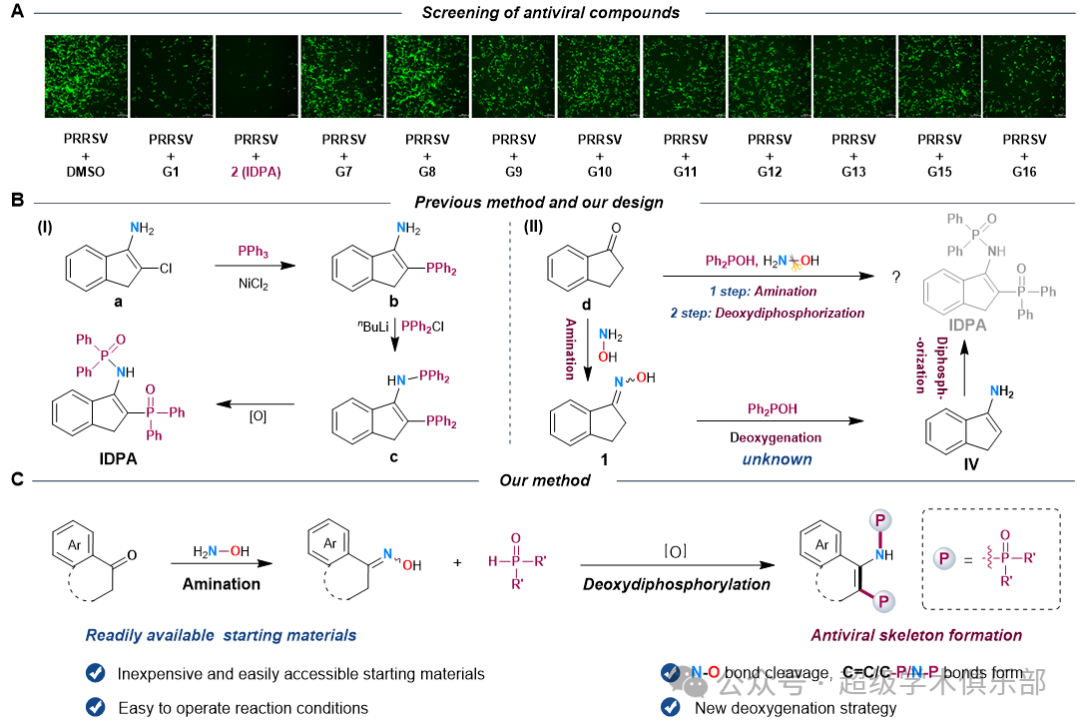
Screening of Antiviral Compounds and Deoxyphosphoamination of Ketones
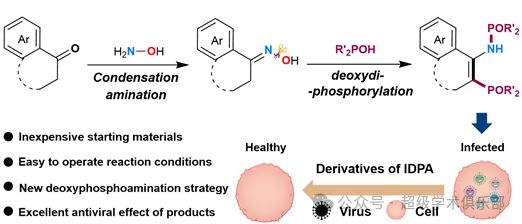
This study first developed a metal-free, light-free, and electricity-free radical-mediated deoxyphosphoamination reaction to construct IDPA and its analogs directly from ketones. Secondly, the antiviral effects of these analogs against PRRSV were evaluated through cellular experiments, establishing a structure-activity relationship while elucidating the specific mechanism of IDPA against PRRSV: inhibiting PRRSV replication by downregulating the viral receptor protein CD163 and the host protein HSP70. Finally, the cytotoxicity of these compounds was assessed, revealing their broad-spectrum antiviral effects against PRRSV, CSFV, PCV2, PEDV, and H1N1. This research not only developed a new deoxy conversion methodology but also synthesized a series of cost-effective and efficient broad-spectrum antiviral lead compounds, establishing a “chemical synthesis-biological evaluation-mechanism analysis” integrated antiviral drug development technical system, providing innovative solutions to overcome the bottlenecks of traditional antiviral drug development.
Researcher Xiao Shuqing is the corresponding author of this paper, Dr. Zhang Jianwu is the first author, and Dr. Liu Xiao is the co-first author. This research was supported by the National Natural Science Foundation, National Key R&D Program, Gansu Provincial Joint Fund, Gansu Provincial Major Science and Technology Project, Innovation Project of the Basic Research Center of the Chinese Academy of Agricultural Sciences, National Key Laboratory for Animal Disease Prevention and Control, and the National Swine Technology Innovation Center Project.

Disclaimer: This account maintains neutrality regarding all original and reprinted articles’ statements and viewpoints, and the content is for readers’ learning and communication purposes only. Materials, images, etc., are sourced from the internet, and their copyrights belong to the original authors. If there is any infringement, please contact us, and we will delete it immediately.

Recommended ArticlesJ Virol.|U508C synonymous mutation in SARS-CoV-2 deletion hotspots reduces deletion frequency and accelerates virus clearanceJ Virol.|Harbin Veterinary Research Institute of the Chinese Academy of Agricultural Sciences analyzes the mechanism of attenuation of PRRSV live attenuated vaccine to assist in the development of new vaccinesACS Nano.|Nanoparticle vaccines trigger the production of IFN-γ and confer protective immunity against PRRSVJ Virol.|Chinese Academy of Agricultural Sciences Harbin Veterinary Research Institute analyzes the assembly mechanism of highly pathogenic blue ear disease virus PRRSV-2J Nanobiotechnology.|Zhejiang University He Fang’s research group reveals a new infection mechanism of the immunosuppressive virus PRRSV and provides a novel nano-peptide prevention and treatment strategyAutophagy.|Professor He Fang’s research team at Zhejiang University reveals that PRRSV utilizes MALT1-regulated autophagic flux to switch virus transmission and reservoir