Journal of the American Chemical SocietySymmetry-Shearing Chemistry Enables Interdigitated 2D Covalent Organic Frameworks with Interlayer Mortise-and-Tenon Interlocks for Efficient Photocatalytic CO2 Fixation
 Recently, the prestigious journal Journal of the American Chemical Society published a groundbreaking study titled “Symmetry-Shearing Chemistry Enabled Interdigitated 2D Covalent Organic Frameworks with Interlayer Mortise-and-Tenon Interlocks for Efficient Photocatalytic CO2 Fixation”. This work designed and synthesized interdigitated two-dimensional covalent organic frameworks (ID-COFs) with a mortise-and-tenon interlocking structure through a “symmetry-shearing chemistry” strategy, significantly enhancing the structural stability and photocatalytic CO2 cycloaddition performance of the materials. Let us delve into this innovative literature.
Research Background: Challenges and Opportunities of 2D COFs
Covalent organic frameworks (COFs) are a class of crystalline porous polymers connected by reversible covalent bonds, widely used in catalysis, adsorption, and other fields due to their tunable pore structures and electronic properties. Among them, two-dimensional (2D) COFs typically rely on interlayer π-π stacking interactions to maintain ordered structures, but this non-covalent interaction is relatively weak, making them prone to interlayer sliding, delamination, or loss of crystallinity, which limits their practical applications. In contrast, three-dimensional (3D) COFs have a fully covalent connected network, making them structurally more stable, but their synthesis is complex and they exhibit poorer π-conjugation. Balancing the electronic advantages of 2D COFs with the stability of 3D COFs has become a key challenge in the field.
Innovative Design: Symmetry-Shearing Chemistry and Mortise-and-Tenon Interlocking Structure
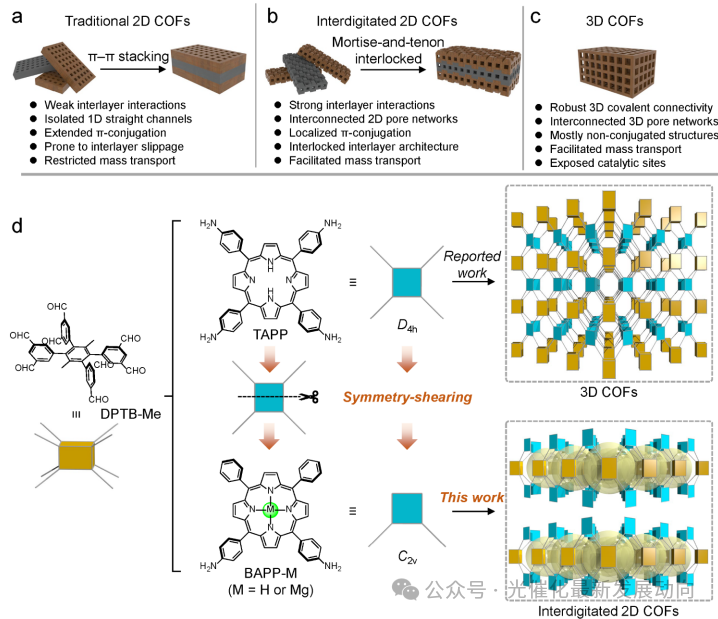
The research team proposed a “symmetry-shearing chemistry” strategy by reducing the symmetry of building blocks (e.g., changing from the octavalent D4h symmetric porphyrin TAPP to the divalent C2v symmetric metal porphyrin BAPP-M), guiding the polymer to grow in a specific direction to form an interdigitated 2D structure. Specifically, using the octaldehyde connector DPTB-Me and the C2v symmetric porphyrin linker (BAPP or BAPP-Mg) as monomers, ID-COF and ID-COF-Mg were synthesized via solvothermal methods.Unlike traditional 2D COFs, ID-COFs possess unique intralayer cage-like voids and interlayer mortise-and-tenon interlocking structures (similar to traditional Chinese woodworking techniques), which not only enhance mechanical stability but also achieve a 3D continuous pore network, facilitating molecular diffusion and charge transport. This structure is realized through covalent-supramolecular synergistic assembly, perfectly combining the advantages of two-dimensional and three-dimensional materials.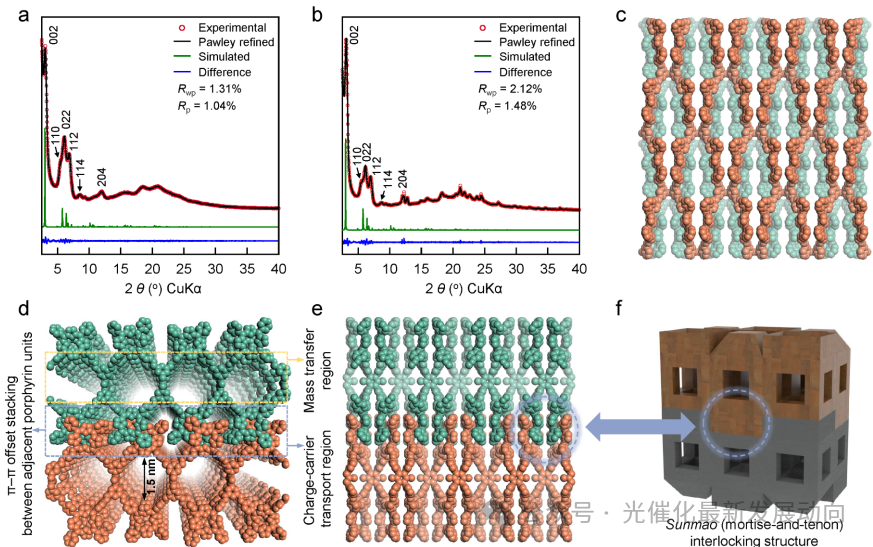
Material Characterization: High Crystallinity, Stability, and Photoelectric Performance
- Structural Verification: PXRD refinement shows that ID-COFs belong to the Cmcm space group, with crystal parameters highly consistent with simulated results (Rwp < 2.12%), confirming crystallinity.
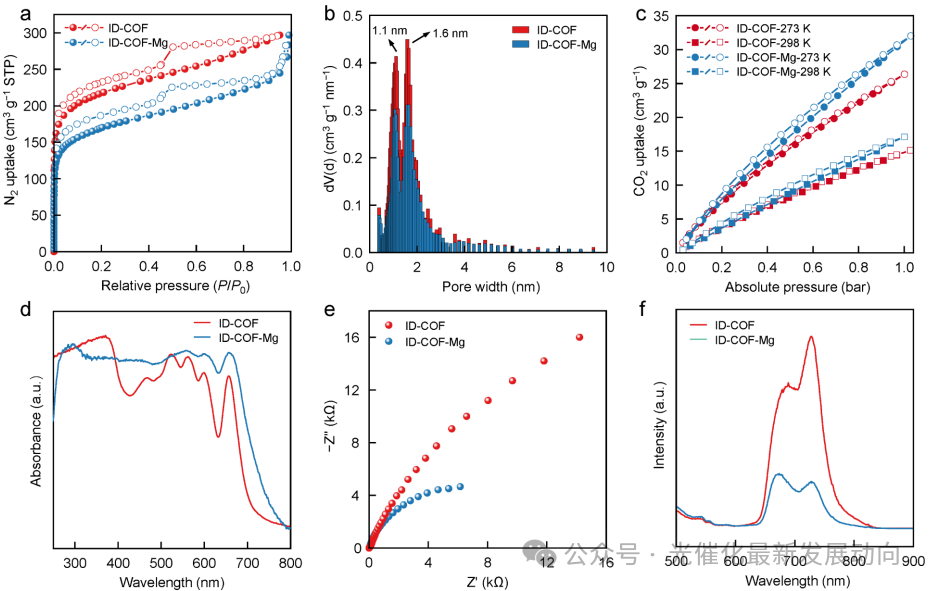
- Pore Structure: N2 adsorption tests indicate that ID-COFs are microporous materials, with BET surface areas of 805.4 m²/g (ID-COF) and 617.1 m²/g (ID-COF-Mg), and pore size distributions concentrated at 1.1 and 1.6 nm.
- CO2 Adsorption: ID-COF-Mg exhibits a higher CO2 adsorption capacity (31.6 cm³/g at 273 K), with the adsorption heat increasing to 24.9 kJ/mol, indicating that the Mg center enhances CO2 affinity.
- Light Absorption and Band Gap: UV-vis spectra show that ID-COFs have strong absorption in the visible light region, with band gaps of 1.81 eV (ID-COF) and 1.73 eV (ID-COF-Mg). Mott-Schottky tests confirm their n-type semiconductor characteristics.
- Charge Separation: EIS and PL spectra indicate that ID-COF-Mg has lower charge transfer resistance and longer carrier lifetime (2.03 ns), which is beneficial for photocatalysis.
Photocatalytic Performance: Efficient CO2 Cycloaddition
Under mild conditions (1 bar CO2, blue LED irradiation, solvent-free), ID-COF-Mg exhibits excellent performance in the cycloaddition reaction of CO2 with epoxides:
- Model Reaction: Using 1-chloro-2,3-epoxypropane (ECH) as the substrate, ID-COF-Mg shows a conversion rate of >99%, outperforming ID-COF (>99%) and the 3D control material CPOF-14-Mg (97%).
- Substrate Versatility: High conversion efficiency (>99%) is achieved for epoxides with hydroxyl, bromo, phenyl, and other substituents, while non-polar substrates (such as 1,2-epoxybutane) show lower activity, reflecting the promoting effect of polar groups on ring-opening.
- Mechanism Verification: Control experiments indicate that the TBAB co-catalyst is essential; thermal filtration experiments confirm the heterogeneous catalytic characteristics; dark reaction conversion rates are only 31-40%, ruling out thermal effects as the main driver.
- Cyclic Stability: ID-COF-Mg retains its activity after five cycles, with FTIR and PXRD confirming structural stability.
Reaction Mechanism: In Situ Spectroscopy and Theoretical Calculations Reveal Insights
Through in situ DRIFTS and EPR analysis, combined with DFT calculations, the photocatalytic mechanism is revealed:
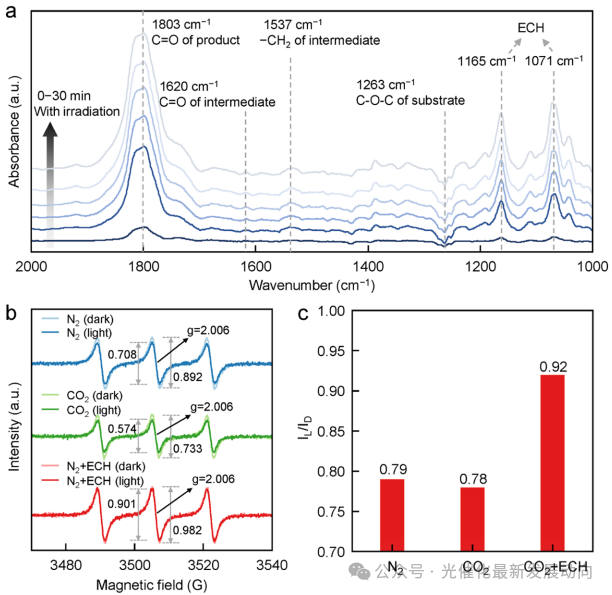
- In Situ DRIFTS: Under light, the characteristic peaks of ECH are enhanced, the C-O-C bond weakens, and carbonate intermediates (1620 cm⁻¹) and product C=O peaks (1803 cm⁻¹) appear, indicating that light promotes substrate activation and conversion.
- EPR Analysis: Using TEMPO as a trapping agent, the signal weakens under light (Ilight/Idark=0.79), with minimal change upon adding ECH (0.92), indicating that photogenerated electrons preferentially transfer to the epoxide rather than CO2.
- DFT Calculations: The adsorption energy of ECH at the Mg center (-0.81 eV) is much higher than that of CO2 (-0.32 eV), and the charge density difference shows electron transfer from Mg to ECH. The reaction energy barrier indicates that CO2 insertion is the rate-determining step (0.82 eV), making the entire pathway thermodynamically feasible.
Conclusion and Outlook
This study successfully constructed interdigitated 2D COFs with a mortise-and-tenon interlocking structure through a symmetry-shearing chemistry strategy, achieving:
- Structural Innovation: Combining the electronic conduction advantages of 2D COFs with the stability and mass transfer efficiency of 3D materials.
- Outstanding Performance: ID-COF-Mg achieves efficient CO2 cycloaddition under mild conditions, with strong substrate versatility and recyclability.
- Clear Mechanism: Through multi-scale characterization and calculations, the key role of the Mg center as an electron donor is revealed.
This work not only provides new ideas for the design of porous framework materials but also offers high-performance catalysts for light-driven CO2 conversion, promising to advance sustainable catalytic technology.Reference Information: J. Am. Chem. Soc. 2025, 147, 40319-40330. DOI: 10.1021/jacs.5c11188