Symmetry-Shearing Chemistry Enables Interdigitated 2D Covalent Organic Frameworks with Interlayer Mortise-and-Tenon Interlocks for Efficient Photocatalytic CO2 Fixation

Symmetry-Shearing Chemistry Enables Interdigitated 2D Covalent Organic Frameworks with Interlayer Mortise-and-Tenon Interlocks for Efficient Photocatalytic CO2 Fixation

Journal of the American Chemical SocietySymmetry-Shearing Chemistry Enables Interdigitated 2D Covalent Organic Frameworks with Interlayer Mortise-and-Tenon Interlocks for Efficient Photocatalytic CO2 Fixation Recently, the prestigious journal Journal of the American Chemical Society published a groundbreaking study titled “Symmetry-Shearing Chemistry Enabled Interdigitated 2D Covalent Organic Frameworks with Interlayer Mortise-and-Tenon Interlocks for Efficient Photocatalytic CO2 Fixation”. This … Read more
N-Protonated Acridinium Catalyst Enables Anti-Markovnikov Hydration of Unconjugated Tri- and Disubstituted Olefins

N-Protonated Acridinium Catalyst Enables Anti-Markovnikov Hydration of Unconjugated Tri- and Disubstituted Olefins

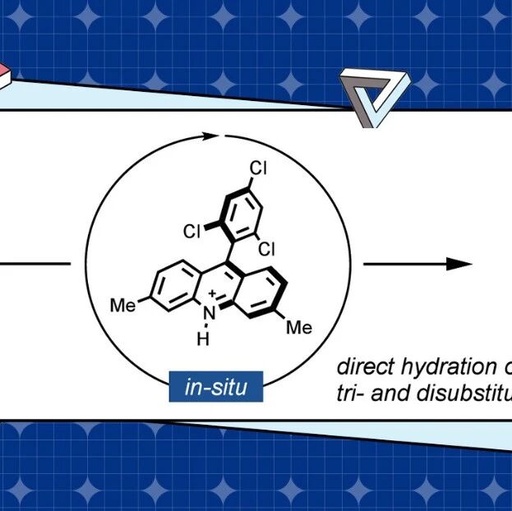
Alcohols can be used as solvents, fuels, detergents, plasticizers, and other specialty chemicals. The synthesis of alcohols typically relies on the use of olefins as readily available feedstocks. The direct preparation of alcohols with anti-Markovnikov selectivity from olefins and water is highly sought after due to its atom economy and potential cost-effectiveness. However, the developed … Read more

Simmons-Smith Cyclopropanation Reaction

Simmons-Smith Cyclopropanation Reaction

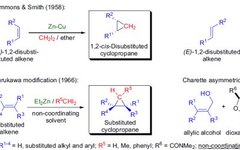
In 1958, H.E. Simmons and R.D. Smith discovered that in the presence of a zinc-copper couple, dichloromethane can convert alkenes (such as cyclohexene and styrene) into stereospecific cyclopropane derivatives. This reaction became one of the most effective methods for synthesizing cyclopropane derivatives, known as the Simmons-Smith reaction. The reaction was later improved for broader use: … Read more

Benzidine Rearrangement: A Name Reaction Explained

Benzidine Rearrangement: A Name Reaction Explained

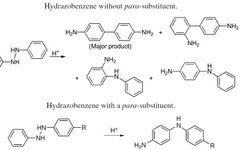
In 1863, Hofmann reported the rearrangement of diphenylhydrazine to 4,4-diaminobiphenyl (aniline) under acid catalysis, known as the benzidine rearrangement. When diphenylhydrazine contains a para-substituent, the product obtained is para-aminobiphenyl, and this reaction is referred to as the Semidine rearrangement. Reaction Mechanism Reaction Examples References 1. Hofmann, A. W., Proc. Roy. Soc. London, 1863, 12, 576. … Read more

Breakthrough in Inertness: Study on Benzylic C-H Carboxylation Reaction Involving Non-Transition Metals and Alkali

Breakthrough in Inertness: Study on Benzylic C-H Carboxylation Reaction Involving Non-Transition Metals and Alkali

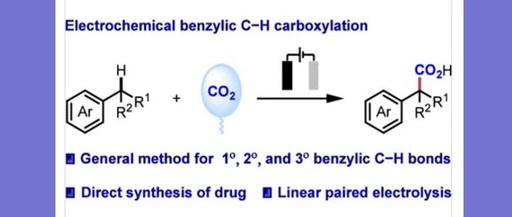
Recently, the team led by Professor Qiu Youai from Nankai University published an article titled “Electrochemical Benzylic C−H Carboxylation” in J. Am. Chem. Soc., reporting a method for achieving benzylic C-H carboxylation reactions through halide-promoted linear paired electrolysis, synthesizing various benzylic carboxylic acids and providing a new green and general method in this field.Research Background … Read more

New Stable Aryl Boronic Esters on Silica Gel with Higher Suzuki-Miyaura Reaction Activity!

New Stable Aryl Boronic Esters on Silica Gel with Higher Suzuki-Miyaura Reaction Activity!

Due to WeChat’s changes to subscription account push rules, many friends cannot quickly find us, but we are actually pushing every day!You can set Organic Synthesis as a star (click the upper right “…” to set it as a star), so you can quickly find us in the WeChat subscription account and check the daily … Read more