Introduction: On October 11, 2025, when Russia’s “New Technology Alliance” unveiled its first domestically produced humanoid robot Aidol (艾多尔), few expected it to stumble in front of an audience. However, this “accident” unexpectedly revealed a truth: true technological innovation is never a perfect showcase, but rather a process of getting back up after falling.

1. Who is Aidol? Russia’s AI Autonomous “Icebreaker”
Aidol is Russia’s first domestically produced artificial intelligence humanoid robot, developed over several years by the “New Technology Alliance”. Its name, “艾多尔”, may evoke the word “idol”, but its mission is far from entertainment—this approximately 1.8-meter tall “steel body” embodies Russia’s strategic ambition for technological autonomy in the fields of AI and robotics.
According to official sources, Aidol’s most notable label is “domestic production”: currently, 77% of its components are sourced from within Russia, and the development team has stated that this proportion will increase to 93% during mass production. In the context of increasingly fierce global technological competition, this figure represents a collective breakthrough of the entire Russian technology industry chain.
2. Three Core Capabilities: Walking, Manipulating, and “Reading Minds”
Aidol is defined as a general-purpose robot that encompasses three key human functions: walking, manipulating objects, and communicating with people. While these three capabilities may seem simple, each one embodies complex technical logic.
🤖 Walking Ability: 6 km/h “Russian Pace”
Aidol can move at a speed of up to 6 kilometers per hour, equivalent to a brisk walking pace for humans. Its legs utilize advanced dynamic balance algorithms, allowing it to adapt to different ground environments. Although it stumbled during the launch event due to insufficient lighting or voltage fluctuations, the developers emphasized that the robot has been tested under “various conditions”, and the stage incident highlighted the necessity of real-world testing.
🦾 Manipulation Ability: 10 kg “Dexterous Hands”
The robot’s mechanical arms can grasp objects weighing up to 10 kilograms, meaning it can handle tasks such as parts transportation on production lines and sorting goods in logistics warehouses. Compared to traditional industrial robots, Aidol’s hands focus more on flexibility and versatility rather than repetitive actions, giving it broad application prospects in manufacturing and logistics.
💬 Communication Ability: “Emotional Face” Driven by 19 Motors
This is Aidol’s most disruptive innovation. Its “face” is equipped with 19 servo motors and a 7-microphone array, enabling it to recognize and express at least 12 basic emotions.
Imagine this: when you complain about work fatigue, its eyebrows will slightly droop, and its mouth will form a curve of understanding; when it completes a task, it will give you a “smile” as feedback. This vivid expression capability is referred to by the developers as Aidol’s “key distinction”. All voice processing is done independently on the device, allowing for natural conversation and emotional recognition without the need for internet connectivity, which is particularly important in data-sensitive environments like banks and airports.
3. Technical Highlights: Offline Intelligence and “Emotional” Robots
🔒 Offline Operation: The Ultimate Answer to Data Security
Unlike many AI products that rely on cloud computing, Aidol performs all voice processing independently on the device. This means it can operate stably in environments without internet access, such as factory workshops, underground mines, or confidential laboratories, fundamentally eliminating the risk of data leakage. For Russia, which places a high emphasis on information security, this design is both a technical choice and a strategic consideration.
😊 Emotional Computing: From Recognition to Empathy
Aidol’s emotional capabilities are not merely preset expressions. Its 19 facial motors can synthesize micro-expressions in real-time, achieving subtle transitions from anger and joy to surprise and disappointment. Coupled with the sound emotional analysis from the microphone array, it can:
-
Recognize emotional tendencies in human dialogue
-
Understand the true intentions behind the context
-
Provide appropriate emotional responses
This bidirectional emotional interaction makes human-robot collaboration no longer a cold execution of commands, but rather a closer cooperation akin to that between colleagues.
4. Insights from the Fall: The Most Authentic Form of Technological Iteration
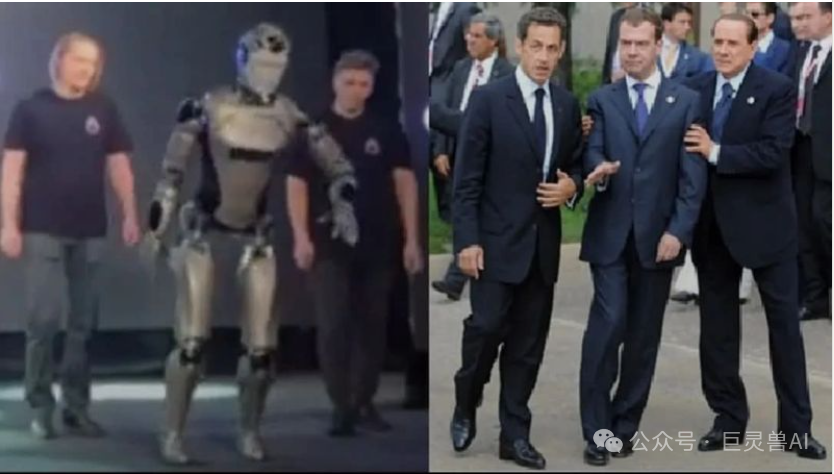
During the launch event, Aidol unexpectedly fell while demonstrating on stage, sparking heated discussions on social media. However, the response from developer CEO Vladimir Vitushin was thought-provoking:
“Successful mistakes can be transformed into knowledge, while failed mistakes can be transformed into experience. I hope this mistake can turn into experience.”
He defined this fall as “real-time training” and explained that the cause might have been insufficient lighting or voltage issues. This candid attitude reveals the truth about AI development: without the “falls” of rigorous testing, there can be no truly reliable intelligence.
Compared to some manufacturers’ meticulously designed “perfect demonstrations”, Aidol’s blunder actually proves that it has indeed undergone testing in real environments. The 6-hour autonomous endurance, 6 km/h movement speed, and 10 kg load capacity—these figures all stem from the imperfect real world, not ideal laboratory conditions.
5. Application Scenarios: “Digital Employees” from Factories to Airports
Aidol’s design goal is to become a versatile assistant across various scenarios:
-
Manufacturing: Performing precision assembly and quality inspection on production lines
-
Logistics: Navigating autonomously and transporting goods in warehouses
-
Banking: Acting as a lobby manager to answer inquiries and guide customers
-
Airports: Providing flight information and assisting special passengers
Its offline operation capability and emotional recognition functions create unique advantages in these scenarios: ensuring data security while providing warm services.
Conclusion: Seeing the Future in the Falls
Aidol’s stumble did not become a “black mark” on Russian technology; instead, it became a symbol of “honest innovation”. When a 77% domestic production rate meets real-world stage testing, and when 19 motor-driven expressions encounter unexpected voltage fluctuations, what we see is not failure, but a solid footprint of a nation on the path to technological autonomy.

From the space race of the Soviet era to today’s AI race, Russia once again proves: the dignity of technology lies not in never falling, but in being able to say after each fall—”This is experience, not the end.”
Perhaps in the near future, when we encounter an Aidol that can smile, feel disappointed, and occasionally trip in factories, banks, or even on the streets, we will understand:
The most valuable AI is not a perfect machine, but a “digital life” that grows authentically.