1. The Role of the Quiescent Point
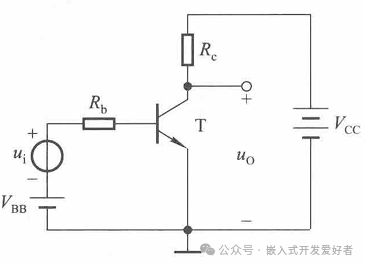 1. Ensure that the transistor operates in the amplification region (linear region), avoiding cutoff or saturation distortion.2. Signal amplification, providing appropriate DC bias for AC signals. Under the influence of the input signal, the amplifier circuit converts the energy from the DC power supply into energy obtained by the load, allowing the load to receive more energy from the power supply than what is provided by the signal source.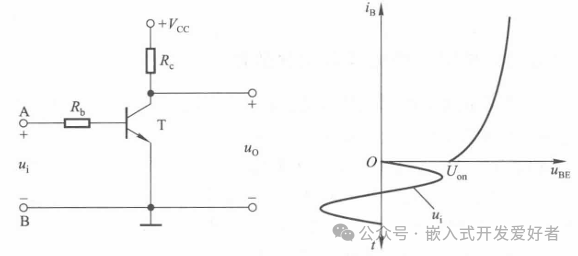
2. DC Path and AC Path
1. DC Path
The DC path is the route through which DC current (quiescent current) flows under the action of the DC power supply, used to study the quiescent point (Quiescent Point, abbreviated as Q point). For the DC path, ① capacitors are considered open circuits; ② inductors are considered short circuits; ③ signal sources are considered short circuits, but their internal resistance should be retained.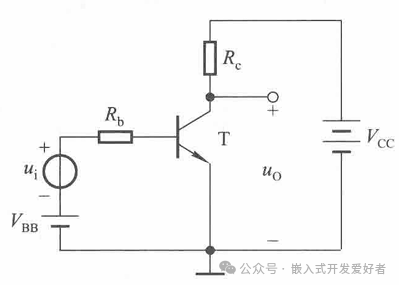
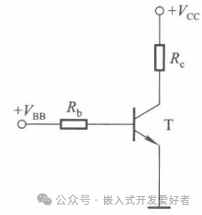
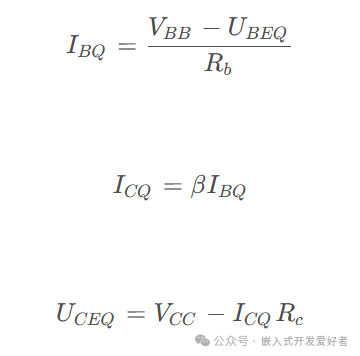
The parameters of the quiescent point include base current IBQ, collector current ICQ, base-emitter voltage UBEQ, and collector-emitter voltage UCEQ.
The working state of the transistor under DC bias, with no AC signal input, is represented by the parameter expressions in the above circuit.
2. AC Path
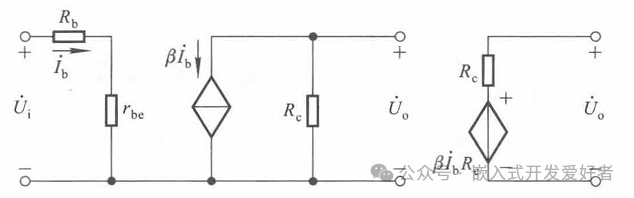
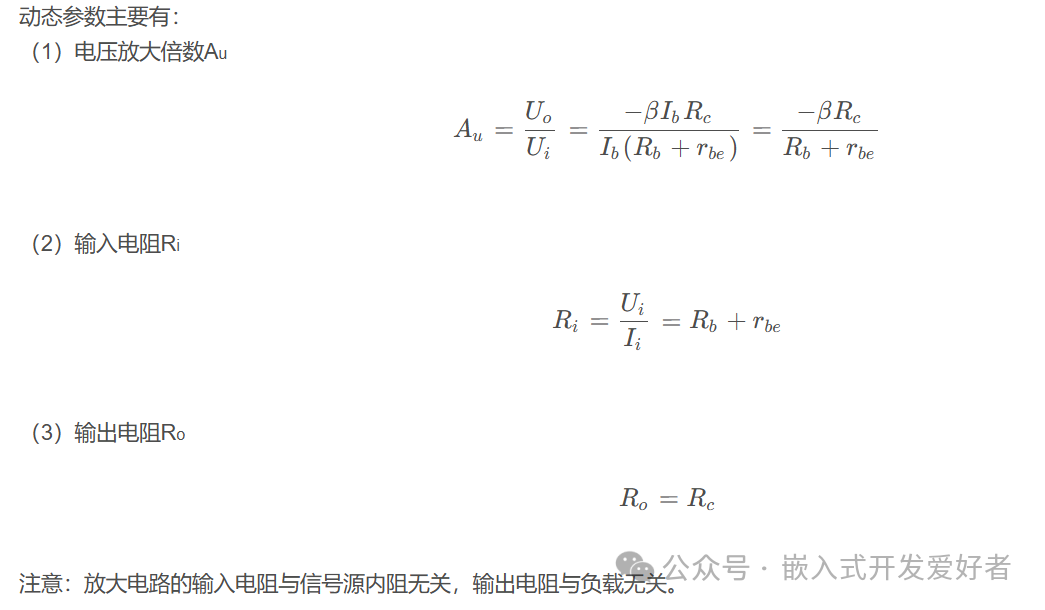
The AC path is the route through which AC signals flow under the influence of the input signal, used to study dynamic parameters. For the AC path, ① large capacitors (such as coupling capacitors) are considered short circuits, ② DC power supplies with no internal resistance (such as Vcc) are considered short circuits.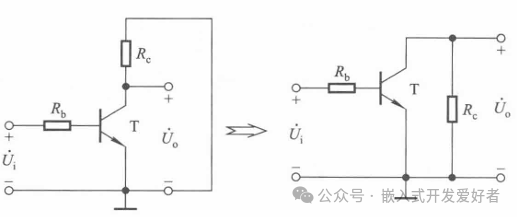 Introducing the h-parameter equivalent model (derivation is complex, interested readers can refer to additional materials), the AC circuit can be equivalently represented as