Why are magnesium alloys the optimal solution for lightweight robotics?The core advantages of magnesium alloys in the robotics field are reflected in four key characteristics: “light, strong, stable, and cool”:① Lightweight: The lowest density commercial metal structural materialWith a density of only 1.74g/cm³, it is 2/3 that of aluminum and 1/4 that of steel, resulting in significant weight reduction for the same volume.The UBTECH Walker X thoracic support frame uses magnesium alloy instead of carbon fiber, reducing weight by 30% and costs by 40%.② High specific strength: Achieving both load-bearing and lightweightHigh-strength magnesium alloys (such as AZ91D) have a tensile strength of 380MPa, close to aluminum alloys (such as 6061-T6 at 310MPa), but are over 30% lighter.The specific stiffness (strength/density) is superior to aluminum and steel, making it suitable for high dynamic load scenarios in robotics (such as joints with repeated start-stop cycles).③ Vibration damping and noise reduction: Enhancing motion stabilityThe damping coefficient is 100 times that of aluminum alloys, capable of absorbing high-frequency vibrations from joint motors.Actual measurements from Estun industrial robots show that magnesium alloy joint housings reduce motor temperature rise by 10% and increase motion cycle speed by 5%.④ Heat dissipation & electromagnetic shielding: Addressing two major pain points in roboticsThe thermal conductivity is 51W/(m·K), better than aluminum alloys (approximately 200W/(m·K)), but far superior to engineering plastics (PEEK only 0.25W/(m·K)), making it suitable for motor/controller heat dissipation.Natural electromagnetic shielding performance avoids interference with servo motor signals (aluminum alloys require additional coating treatment).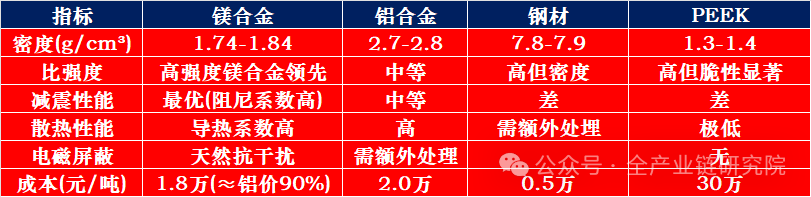 The application of magnesium alloys in electric drive housings (~20kg) is transitioning from small batch production to large-scale mass production. It is expected that the switch in 25H2 will accelerate, pushing the usage of magnesium alloys per vehicle from 10kg to 30kg, and with more components switching (rear bottom plates, battery housings, etc.), it is anticipated to approach 50-100kg/vehicle (SLS) in the medium to long term, with a tenfold potential in automotive applications alone. Coupled with the increasing demand from robotics, two-wheeled vehicles, and low-altitude applications, the industry trend is evident.