1. Introduction: The Rise and Controversy of Humanoid Robots
At the 2025 World Robot Conference, the new generation humanoid robot DexForceW1Pro from Kuawei Intelligence transformed into a barista, making coffee for attendees on-site. It accurately picked up a capsule coffee from the tray, performed an elegant hand-switching motion in the air, and steadily placed the capsule into the coffee machine. Once the coffee was brewed, it served a cup of aromatic coffee. This scene showcased the ability of humanoid robots to perform delicate operations in unstructured environments, prompting a re-evaluation of the value of humanoid robots.
Humanoid robots are rapidly moving from laboratories to industrial and everyday scenarios, with technological breakthroughs and commercialization reshaping multiple industry ecosystems. However, the debate over whether “robots need to be humanoid” has never ceased. Supporters argue that humanoid form is the best adaptation for robots in human environments; opponents question whether humanoid design is merely a gimmick rather than the best solution to practical problems.
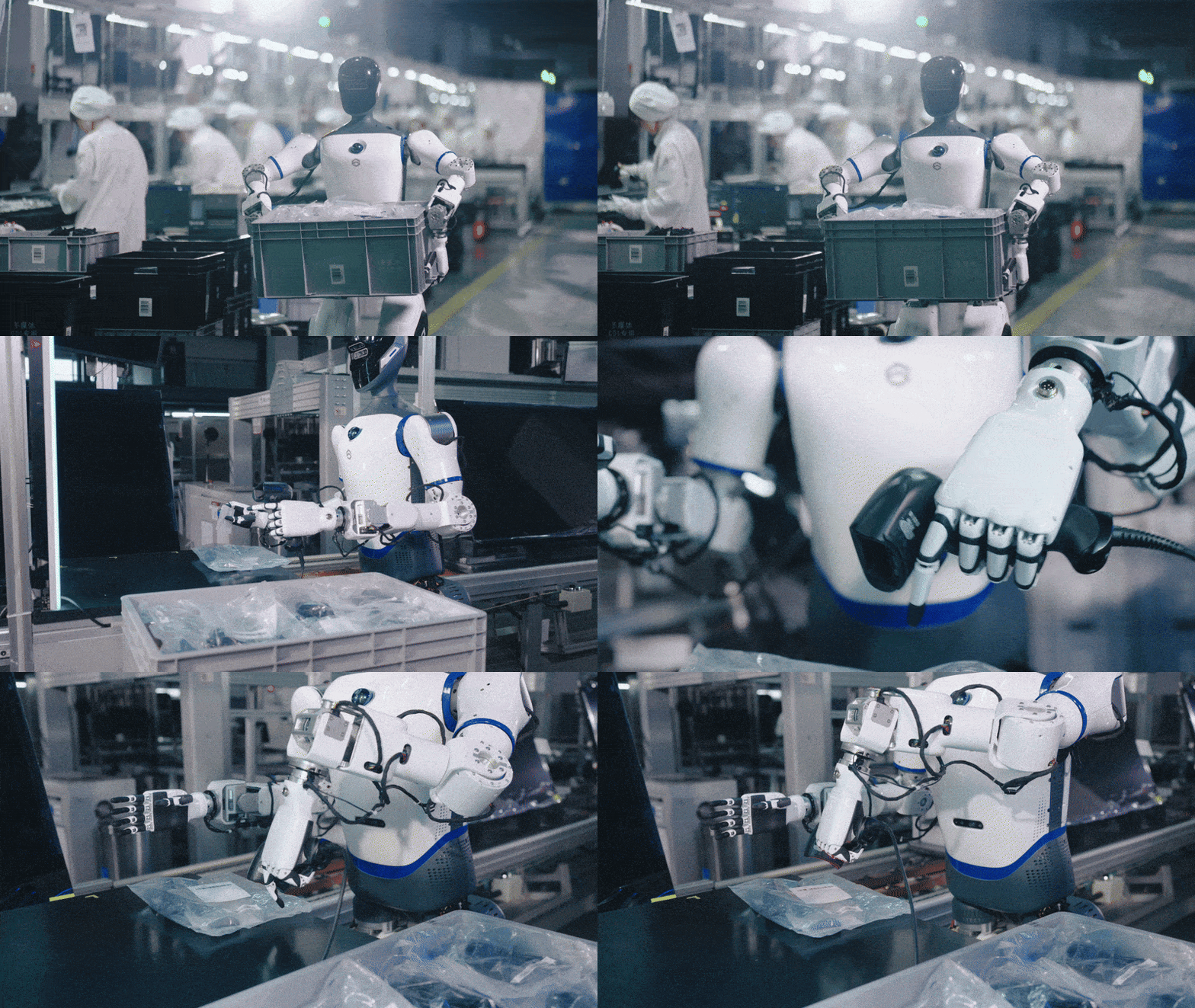
From a technological development perspective, the world’s first humanoid robot, “ASIMO,” was launched by Honda in 2000. After more than twenty years of development, humanoid robot technology has made significant progress, but high costs and limited practical application scenarios have slowed the commercialization process. It wasn’t until 2022 when Tesla announced the development of the Optimus humanoid robot that global enthusiasm for humanoid robots was reignited.
In 2025, the humanoid robot industry reached a critical turning point. Musk stated that Tesla plans to produce 10,000 Optimus robots by 2025, and if all goes well, mass production of 10,000 units per month could begin by mid-2026. Meanwhile, several Chinese companies, such as UBTECH and Yushu Technology, are also actively entering the humanoid robot market. With breakthroughs in AI large model technology, humanoid robots are transitioning from “showcasing technology” to “performing tasks,” demonstrating unprecedented development potential.
This article will explore the adaptability of humanoid robots in unstructured scenarios from a communication perspective, analyze the necessity of humanoid design, and propose that structured design oriented towards humans is the ultimate solution for robot development.
2. Challenges and Opportunities in Unstructured Scenarios
2.1 Definition and Characteristics of Unstructured Scenarios
Unstructured scenarios refer to environments that are complex and variable, lacking clear rules or fixed patterns. Unlike structured environments such as factory assembly lines, unstructured scenarios typically have the following characteristics:
- High Environmental Uncertainty: Irregular terrain, randomly distributed obstacles, significant light variations, etc.
- Diversity of Tasks: Various types of tasks need to be completed, with blurred task boundaries.
- Dynamic Changes: People and objects in the environment are constantly moving and changing.
- Incomplete Information: Sensors cannot capture all environmental information, leading to information blind spots.
In unstructured scenarios, traditional industrial robots often cannot work effectively because they are typically designed to perform repetitive, precise tasks, are highly dependent on the environment, and have poor adaptability. In contrast, humans can easily cope with various unstructured scenarios, thanks to their highly developed perception systems, flexible body structures, and strong cognitive abilities.
2.2 Limitations of Traditional Automation Equipment
Traditional automation equipment performs excellently in structured environments but faces numerous challenges in unstructured scenarios:
- Insufficient Adaptability: Industrial robotic arms and similar equipment can usually only perform pre-programmed fixed actions, making it difficult to respond to environmental changes.
- Limited Perception Capabilities: Most automation equipment relies on precise maps or sensor data, which can easily fail in complex environments.
- Poor Generalization: Specialized equipment can only complete specific tasks and cannot flexibly switch between different tasks.
- Weak Interaction Capabilities: Lacking the ability to interact naturally with humans, making it difficult to work safely in human environments.
For example, in logistics scenarios, traditional AGVs (Automated Guided Vehicles) can efficiently complete transportation tasks, but they require the installation of magnetic strips or QR codes for navigation, which demands high environmental modification and makes it difficult to adapt to dynamically changing unstructured environments. In contrast, humanoid robots can move freely in various environments like humans without the need for extensive modifications.
2.3 New Requirements for Robots in Unstructured Scenarios
Unstructured scenarios impose higher requirements on robots, mainly reflected in the following aspects:
- Environmental Perception Capability: Requires multi-modal perception capabilities to sense environmental changes in real-time.
- Dynamic Decision-Making Capability: Able to make quick decisions based on environmental changes and adjust action strategies.
- Body Flexibility: Requires a flexible body structure capable of performing various complex actions.
- Safe Interaction Capability: Able to coexist safely with humans, avoiding collisions and injuries.
- Learning and Adaptation Capability: Able to continuously adapt to new environments and tasks through learning.
Experts predict that by 2025, robots will be able to adapt to workplaces by learning about their surrounding environments, improving navigation capabilities, and collaborating more seamlessly with human colleagues. This trend indicates that unstructured scenarios are becoming an important direction for the development of robotic technology.
3. Technical Advantages of Humanoid Robots
3.1 Morphological Adaptation: A Natural Interface for Human Environments
The greatest advantage of humanoid robots lies in their similarity to human form, allowing them to naturally adapt to environments designed for humans:
- Physical Space Adaptation: The height, width, and joint movement range of humanoid robots are similar to those of humans, enabling free movement in human-designed spaces.
- Tool Usage Capability: Humanoid robots can grasp and operate tools designed for humans, such as door handles, screwdrivers, cups, etc.
- Natural Interaction Methods: Humans find it easier to understand and adapt to robots with similar forms, reducing barriers to human-robot interaction.
From an evolutionary perspective, humans have spent millions of years adapting to the Earth’s environment, while humanoid robots can directly leverage this evolutionary achievement without needing to redesign the environment or tools. This morphological adaptability gives humanoid robots a natural advantage when entering human environments.
3.2 Generalization Capability: Transitioning from Specialized to Generalized
Another core advantage of humanoid robots is their generalization capability, which allows them to flexibly transfer between different scenarios and tasks:
- Skill Transfer: Humanoid robots can more easily apply learned skills to other related skills.
- Scene Adaptation: The same hardware platform can adapt to various environments, such as homes, offices, factories, etc.
- Task Versatility: Humanoid robots can perform a wide range of tasks, from simple transportation to complex operations, increasing return on investment.
For example, UBTECH’s Walker S has already demonstrated its versatility in multiple fields, including automotive manufacturing, logistics, and home services. This generalization capability makes humanoid robots more valuable in the long term compared to specialized equipment, allowing them to play roles in different scenarios.
3.3 Integrated Multi-Modal Perception and Action
Humanoid robots integrate various perception and action capabilities, forming an efficient multi-modal system:
- Perception System Integration: Combines visual, auditory, tactile, and force perception capabilities to form a comprehensive understanding of the environment.
- Whole-Body Coordinated Control: Capable of coordinating movements of all body parts to perform complex whole-body actions.
- Perception-Action Feedback Loop: Perception information can guide actions in real-time, and the results of actions can feedback to correct perception, forming a closed-loop system.
Research shows that humanoid robots are natural entities for multi-modal machine learning, with their eyes (vision), ears (hearing), hands (touch), and legs (action) all integrated into one body, forming a data feedback loop that benefits AI model perception and decision-making training. This integrated design enables humanoid robots to learn and adapt to unstructured environments more efficiently.
4. Human-Centered Structured Design: The Ultimate Solution
4.1 The Role of Humans as a Universal Interface
Humans themselves are a “universal interface” capable of interacting with various environments and tools. By mimicking human form, humanoid robots are effectively creating an interface that seamlessly adapts to the physical world:
- Tool Compatibility: Tools designed by humans are based on ergonomic principles, allowing humanoid robots to use these tools directly without modification.
- Environmental Interaction: Environmental facilities such as door handles, stairs, and switches are designed for humans, enabling humanoid robots to interact with them naturally.
- Social Interaction: Humans are more likely to accept and understand robots with similar forms, which helps establish trust.
On Earth, the vast majority of tools and facilities are designed for human use. Screwdrivers, keyboards, door handles, and steering wheels are not suitable for operation by robotic arms or wheeled robots. Using humanoid robots can significantly reduce the need for “tool redesign,” making it the most economical solution for “adapting to human historical legacy assets.”
4.2 Maximizing Tool Ecosystem Reuse
One important value of humanoid robots is their ability to maximize the reuse of existing tool ecosystems:
- Reducing Modification Costs: No need to redesign tools and environments for robots, saving significant costs.
- Accelerating Application Implementation: Can directly use existing tools and facilities, shortening development cycles.
- Efficient Resource Utilization: Fully utilize existing material resources, reducing waste.
For example, in home environments, existing household appliances, furniture, and tools are designed for human use. Developing home systems specifically for non-humanoid robots would require enormous R&D and modification costs. In contrast, humanoid robots can directly use existing home environments, achieving maximum resource reuse.
4.3 Social Acceptance and Emotional Interaction
Humanoid robots have significant advantages in social acceptance and emotional interaction:
- Psychological Acceptance: Humans are naturally more accepting of forms that resemble themselves, making them less likely to reject.
- Trust Building: In fields such as medical care, childcare, and education, humanoid robots are more likely to gain trust.
- Emotional Interaction: Human-like appearance and movements can convey emotional information, enhancing the emotional connection between humans and robots.
Research indicates that in scenarios requiring emotional interaction, humanoid robots perform significantly better than non-humanoid robots. For example, in nursing homes, humanoid robots can establish emotional connections with the elderly, providing psychological support. This social acceptance allows humanoid robots to integrate more naturally into human society.
5. Industry Practices and Case Studies
5.1 Applications of Humanoid Robots in Industrial Scenarios
Industrial scenarios are currently one of the most promising application areas for humanoid robots. Although the environment is relatively structured, it has begun to showcase the value of humanoid robots:
- Automotive Manufacturing: UBTECH’s Walker S has entered factories such as NIO and FAW-Volkswagen, completing tasks such as bolt tightening, parts installation, and quality inspection.
- 3C Manufacturing: The application of humanoid robots in the electronics manufacturing field is expanding, especially in areas requiring precise operations and flexible adaptation.
- Logistics and Warehousing: Humanoid robots can complete tasks such as sorting and transporting goods in complex warehousing environments.
UBTECH Vice President Jiao Jichao stated that one of the main goals of humanoid robots in industrial manufacturing is to replace positions facing labor shortages due to aging populations and declining birth rates. In the 3C industry, such as in the production of laptops and mobile phones, some positions require the use of harmful chemicals, which are also suitable for humanoid robots to replace human labor.
5.2 Exploration of Home Service Scenarios
The home environment is the most typical unstructured scenario and an important future application direction for humanoid robots:
- Daily Household Tasks: Humanoid robots can assist with cleaning, cooking, organizing, and other household chores.
- Elderly Care: Providing assistance to elderly individuals with limited mobility, such as fetching items and reminding them to take medication.
- Child Companionship: Interacting with children, learning, and playing, providing educational support.
Figure AI has begun testing humanoid robots in home environments, with its developed Helix robot being the first step towards using robots in non-structured environments like homes. Although home service robots currently face challenges such as high costs and insufficient reliability, breakthroughs are expected in this field in the coming years as technology advances and costs decrease.
5.3 Alternative Roles in Extreme Environments
In some extreme environments that are dangerous or difficult for humans to reach, humanoid robots have unique advantages:
- Nuclear Radiation Zones: Replacing humans for equipment maintenance and inspection, reducing radiation exposure risks.
- Disaster Relief: Performing search and rescue tasks in disaster sites such as earthquakes and fires.
- Space Exploration: Executing tasks on space stations or other planets, expanding the boundaries of human exploration.
Research indicates that in scenarios such as nuclear radiation zones, disaster ruins, fire scenes, and space stations, a human form is needed to adapt to human tools. If humanoid robots are not used, the environment, tools, and interfaces must be rebuilt, which is extremely costly. Therefore, to minimize costs in adapting to extreme environments, humanoid robots that “replace humans” must be chosen.
6. Future Trends and Challenges
6.1 Technical Challenges: Model Architecture and Generalization Capability
Despite significant progress in humanoid robots, they still face several technical challenges:
- Non-Uniform Model Architecture: Yushu Technology CEO Wang Xingxing pointed out that the current robotics industry is facing the issue of non-uniform model architecture. Even with many good data for training, they cannot be utilized, similar to the 1-3 years before the emergence of ChatGPT.
- Embodied Intelligent Large Models: The most critical challenge for intelligent robots now and in the future remains the “embodied intelligent robot large model.” Current model development is slow, architecture is non-uniform, and no significant breakthroughs have emerged.
- Real-Time Response Delays: Large model inference delays of 2-3 seconds make it difficult to meet industrial millisecond-level control requirements.
- Computational Power Deployment Dilemmas: Edge computing power is limited by battery constraints and relies on edge servers, but 5G-A network coverage is not yet complete.
To address these challenges, the focus of intelligent robot technology in the next 2-5 years will be on unified, end-to-end intelligent robot large models, lower-cost, longer-lasting hardware, large-scale manufacturing, and low-cost, large-scale computational power. These technological breakthroughs will lay the foundation for the widespread application of humanoid robots.
6.2 Economic and Market Trends
From an economic and market perspective, the humanoid robot industry is in a rapid development phase:
- Cost Decline Trend: With technological advancements and scale expansion, the cost of humanoid robots is expected to continue to decline. Optimistic forecasts suggest that by 2025, through small-batch production, costs could drop to between $30,000 and $100,000; by 2030, costs are expected to further decrease to below $20,000.
- Market Size Forecast: Morgan Stanley predicts that by 2050, the global market size for humanoid robots could reach $5 trillion, with over 1 billion humanoid robots in use worldwide.
- Expansion of Application Scenarios: By 2025, the application scenarios for humanoid robots will begin to expand from a single industrial field to broader commercial, service, and home areas.
According to information disclosed at the China Humanoid Robot Industry Conference, the market size for humanoid robots in China is expected to be approximately 2.76 billion yuan in 2024. The Ministry of Industry and Information Technology’s “Guiding Opinions on the Innovative Development of Humanoid Robots,” released in November 2023, clearly states that by 2027, the humanoid robot industry will accelerate its large-scale development, with more diverse application scenarios and related products deeply integrated into the real economy, becoming an important new engine for economic growth.
6.3 Social Impact and Ethical Considerations
The widespread application of humanoid robots will bring profound social impacts and ethical challenges:
- Changes in Employment Structure: Humanoid robots may replace some job positions, especially those that are highly repetitive, dangerous, or harmful to human health.
- Reconstruction of Social Relationships: The proliferation of humanoid robots may change the relationships between people and between humans and machines, affecting social structures.
- Ethical and Safety Issues: Ensuring that humanoid robots’ behaviors align with ethical standards and addressing issues related to harm caused by robots need in-depth exploration.
- Privacy and Data Security: Protecting user privacy becomes a significant issue when humanoid robots are used in private environments such as homes.
Experts predict that the future of humanoid robots is not only about technological iteration but also about the evolution from “mechanical substitutes” to “social members,” reshaping forms of civilization. In the near term, humanoid robots will validate their economic viability in logistics, industry, and exhibitions; in the long term, human-robot collaboration will give rise to an “intelligent social collaboration network”—robots autonomously scheduling resources in factories and understanding emotions and providing care in homes.
Conclusion: The Inevitability and Future Role of Humanoid Robots
Through the analysis of the adaptability of humanoid robots in unstructured scenarios and their design logic, we can draw the following conclusions:
- Humanoid is the Inevitable Choice for Adapting to Unstructured Scenarios: Humans have spent millions of years adapting to the Earth’s environment, and humanoid robots can directly leverage this evolutionary achievement, performing excellently in unstructured environments.
- The Core Value of Humanoid Robots Lies in Their Generalization Capability: Unlike specialized equipment, humanoid robots can flexibly transfer between different scenarios and tasks, maximizing resource reuse and return on investment.
- Humanoid Robots Do Not Replace Automation Equipment, but Rather Replace the Users of Equipment: The goal of humanoid robots is not simply to replace existing automation equipment but to flexibly use various tools and devices like humans, completing more complex and diverse tasks.
- Human-Centered Structured Design is the Ultimate Solution: Regardless of how technology develops, it ultimately needs to return to the core of “humans,” and all technological innovations should serve human needs and well-being.
Looking ahead, humanoid robots will develop along the logic of “environments moving from closed to open, tasks from simple to complex, and human-robot interactions increasing from few to many.” With advancements in AI technology and decreasing hardware costs, humanoid robots will gradually expand from industrial fields to broader areas such as homes, healthcare, and education, becoming an indispensable part of human society.
In this process, we need to remain rational and prudent, recognizing both the opportunities presented by humanoid robots and the challenges they may bring. Only by combining technological development with humanistic care can we achieve a beautiful future of human-robot collaboration.