1. Background Significance
GRBL has conducted research on bus-based embedded CNC systems, introducing trajectory planning algorithms such as corner arc transition and dynamic speed anticipation to optimize processing paths. The embedded CNC system based on the CANopen bus can accurately track processing trajectories, and compared to traditional pulse control methods, the number of connections is reduced by 50%, effectively improving the processing efficiency and reliability of the embedded CNC system.
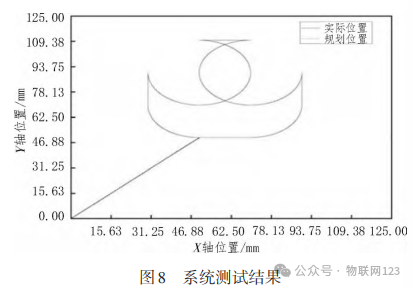
2. Theoretical PrinciplesThe embedded CNC master station receives G-code sent from the host computer via serial port or reads G-code files stored on a USB drive, then parses them according to standard G-code syntax to obtain trajectory commands such as straight lines or arcs. A series of trajectory planning algorithms optimize the processing path, and finally, the CANopen communication protocol is used to control stepper or servo motor drivers, making it applicable to small CNC devices that require high precision and speed while being cost-sensitive.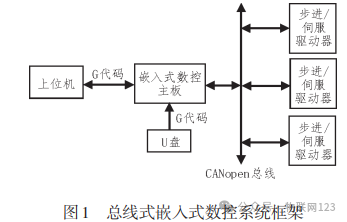 3. Experimental System and ConditionsThe embedded CNC system master station was tested on the STM32F407IGT6 motion control development board. The host computer used LaserGRBL software to generate G-code, and the CNC mainboard was connected to two closed-loop stepper motor drivers via the CANopen bus to form an XY two-axis motion platform. By sending G-code to the CNC mainboard and printing the planned and actual positions of each axis through the serial port during each interpolation cycle.
 4. Experimental Results and Analysis
The experimental results show that the actual position coincides exactly with the planned position, indicating that the embedded CNC system based on the CANopen bus can accurately track processing trajectories. Compared to traditional pulse control solutions, the number of connections between the CNC mainboard and each motor driver is reduced from 4 to 2.
5. Conclusion
In response to the current issues of cost sensitivity, complex wiring, and poor stability in small CNC systems, a design for an embedded CNC system master station based on the CANopen bus has been proposed. Detailed explanations have been provided regarding software architecture, trajectory planning algorithms, and CANopen communication implementation. Finally, hardware testing has proven the effectiveness of the solution, which can be applied to devices such as 3D printers, CNC engraving machines, and robots to improve production efficiency, precision, and reliability.
References:
[1] Sun Zhenhao, Chen Wei. Design of an Embedded CNC System Master Station Based on CANopen Bus [J]. Electronic Design Engineering, 2024, 32(19): 71-75.
| Disclaimer: The images and text used in this article are reproduced. If there are any copyright issues, please inform us immediately, and we will confirm and delete the content based on the proof materials you provide. The content of this article represents the author’s personal views and does not reflect the views or positions of IoT 123. |
Special Reminder:IoT Professional CommunicationGroup welcomes individuals related to the IoT industry to join. The group also welcomes various social butterflies, experts, and seniors. In the group, aside fromnot being able to post sensitive content, pornographic content, and it is not recommended to send promotional content multiple times, other topics can be freely discussed~——Communication QQ Group 724511126,friends joining the group please note: Name – Organization – Research Direction (without notes, please forgive us for not passing), and will be invited to join the group after editor review!